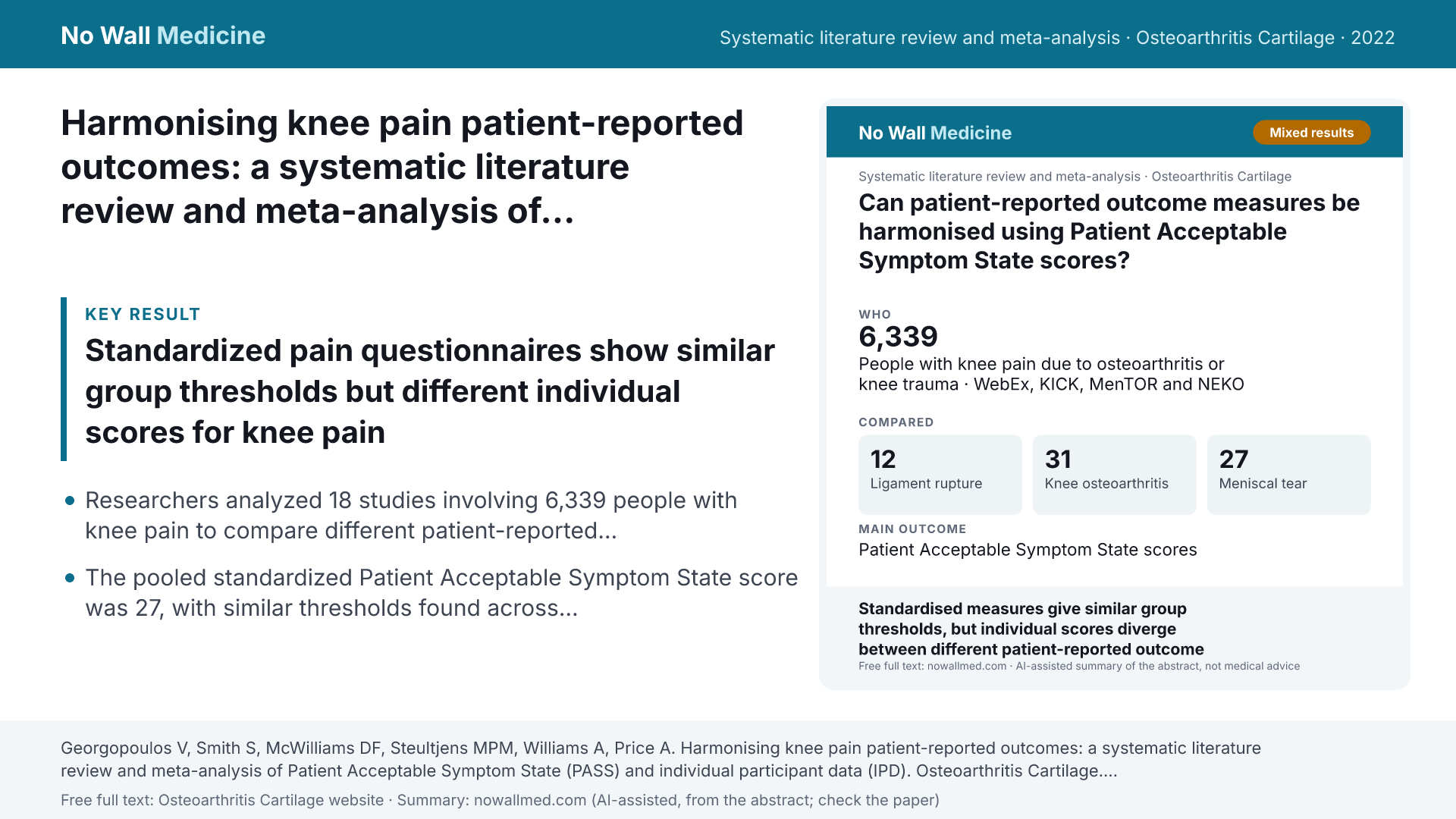
Standardized pain questionnaires show similar group thresholds but different individual scores for knee pain
Harmonising knee pain patient-reported outcomes: a systematic literature review and meta-analysis of Patient Acceptable Symptom State (PASS) and individual participant data (IPD)
Systematic literature review and meta-analysisMixed results
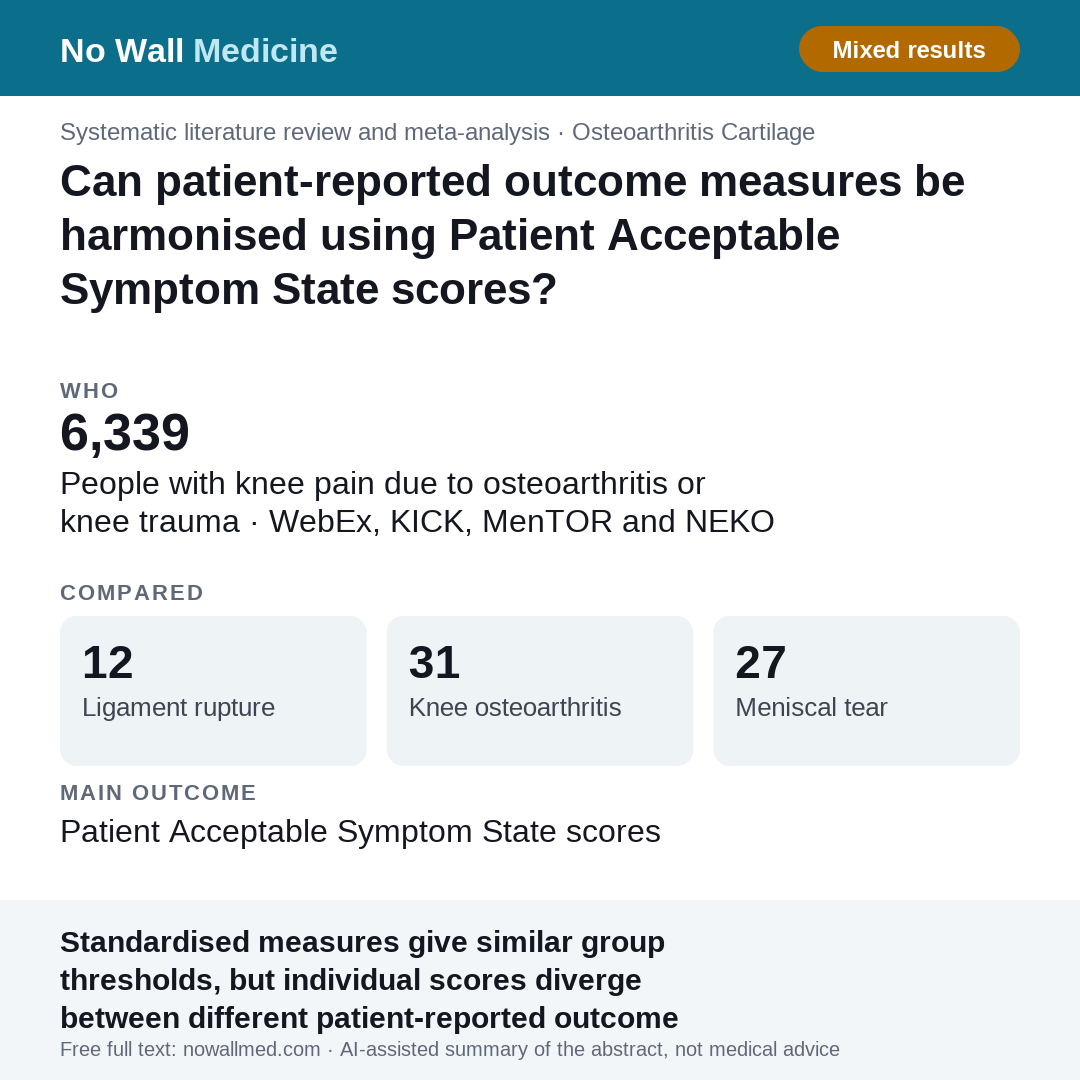
Can patient-reported outcome measures be harmonised using Patient Acceptable Symptom State scores?
Who
6,339
People with knee pain due to osteoarthritis or knee trauma · WebEx, KICK, MenTOR and NEKO studies
Compared
12Ligament rupture (95% CI: 11 to 13)
31Knee osteoarthritis (95% CI: 26 to 36)
27Meniscal tear (95% CI: 20 to 35)
Main outcome
Patient Acceptable Symptom State scores
Result: pooled standardised PASS was 27 (95% CI: 21 to 35)
Bottom line: Standardised measures give similar group thresholds, but individual scores diverge between different patient-reported outcome measures.
Limitation: Different patient-reported outcome measures give divergent scores within individuals.
Osteoarthritis Cartilage · 2022-09-08Download image
Clinical question: Can patient-reported outcome measures be harmonised using Patient Acceptable Symptom State scores?
Why it matters: It is unclear if different patient-reported outcome measures provide consistent thresholds for what patients consider an acceptable symptom state in knee pain.
Key points
- Researchers analyzed 18 studies involving 6,339 people with knee pain to compare different patient-reported outcome measures using the Patient Acceptable Symptom State score.
- The pooled standardized Patient Acceptable Symptom State score was 27, with similar thresholds found across different standardized questionnaires.
- While group means were similar, individual scores between different questionnaires diverged, with limits of agreement between -7 to -38 and +25 to 52.
Headline and key points written with AI from the paper’s abstract, with every number checked against it. Read the paper before relying on them.
Was this summary helpful?
Abstract
Objective
In order to facilitate data pooling between studies, we explored harmonisation of patient-reported outcome measures (PROMs) in people with knee pain due to osteoarthritis or knee trauma, using the Patient Acceptable Symptom State scores (PASS) as a criterion.Methods
We undertook a systematic literature review (SLR) of PASS scores, and performed individual participant data (IPD) analysis of score distributions from concurrently completed PROM pairs. Numerical rating scales (NRS), visual analogue scales, KOOS and WOMAC pain questionnaires were standardised to 0 to 100 (worst) scales. Meta-regression explored associations of PASS. Bland Altman plots compared PROM scores within individuals using IPD from WebEx, KICK, MenTOR and NEKO studies.Results
SLR identified 18 studies reporting PASS in people with knee pain. Pooled standardised PASS was 27 (95% CI: 21 to 35; n = 6,339). PASS was statistically similar for each standardised PROM. Lower PASS was associated with lower baseline pain (β = 0.49, P = 0.01) and longer time from treatment initiation (Q = 6.35, P = 0.04). PASS scores were lowest in ligament rupture (12, 95% CI: 11 to 13), but similar between knee osteoarthritis (31, 95% CI: 26 to 36) and meniscal tear (27, 95% CI: 20 to 35). In IPD, standardised PROMs each revealed similar group mean scores, but scores within individuals diverged between PROMs (LoA between -7 to -38 and +25 to 52).Conclusion
Different standardised PROMs give similar PASS thresholds in group data. PASS thresholds may be affected more by patient and treatment characteristics than between PROMs. However, different PROMs give divergent scores within individuals, possibly reflecting different experiences of pain.
Abstract reproduced under the article’s CC BY licence.
Subject terms
Cite this article
Georgopoulos V, Smith S, McWilliams DF, Steultjens MPM, Williams A, Price A. Harmonising knee pain patient-reported outcomes: a systematic literature review and meta-analysis of Patient Acceptable Symptom State (PASS) and individual participant data (IPD). Osteoarthritis Cartilage. 2022. doi:10.1016/j.joca.2022.08.011
Spotted a mistake? Suggest a correction
Top studies every Monday
The week’s key trials and guidelines in your specialties, plus any topics you follow. By email, free.
Get the weekly digest