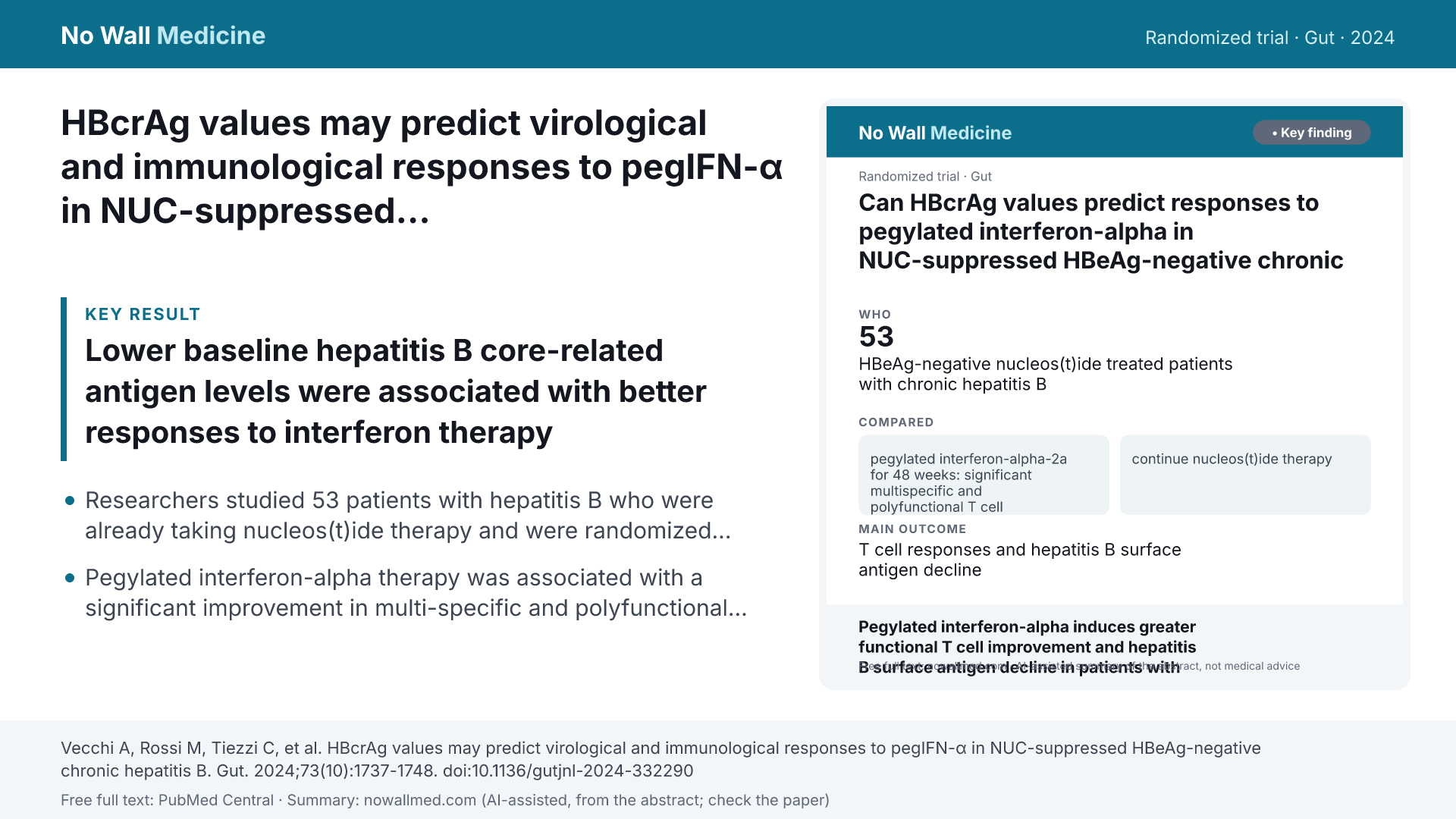
Lower baseline hepatitis B core-related antigen levels were associated with better responses to interferon therapy
HBcrAg values may predict virological and immunological responses to pegIFN-α in NUC-suppressed HBeAg-negative chronic hepatitis B
Randomized trialBenefit found
Can HBcrAg values predict responses to pegylated interferon-alpha in NUC-suppressed HBeAg-negative chronic hepatitis B?
Who
53
HBeAg-negative nucleos(t)ide treated patients with chronic hepatitis B
Compared
pegylated interferon-alpha-2a for 48 weeks: significant multispecific and polyfunctional T cell improvement at week 24 post-treatment
continue nucleos(t)ide therapy
Main outcome
T cell responses and hepatitis B surface antigen decline
Bottom line: Pegylated interferon-alpha induces greater functional T cell improvement and hepatitis B surface antigen decline in patients with lower baseline HBcrAg levels.
Gut · 2024-09-09Download image
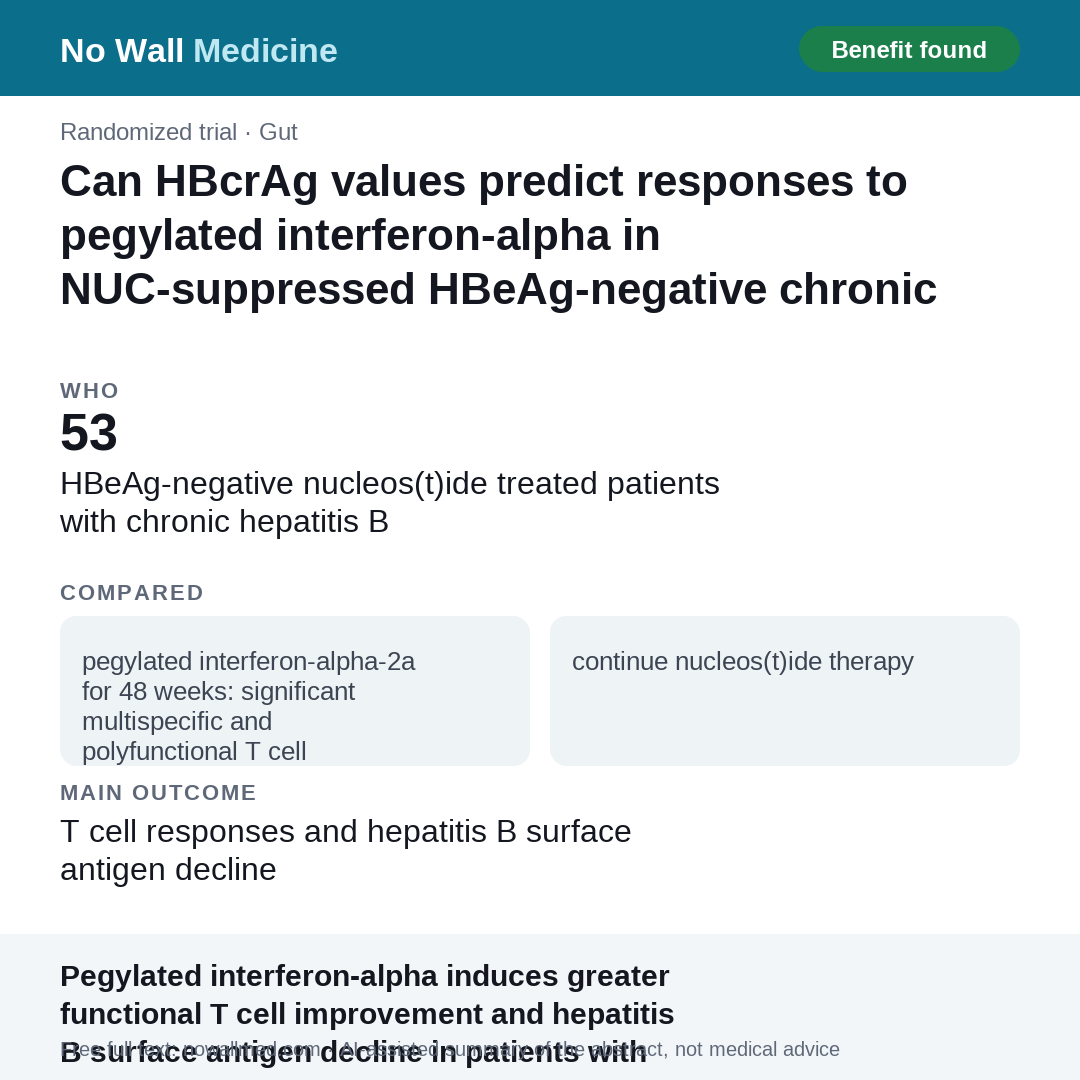
Clinical question: Can HBcrAg values predict responses to pegylated interferon-alpha in NUC-suppressed HBeAg-negative chronic hepatitis B?
Why it matters: It is unknown which cellular or blood markers can predict if patients with suppressed hepatitis B will respond well to adding pegylated interferon-alpha to their current medication.
Key points
- Researchers studied 53 patients with hepatitis B who were already taking nucleos(t)ide therapy and were randomized to receive pegylated interferon-alpha for 48 weeks or continue their current treatment.
- Pegylated interferon-alpha therapy was associated with a significant improvement in multi-specific and polyfunctional T cell responses at week 24 after treatment compared to baseline.
- The greatest T cell improvement was associated with a higher drop in hepatitis B surface antigen levels and lower initial hepatitis B core-related antigen values.
Headline and key points written with AI from the paper’s abstract, with every number checked against it. Read the paper before relying on them.
Was this summary helpful?
Abstract
Objective
Selected populations of patients with chronic hepatitis B (CHB) may benefit from a combined use of pegylated interferon-alpha (pegIFN-α) and nucleos(t)ides (NUCs). The aim of our study was to assess the immunomodulatory effect of pegIFN-α on T and natural killer (NK) cell responses in NUC-suppressed patients to identify cellular and/or serological parameters to predict better T cell-restoring effect and better control of infection in response to pegIFN-α for a tailored application of IFN-α add-on. Design
53 HBeAg-negative NUC-treated patients with CHB were randomised at a 1:1 ratio to receive pegIFN-α-2a for 48 weeks, or to continue NUC therapy and then followed up for at least 6 months maintaining NUCs. Serum hepatitis B surface antigen (HBsAg) and hepatitis B core-related antigen (HBcrAg) levels as well as peripheral blood NK cell phenotype and function and HBV-specific T cell responses upon in vitro stimulation with overlapping HBV peptides were measured longitudinally before, during and after pegIFN-α therapy. Results
Two cohorts of pegIFN-α treated patients were identified according to HBsAg decline greater or less than 0.5 log at week 24 post-treatment. PegIFN-α add-on did not significantly improve HBV-specific T cell responses during therapy but elicited a significant multispecific and polyfunctional T cell improvement at week 24 post-pegIFN-α treatment compared with baseline. This improvement was maximal in patients who had a higher drop in serum HBsAg levels and a lower basal HBcrAg values. Conclusions
PegIFN-α treatment can induce greater functional T cell improvement and HBsAg decline in patients with lower baseline HBcrAg levels. Thus, HBcrAg may represent an easily and reliably applicable parameter to select patients who are more likely to achieve better response to pegIFN-α add-on to virally suppressed patients.
Abstract reproduced under the article’s CC BY NC licence.
Subject terms
Cite this article
Vecchi A, Rossi M, Tiezzi C, Fisicaro P, Doselli S, Gabor EA. HBcrAg values may predict virological and immunological responses to pegIFN-α in NUC-suppressed HBeAg-negative chronic hepatitis B. Gut. 2024. doi:10.1136/gutjnl-2024-332290
Spotted a mistake? Suggest a correction
Top studies every Monday
The week’s key trials and guidelines in your specialties, plus any topics you follow. By email, free.
Get the weekly digest