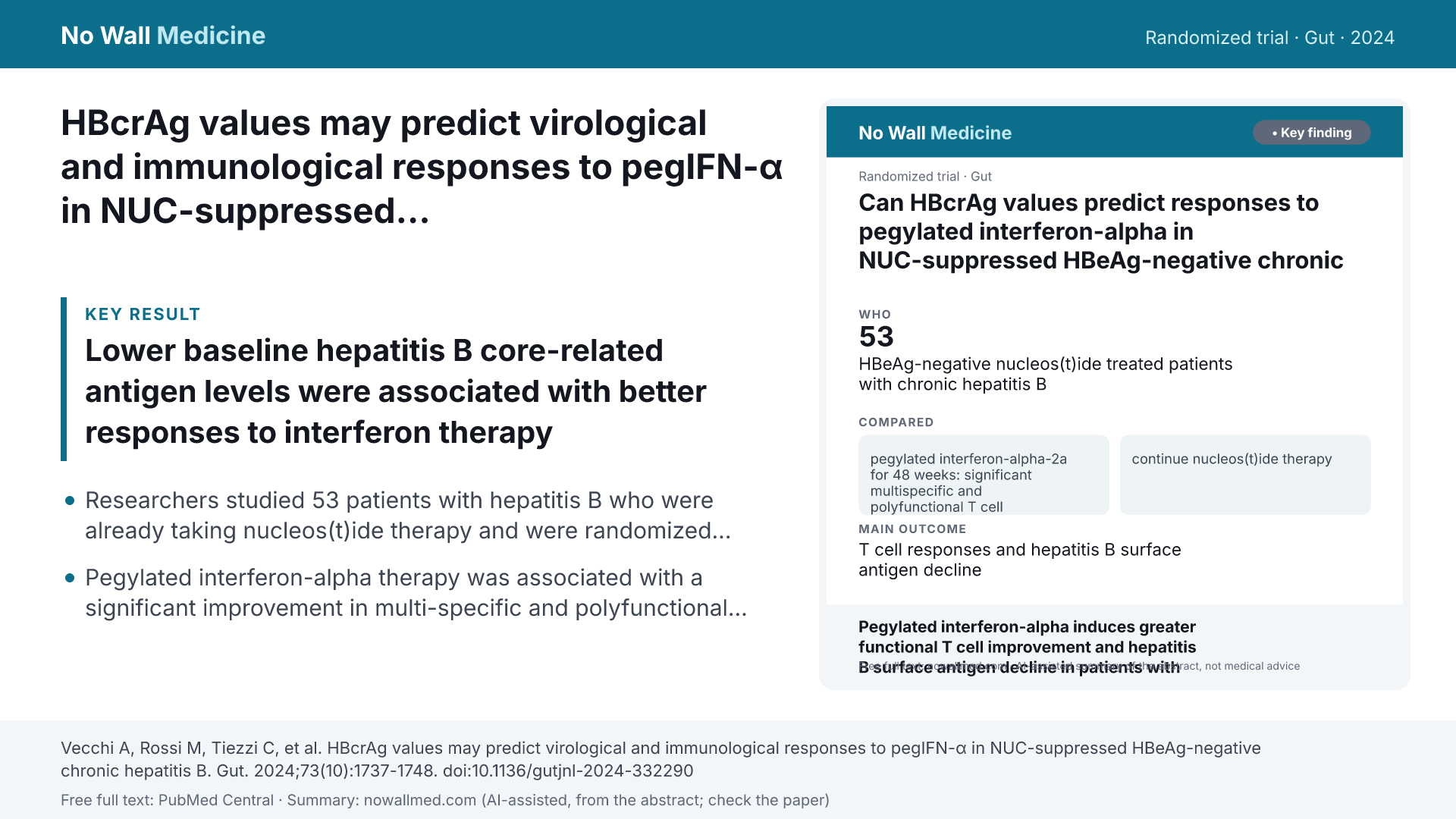
HBcrAg values may predict virological and immunological responses to pegIFN-α in NUC-suppressed HBeAg-negative chronic hepatitis B
Key result: Lower baseline hepatitis B core-related antigen levels were associated with better responses to interferon therapy
Randomized trialKey finding
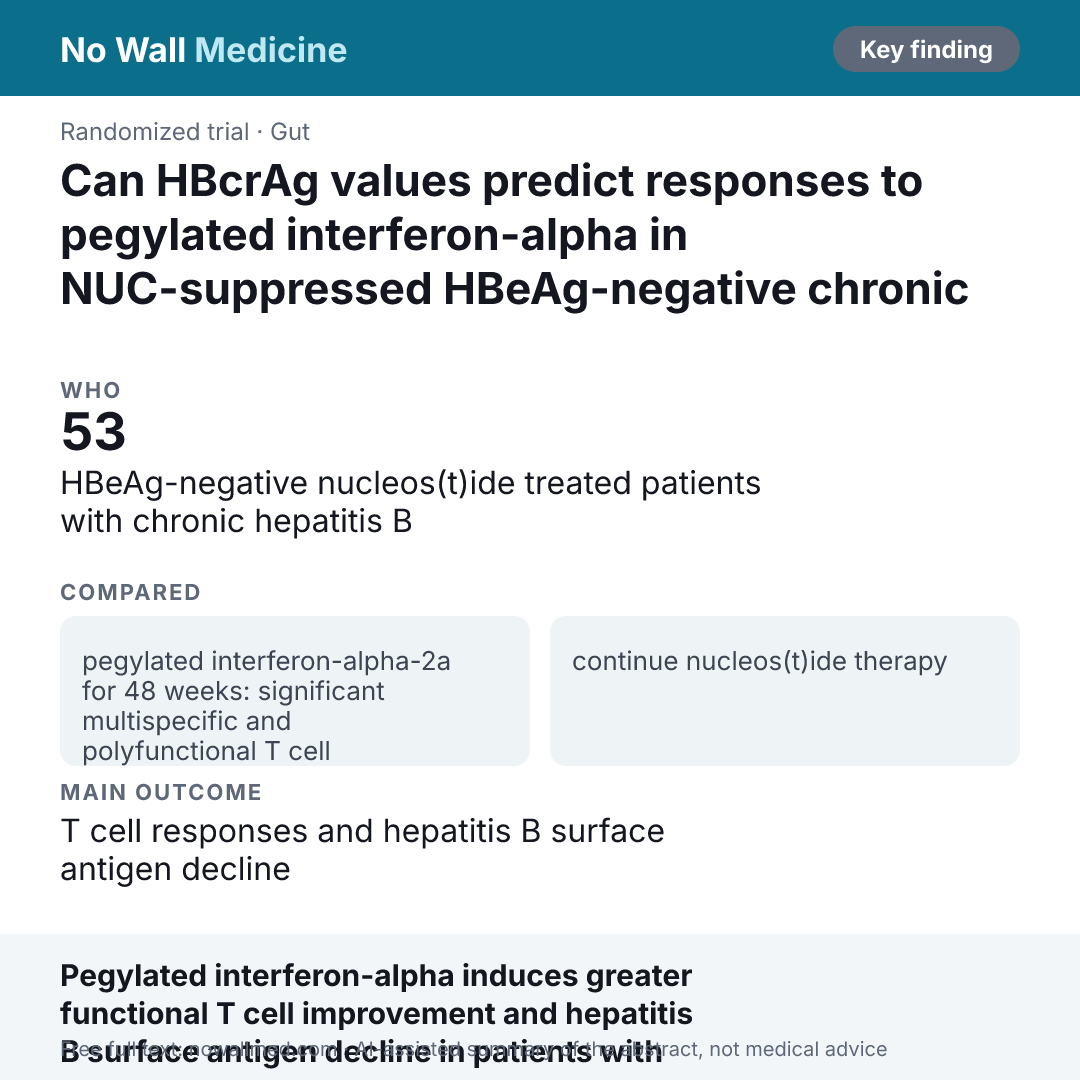
Can HBcrAg values predict responses to pegylated interferon-alpha in NUC-suppressed HBeAg-negative chronic hepatitis B?
Who
53
HBeAg-negative nucleos(t)ide treated patients with chronic hepatitis B
Compared
pegylated interferon-alpha-2a for 48 weeks: significant multispecific and polyfunctional T cell improvement at week 24 post-treatment
continue nucleos(t)ide therapy
Main outcome
T cell responses and hepatitis B surface antigen decline
Bottom line: Pegylated interferon-alpha induces greater functional T cell improvement and hepatitis B surface antigen decline in patients with lower baseline HBcrAg levels.
Gut · 2024-09-09 · Save PNG
Key points
- Researchers studied 53 patients with hepatitis B who were already taking nucleos(t)ide therapy and were randomized to receive pegylated interferon-alpha for 48 weeks or continue their current treatment.
- Pegylated interferon-alpha therapy was associated with a significant improvement in multi-specific and polyfunctional T cell responses at week 24 after treatment compared to baseline.
- The greatest T cell improvement was associated with a higher drop in hepatitis B surface antigen levels and lower initial hepatitis B core-related antigen values.
Discussion prompts
- Would these patients look like yours? Who was left out?
- Is the main outcome one that matters to patients?
- Is the difference large enough to change what you do?
Cite: Vecchi A, Rossi M, Tiezzi C, et al. HBcrAg values may predict virological and immunological responses to pegIFN-α in NUC-suppressed HBeAg-negative chronic hepatitis B. Gut. 2024;73(10):1737-1748. doi:10.1136/gutjnl-2024-332290
Free full text: PubMed Central · Summary and visual abstract: nowallmed.com/a/hbcrag-values-may-predict-virological-and-immunological-responses-to-1fmjegr/ (AI-assisted from the abstract; check the paper before relying on it).