Surveillance for liver cancer in patients with cirrhosis was associated with better survival and detection
HCC surveillance improves early detection, curative treatment receipt, and survival in patients with cirrhosis: A meta-analysis
Systematic review and meta-analysis of cohort studiesBenefit found
Does hepatocellular carcinoma surveillance improve outcomes in patients with cirrhosis?
Who
145396
Patients with cirrhosis
Compared
Hepatocellular carcinoma surveillance
No surveillance
Main outcome
Early-stage detection, curative treatment receipt, and overall survival
Result: hazard ratio 0.67 (95% CI 0.61-0.72)
Bottom line: Hepatocellular carcinoma surveillance is associated with improved early detection, curative treatment receipt, and survival in patients with cirrhosis.
Limitation: Notable heterogeneity in all pooled estimates and lack of data on financial or psychological harms.
J Hepatol · 2022-02-06Download image
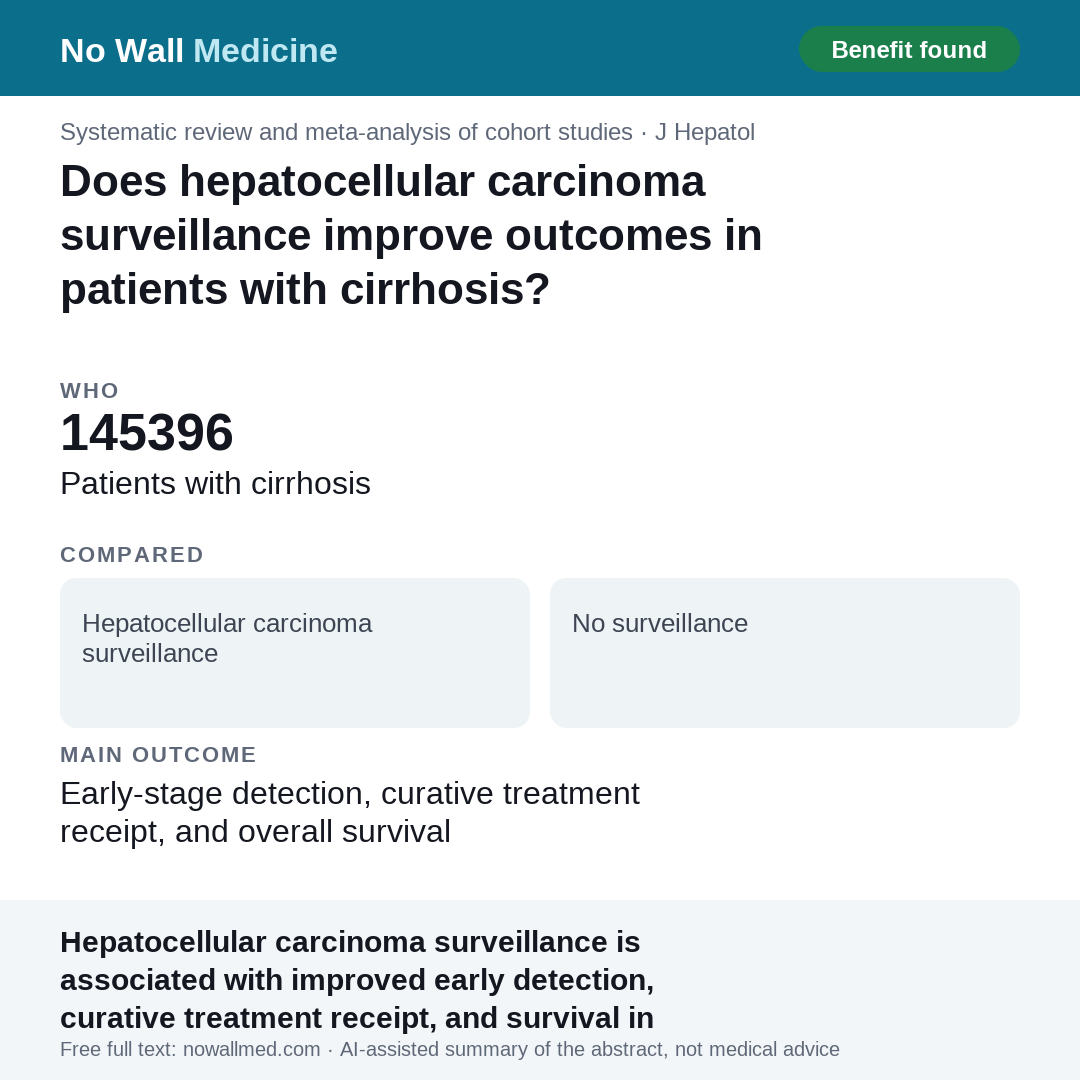
Clinical question: Does hepatocellular carcinoma surveillance improve outcomes in patients with cirrhosis?
Why it matters: The overall value of hepatocellular carcinoma surveillance in patients with cirrhosis is controversial due to a lack of data from randomized-controlled trials.
Key points
- Researchers analyzed 59 studies involving 145,396 patients with hepatocellular carcinoma, which is a type of primary liver cancer.
- Surveillance was associated with improved early-stage detection (RR 1.86), curative treatment receipt (RR 1.83), and overall survival (hazard ratio 0.67).
- Physical harms from false positive or indeterminate results were reported in 8.8% to 27.5% of patients across four studies.
Limitation the authors note: There was notable heterogeneity in all pooled estimates and no studies examined potential financial or psychological harms.
Headline and key points written with AI from the paper’s abstract, with every number checked against it. Read the paper before relying on them.
Was this summary helpful?
Subject terms
Cite this article
Singal AG, Zhang E, Narasimman M, Rich NE, Waljee AK, Hoshida Y. HCC surveillance improves early detection, curative treatment receipt, and survival in patients with cirrhosis: A meta-analysis. J Hepatol. 2022. doi:10.1016/j.jhep.2022.01.023
Spotted a mistake? Suggest a correction
Top studies every Monday
The week’s key trials and guidelines in your specialties, plus any topics you follow. By email, free.
Get the weekly digest