Predictive models may help identify patients likely to complete liver cancer screening
Novel Application of Predictive Modeling: A Tailored Approach to Promoting HCC Surveillance in Patients With Cirrhosis
Secondary analysis of a randomized clinical trialBenefit found
Can predictive models identify patients likely to complete hepatocellular carcinoma surveillance?
Who
1200
Patients with cirrhosis at a safety-net health system · A safety-net health system
Compared
Regularized logistic regression model: AUROC 0.67 to 0.77
Gradient boosting machine model: AUROC 0.66 to 0.77
Main outcome
Hepatocellular carcinoma surveillance completion
Bottom line: Predictive models can stratify patients' likelihood to respond to surveillance outreach to improve population health programs.
Clin Gastroenterol Hepatol · 2021-03-02Download image
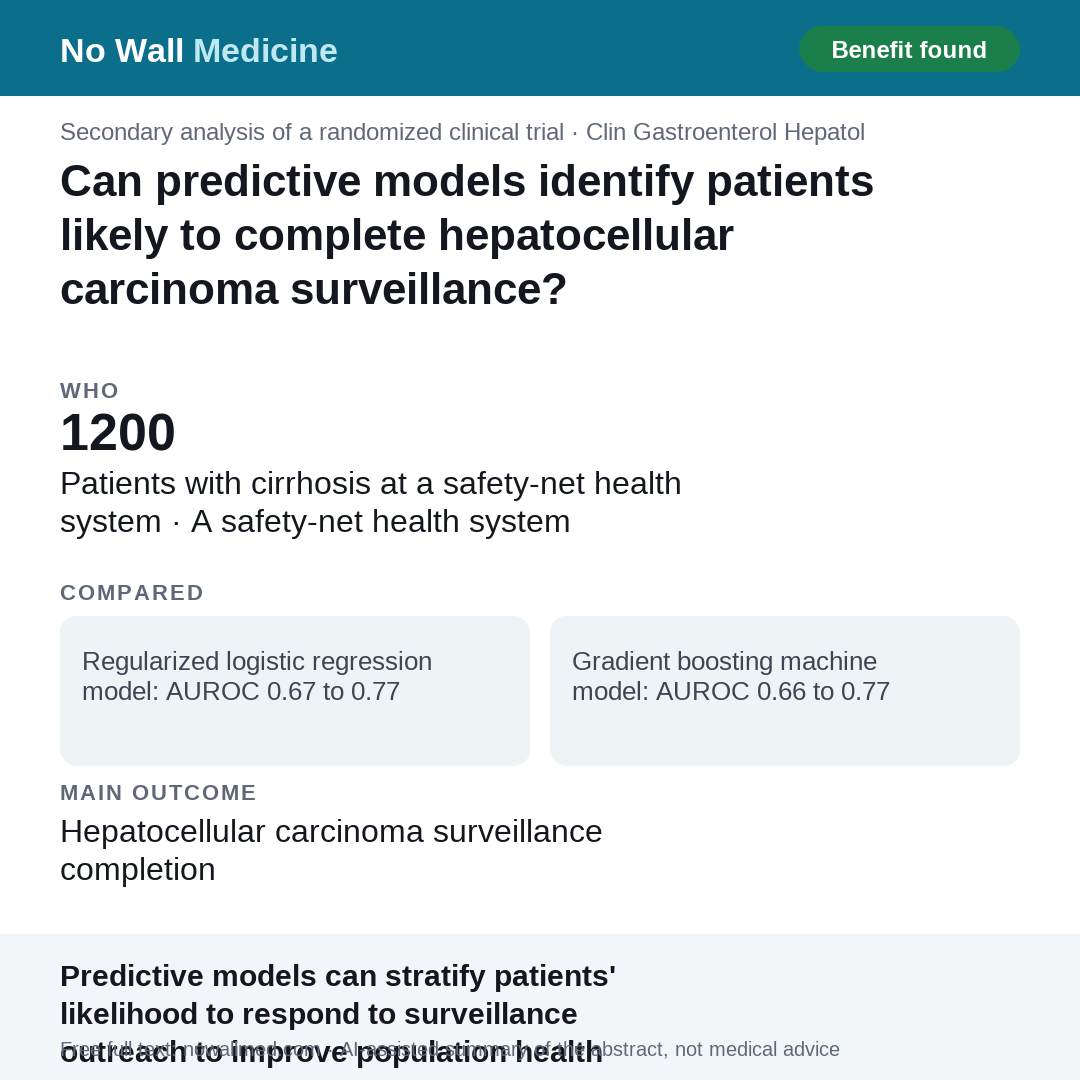
Clinical question: Can predictive models identify patients likely to complete hepatocellular carcinoma surveillance?
Why it matters: Low utilization and high rates of late-stage detection of liver cancer make it difficult to determine which patients will respond to outreach interventions.
Key points
- Researchers analyzed 1200 patients with cirrhosis to see if mathematical models could predict completion of hepatocellular carcinoma (liver cancer) surveillance.
- The models showed an area under the receiver operating characteristic curve of 0.67 and 0.66 in the first round, which increased to 0.77 by the third round.
- Prior screening completion status and past contact with primary care providers were the most important variables for the predictive models.
Headline and key points written with AI from the paper’s abstract, with every number checked against it. Read the paper before relying on them.
Was this summary helpful?
Subject terms
Cite this article
Singal AG, Chen Y, Sridhar S, Mittal V, Fullington H, Shaik M. Novel Application of Predictive Modeling: A Tailored Approach to Promoting HCC Surveillance in Patients With Cirrhosis. Clin Gastroenterol Hepatol. 2021. doi:10.1016/j.cgh.2021.02.038
Spotted a mistake? Suggest a correction
Top studies every Monday
The week’s key trials and guidelines in your specialties, plus any topics you follow. By email, free.
Get the weekly digest