Elevated head position did not improve functional outcomes after stroke treatment in randomized trial
Head positioning after endovascular therapy for acute stroke due to large vessel occlusion (HeadSOAR): multicentre randomised controlled trial
Multicentre, prospective, randomised, open label, blinded endpoint trialNo clear difference
Does elevated head position improve functional outcomes after successful reperfusion in acute stroke?
Who
1368
Adults with acute ischaemic stroke and successful endovascular reperfusion · 67 comprehensive stroke centres in China
Compared
Elevated head position (30-40°): median modified Rankin scale score 3 (IQR 1-5)
Flat head position (0-10°): median modified Rankin scale score 3 (IQR 1-5)
Main outcome
Functional status at 90 days using modified Rankin scale
Result: adjusted generalised odds ratio 1.12 (95% CI 0.97 to 1.29)
Bottom line: Elevated head position did not significantly improve 90 day functional outcomes compared to flat head positioning.
BMJ · 2026-08-20Download image
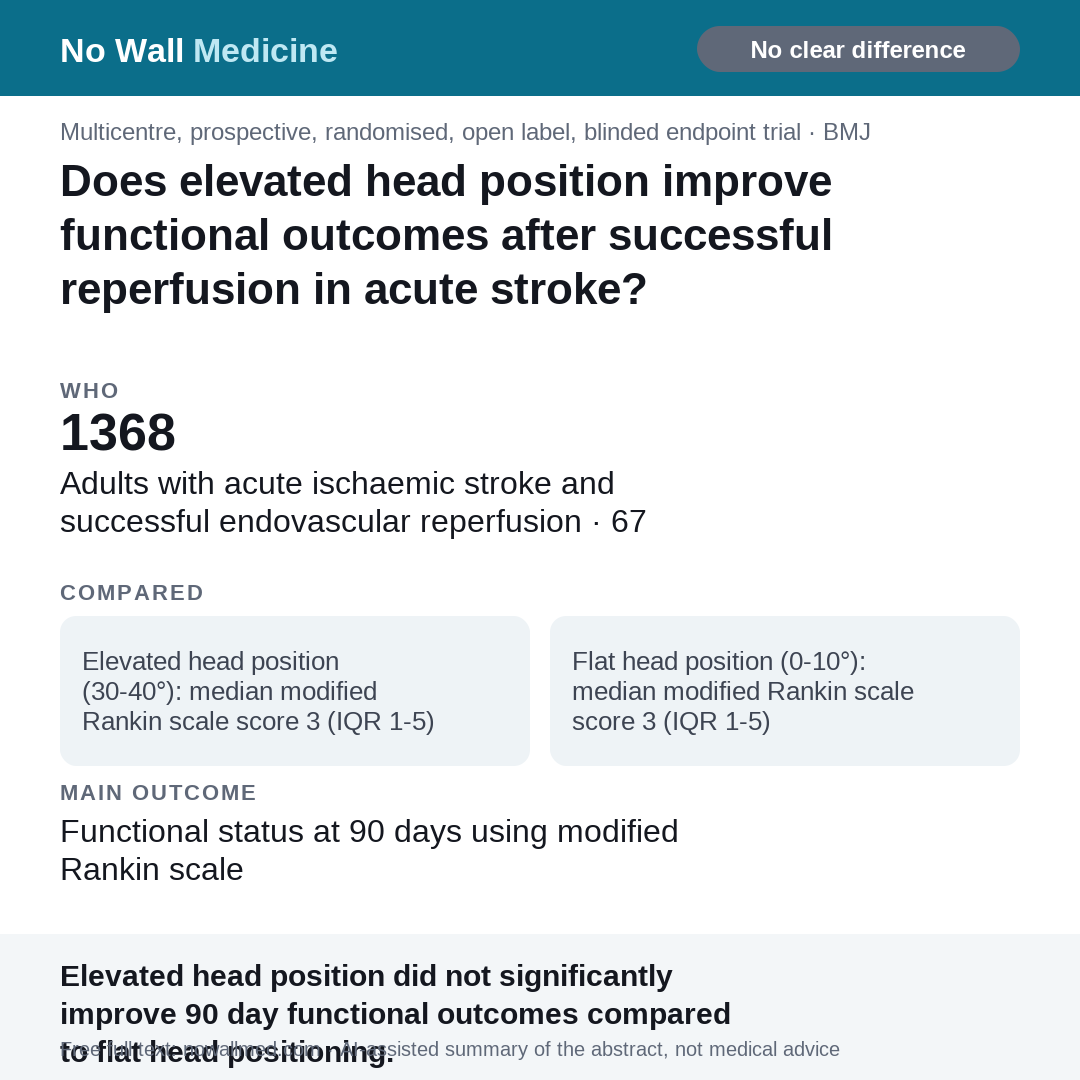
Clinical question: Does elevated head position improve functional outcomes after successful reperfusion in acute stroke?
Why it matters: It is unclear if elevating the head after successful blood flow restoration improves recovery for patients with large vessel stroke.
Key points
- Researchers studied 1368 adults with acute ischaemic stroke from large vessel occlusion who achieved successful blood flow restoration after endovascular thrombectomy.
- The median 90 day disability score was 3 for both the elevated head position group and the flat head position group.
- All cause mortality at 90 days was 18.3% in the elevated head group and 20.3% in the flat head group.
Limitation the authors note: The authors state that a smaller than expected difference in results leaves open the possibility of a modest but clinically meaningful benefit.
Headline and key points written with AI from the paper’s abstract, with every number checked against it. Read the paper before relying on them.
Abstract
Objective
To determine whether an elevated head position (30-40°) improves functional outcomes compared with a flat head position (0-10°) in patients with acute ischaemic stroke caused by anterior circulation large vessel occlusion who have achieved successful reperfusion after endovascular thrombectomy. Design
Multicentre, prospective, randomised, open label, blinded endpoint clinical trial. Setting
67 comprehensive stroke centres in China, between 16 November 2023 and 23 January 2025. Participants
1368 adults (aged ≥18 years) with acute ischaemic stroke caused by anterior circulation large vessel occlusion who achieved successful endovascular reperfusion, defined as an expanded thrombolysis in cerebral infarction score ≥2b after endovascular thrombectomy. Interventions
Participants were randomly assigned (1:1) to maintain either an elevated head position (30-40°, n=685) or a flat head position (0-10°, n=683) for 72 hours after endovascular thrombectomy. MAIN: outcome measures The primary outcome was functional status at 90 days after randomisation, assessed by shift analysis of scores on the modified Rankin scale (range 0-6). The primary safety outcome was all cause mortality at 90 days after randomisation. Efficacy analyses used the randomised, full analysis set, and safety analyses used the safety population (identical to the randomised population). Adjusted models included age, baseline National Institutes of Health Stroke Scale score (NIHSS), baseline Alberta Stroke Programme Early Computed Tomography Score, occlusion site, and time from last known well (ie, the last time when the patient was known to be at their usual neurological baseline before the current stroke event) to randomisation. Results
In the population of 1368 randomised patients, the median age was 68 years, 565 participants (41.3%) were women, and 1358 (99.3%) completed the 90 day follow-up. The median baseline NIHSS score was 15, the median 90 day modified Rankin scale score was 3 (interquartile range (IQR) 1-5) in the head elevation group versus 3 (IQR 1-5) in the flat head position group (adjusted generalised odds ratio for a lower level of disability 1.12, 95% confidence interval (CI) 0.97 to 1.29, P=0.14). All cause mortality at 90 days occurred in 125 (18.3%) of 682 patients in the elevated head position group and 137 (20.3%) of 676 patients in the flat head position group (adjusted risk ratio 0.86, 95% CI 0.69 to 1.07, P=0.18). Conclusions
72 hours of head elevation did not significantly improve 90 day functional outcomes versus flat head positioning in patients who had acute ischaemic stroke from large vessel occlusion with successful reperfusion after thrombectomy. The smaller than expected difference in results between the two groups leaves open the possibility of a modest but clinically meaningful benefit of head elevation in these patients. Trial
registration ClinicalTrials.gov NCT06115707.
Abstract reproduced under the article’s CC BY NC licence.
Topics
Cite this article
Yuan Z, Peng J, Gu L, Hu F, Li G, Li J. Head positioning after endovascular therapy for acute stroke due to large vessel occlusion (HeadSOAR): multicentre randomised controlled trial. BMJ. 2026. doi:10.1136/bmj-2026-100363
Spotted a mistake? Suggest a correction