Three lung cancer risk models showed better predictive performance than other questionnaire-based tools
Head-to-head comparisons of risk discrimination by questionnaire-based lung cancer risk prediction models: a systematic review and meta-analysis
Systematic review and meta-analysisKey finding
How do different questionnaire-based lung cancer risk prediction models compare in risk discrimination?
Who
4,134,648
Participants with previous or current smoking exposure
Compared
LCRAT, Bach and PLCOm2012 models: higher AUC
Alternative questionnaire-based risk prediction tools
Main outcome
Area under the curve of risk discrimination
Result: AUC differences ranging between 0.018 (95% CI 0.011, 0.026) and 0.044 (95% CI 0.038, 0.049)
Bottom line: The LCRAT, Bach and PLCOm2012 models consistently outperformed alternative questionnaire-based lung cancer risk prediction tools.
Limitation: Limited to the availability of head-to-head comparisons
Funded by: European Union
eClinicalMedicine · 2025-01-30Download image
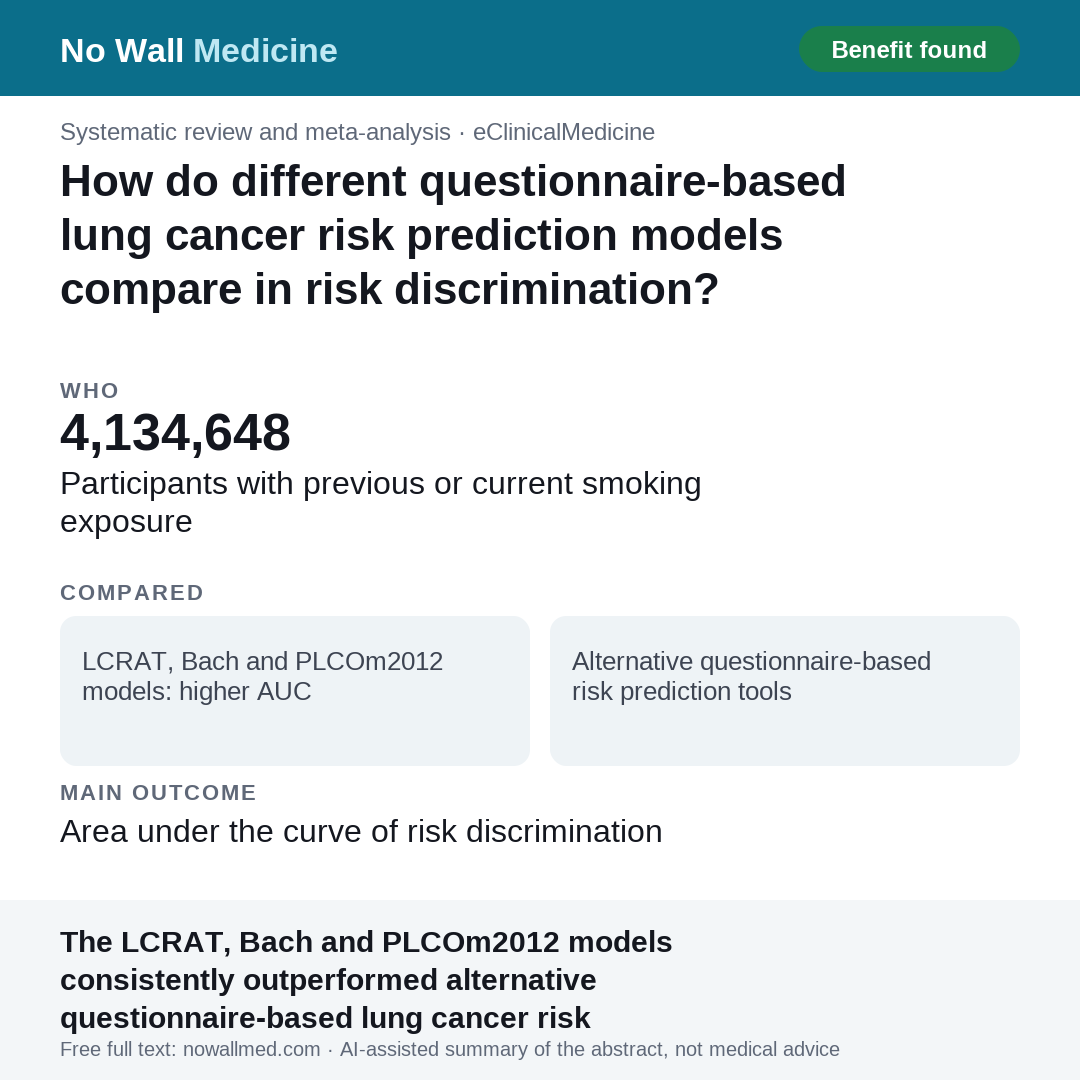
Clinical question: How do different questionnaire-based lung cancer risk prediction models compare in risk discrimination?
Why it matters: Evaluations of how well different questionnaire-based lung cancer risk models can distinguish between high-risk and low-risk individuals have reported inconsistent findings across different research groups.
Key points
- Researchers analyzed 15 studies involving 4,134,648 people with smoking history, of whom 45,448 (1.10%) developed lung cancer within 5-7 years.
- The Lung Cancer Risk Assessment Tool, Bach model, and PLCOm2012 model consistently had higher area under the curve values, with differences between 0.018 (95% CI 0.011, 0.026) and 0.044 (95% CI 0.038, 0.049).
- Among the 24 model pairs compared, notable heterogeneity was found in eight pairs where I2 was ≥50%.
Limitation the authors note: The review was limited by the availability of head-to-head comparisons between models.
Headline and key points written with AI from the paper’s abstract, with every number checked against it. Read the paper before relying on them.
Was this summary helpful?
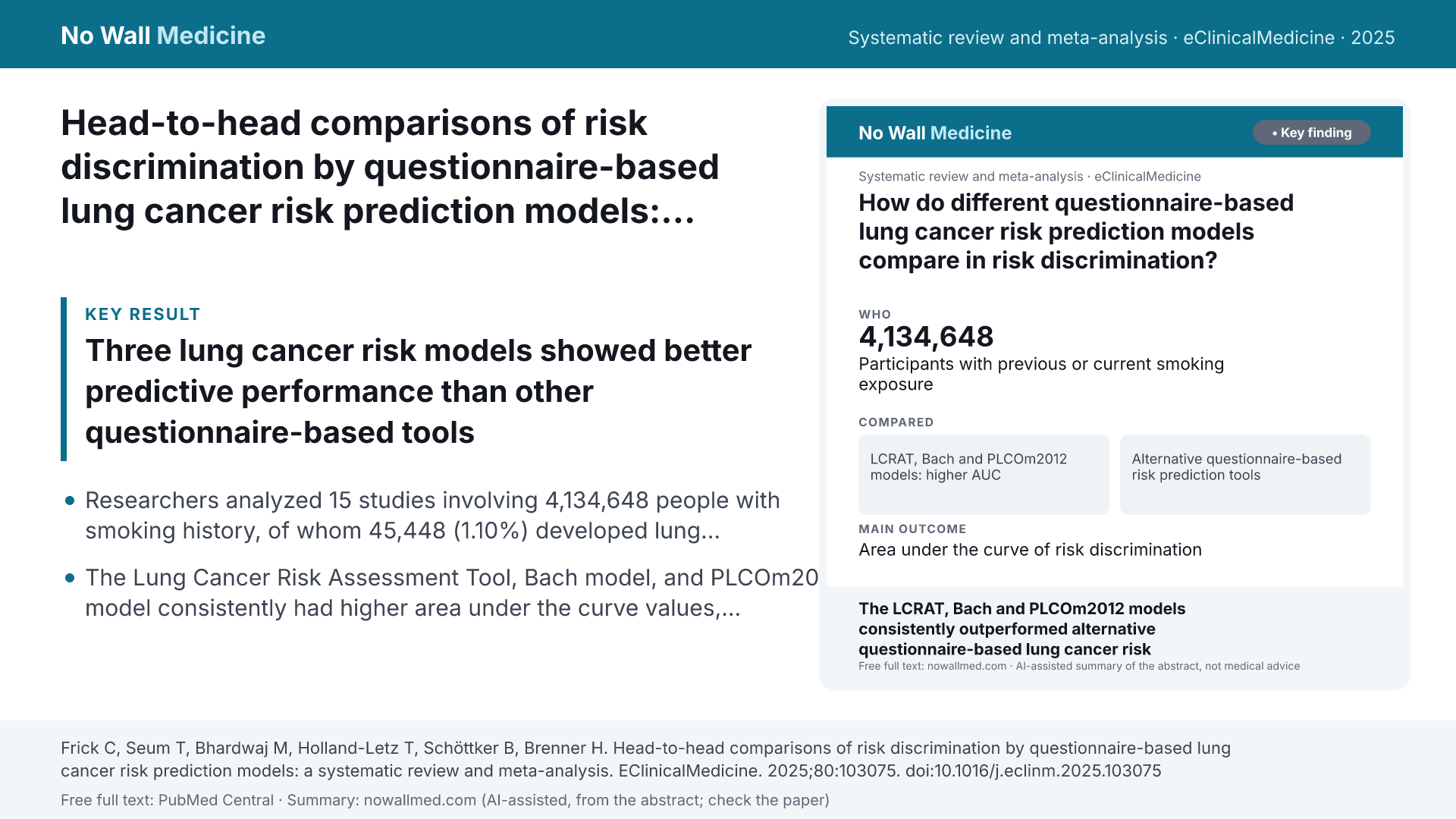
Headline, design, result, key points, caveat and citation as plain text.
Cite this article
Frick C, Seum T, Bhardwaj M, Holland-Letz T, Schöttker B, Brenner H. Head-to-head comparisons of risk discrimination by questionnaire-based lung cancer risk prediction models: a systematic review and meta-analysis. eClinicalMedicine. 2025. doi:10.1016/j.eclinm.2025.103075
Spotted a mistake? Suggest a correction