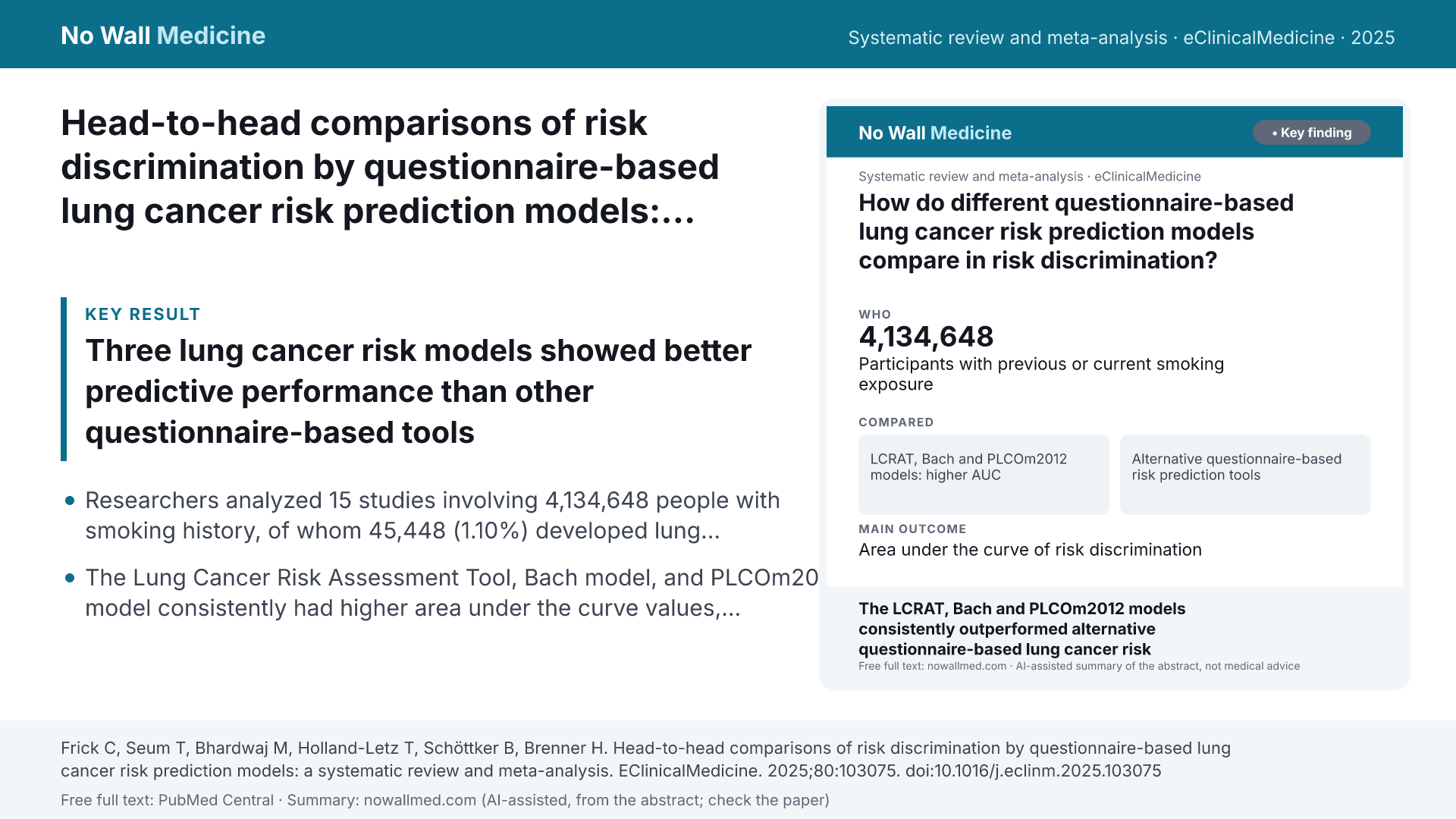
Head-to-head comparisons of risk discrimination by questionnaire-based lung cancer risk prediction models: a systematic review and meta-analysis
Key result: Three lung cancer risk models showed better predictive performance than other questionnaire-based tools
Key points
- Researchers analyzed 15 studies involving 4,134,648 people with smoking history, of whom 45,448 (1.10%) developed lung cancer within 5-7 years.
- The Lung Cancer Risk Assessment Tool, Bach model, and PLCOm2012 model consistently had higher area under the curve values, with differences between 0.018 (95% CI 0.011, 0.026) and 0.044 (95% CI 0.038, 0.049).
- Among the 24 model pairs compared, notable heterogeneity was found in eight pairs where I2 was ≥50%.
Why it matters: Evaluations of how well different questionnaire-based lung cancer risk models can distinguish between high-risk and low-risk individuals have reported inconsistent findings across different research groups.
Limitation the authors note: The review was limited by the availability of head-to-head comparisons between models.
Discussion prompts
- Would these patients look like yours? Who was left out?
- Is the main outcome one that matters to patients?
- Is the difference large enough to change what you do?
Cite: Frick C, Seum T, Bhardwaj M, Holland-Letz T, Schöttker B, Brenner H. Head-to-head comparisons of risk discrimination by questionnaire-based lung cancer risk prediction models: a systematic review and meta-analysis. EClinicalMedicine. 2025;80:103075. doi:10.1016/j.eclinm.2025.103075
Free full text: PubMed Central · Summary and visual abstract: nowallmed.com/a/head-to-head-comparisons-of-risk-discrimination-by-questionnaire-1uziai8/ (AI-assisted from the abstract; check the paper before relying on it).