Health Communication and Adherence to Noninvasive Ventilation in Chronic Hypercapnic Respiratory Failure: A Randomized Clinical Trial
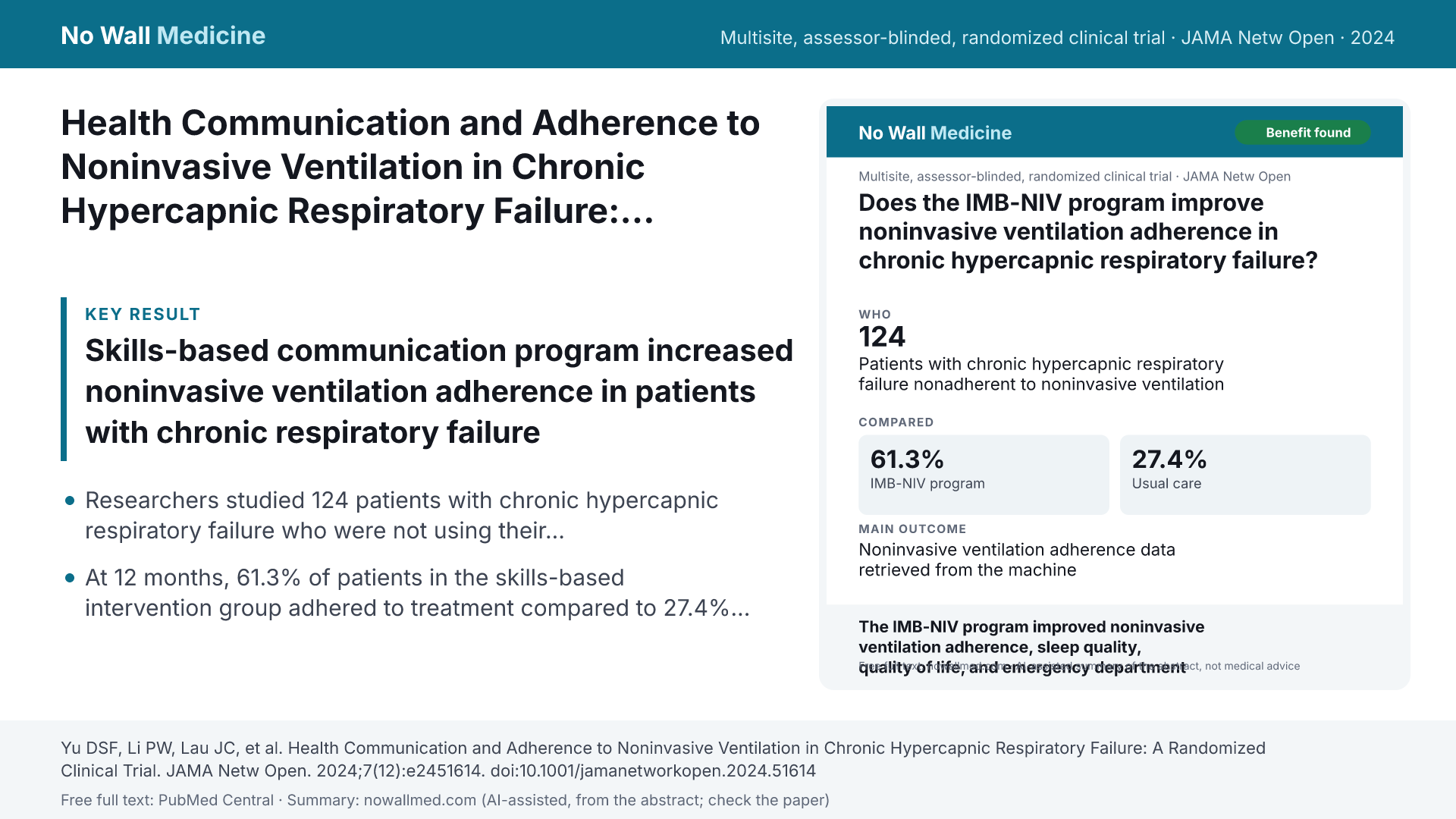
Key result: Skills-based communication program increased noninvasive ventilation adherence in patients with chronic respiratory failure
Key points
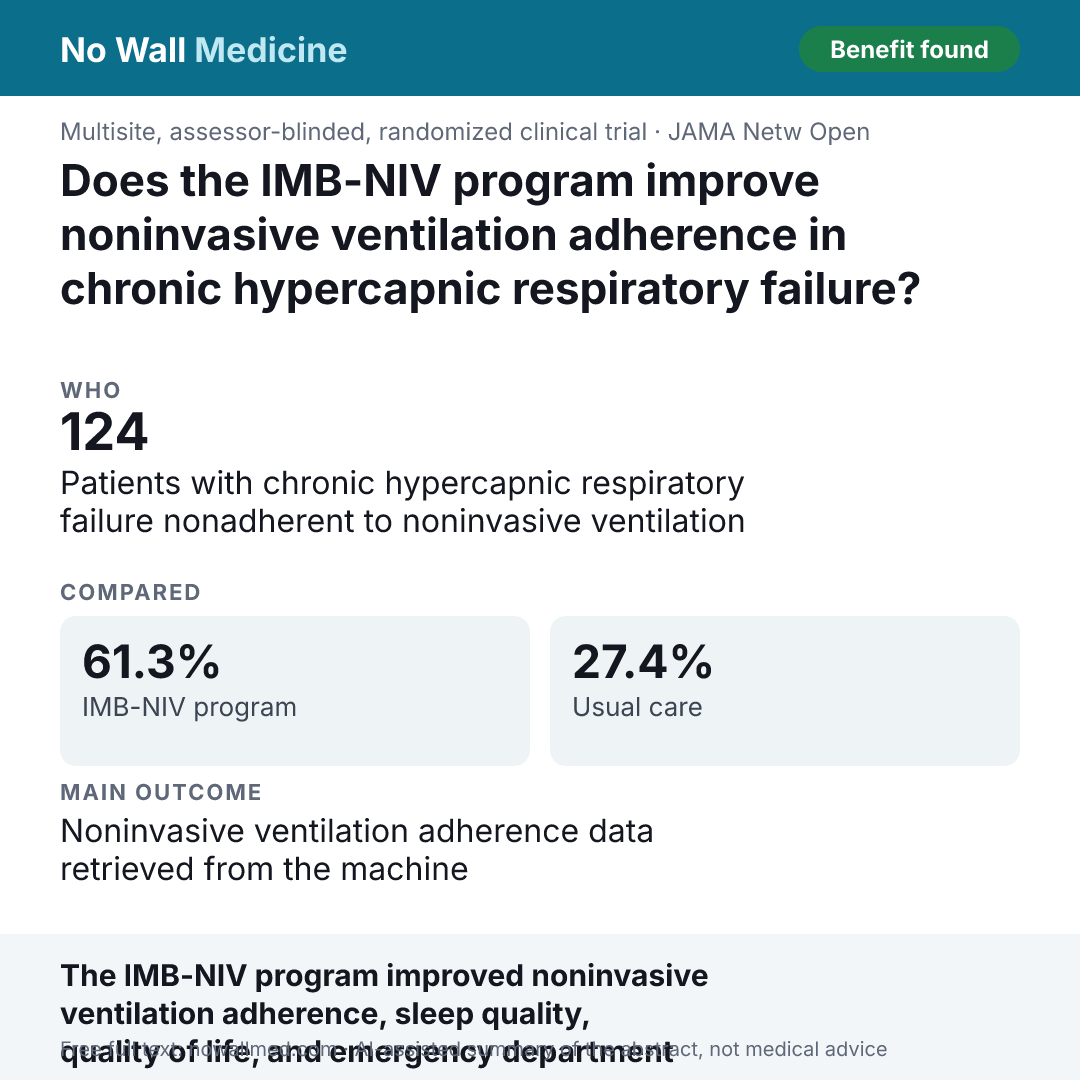
- Researchers studied 124 patients with chronic hypercapnic respiratory failure who were not using their prescribed noninvasive ventilation machines as directed.
- At 12 months, 61.3% of patients in the skills-based intervention group adhered to treatment compared to 27.4% in the usual care group.
- The intervention group showed significantly better sleep quality, higher health-related quality of life, and fewer emergency department visits at 12 months.
In absolute numbers: IMB-NIV program 61.3% vs Usual care 27.4%, a difference of 33.9 percentage points (about 3 people treated for one more to benefit).
Why it matters: Poor adherence to noninvasive ventilation limits the effectiveness of this standard treatment for patients with chronic hypercapnic respiratory failure.
Discussion prompts
- Would these patients look like yours? Who was left out?
- Is the main outcome one that matters to patients?
- Is the difference large enough to change what you do?
Cite: Yu DSF, Li PW, Lau JC, et al. Health Communication and Adherence to Noninvasive Ventilation in Chronic Hypercapnic Respiratory Failure: A Randomized Clinical Trial. JAMA Netw Open. 2024;7(12):e2451614. doi:10.1001/jamanetworkopen.2024.51614
Free full text: PubMed Central · Summary and visual abstract: nowallmed.com/a/health-communication-and-adherence-to-noninvasive-ventilation-in-a5a5hd/ (AI-assisted from the abstract; check the paper before relying on it).