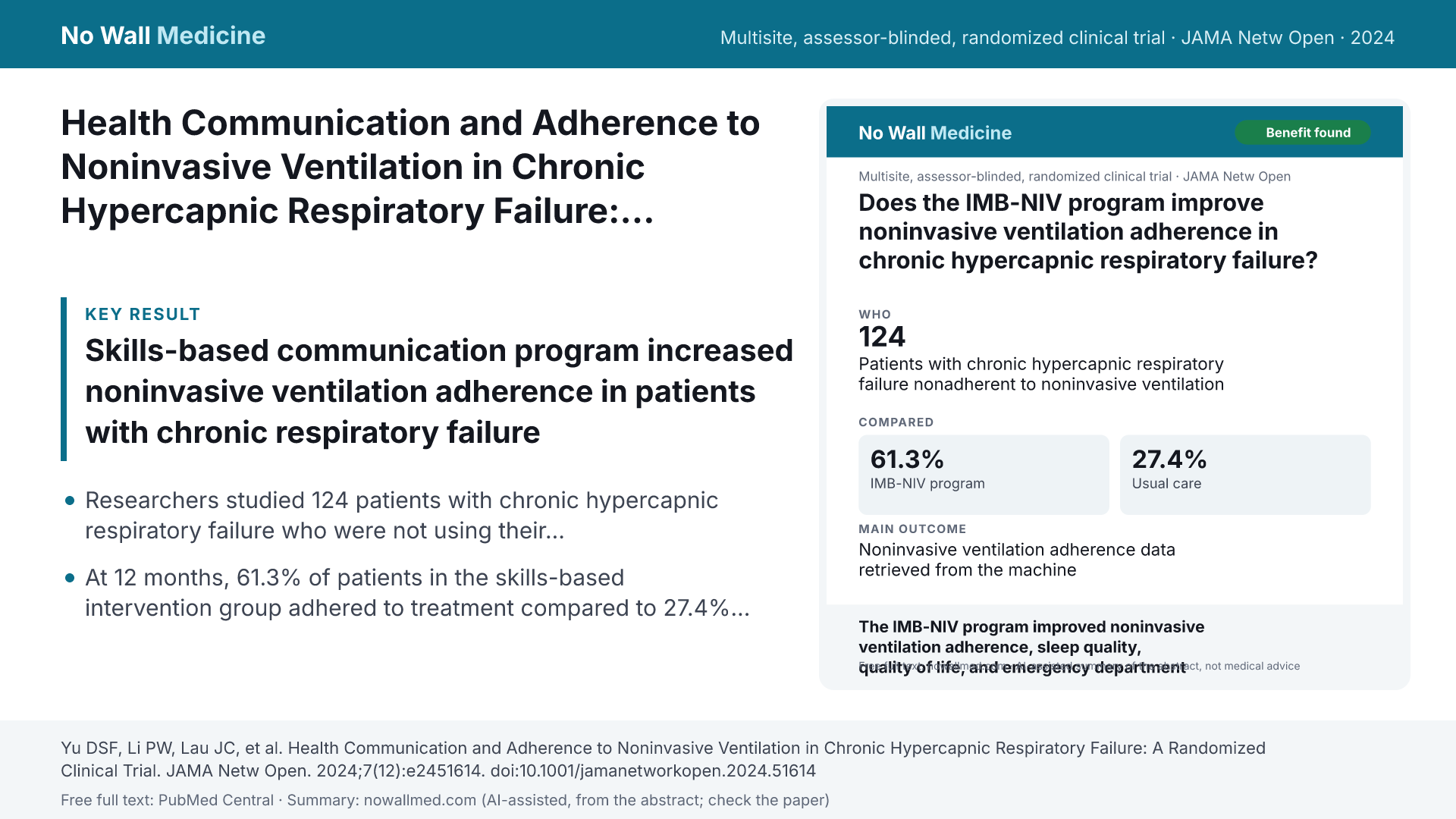
Skills-based communication program increased noninvasive ventilation adherence in patients with chronic respiratory failure
Health Communication and Adherence to Noninvasive Ventilation in Chronic Hypercapnic Respiratory Failure: A Randomized Clinical Trial
Multisite, assessor-blinded, randomized clinical trialBenefit found
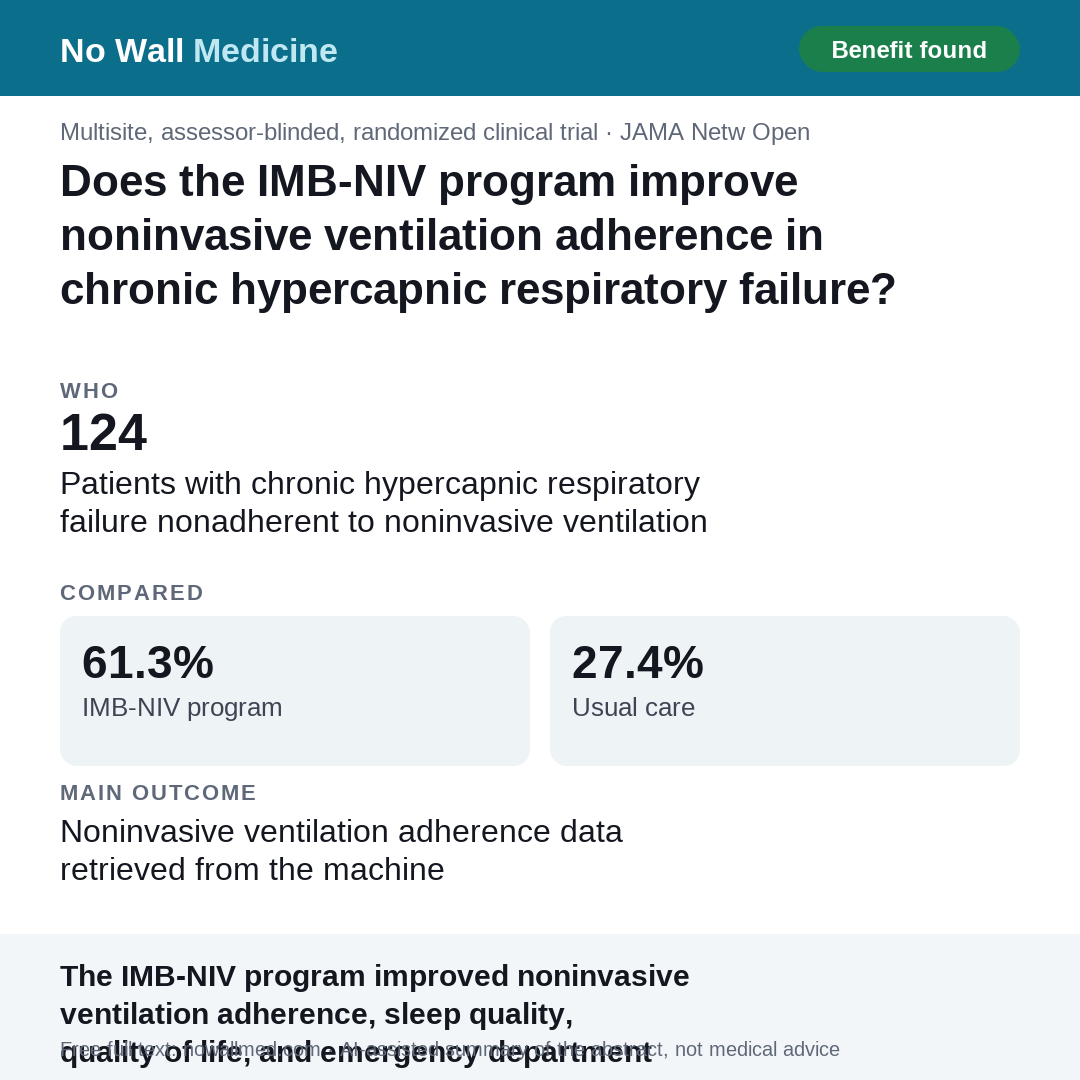
Does the IMB-NIV program improve noninvasive ventilation adherence in chronic hypercapnic respiratory failure?
Who
124
Patients with chronic hypercapnic respiratory failure nonadherent to noninvasive ventilation · 2 regional hospitals in Hong Kong
Compared
61.3%IMB-NIV program
27.4%Usual care
Main outcome
Noninvasive ventilation adherence data retrieved from the machine
Result: odds ratio 2.78 (95% CI 1.69 to 4.55)
Bottom line: The IMB-NIV program improved noninvasive ventilation adherence, sleep quality, quality of life, and emergency department admissions.
JAMA Netw Open · 2024-12-02Download image
Clinical question: Does the IMB-NIV program improve noninvasive ventilation adherence in chronic hypercapnic respiratory failure?
Why it matters: Poor adherence to noninvasive ventilation limits the effectiveness of this standard treatment for patients with chronic hypercapnic respiratory failure.
In absolute numbers
IMB-NIV program: 61.3% · Usual care: 27.4% → a difference of 33.9 percentage points, so about 3 people would need the treatment for 1 more to benefit (number needed to treat) over the trial’s follow-up.
Worked out by us from the two group results above, not reported by the authors. Check the paper for the exact outcome and timing.
Key points
- Researchers studied 124 patients with chronic hypercapnic respiratory failure who were not using their prescribed noninvasive ventilation machines as directed.
- At 12 months, 61.3% of patients in the skills-based intervention group adhered to treatment compared to 27.4% in the usual care group.
- The intervention group showed significantly better sleep quality, higher health-related quality of life, and fewer emergency department visits at 12 months.
Headline and key points written with AI from the paper’s abstract, with every number checked against it. Read the paper before relying on them.
Was this summary helpful?
Subject terms
Cite this article
Yu DSF, Li PW, Lau JC, Cheung PSA, Ip M, Cheng SLL. Health Communication and Adherence to Noninvasive Ventilation in Chronic Hypercapnic Respiratory Failure: A Randomized Clinical Trial. JAMA Netw Open. 2024. doi:10.1001/jamanetworkopen.2024.51614
Spotted a mistake? Suggest a correction