High flow nasal cannula oxygen therapy was not non-inferior to non-invasive ventilation for COPD patients
High flow nasal cannula oxygen therapy versus non-invasive ventilation for acute exacerbations of chronic obstructive pulmonary disease with acute-moderate hypercapnic respiratory failure: a randomized controlled non-inferiority trial
Randomized, open label, non-inferiority trialHarm found
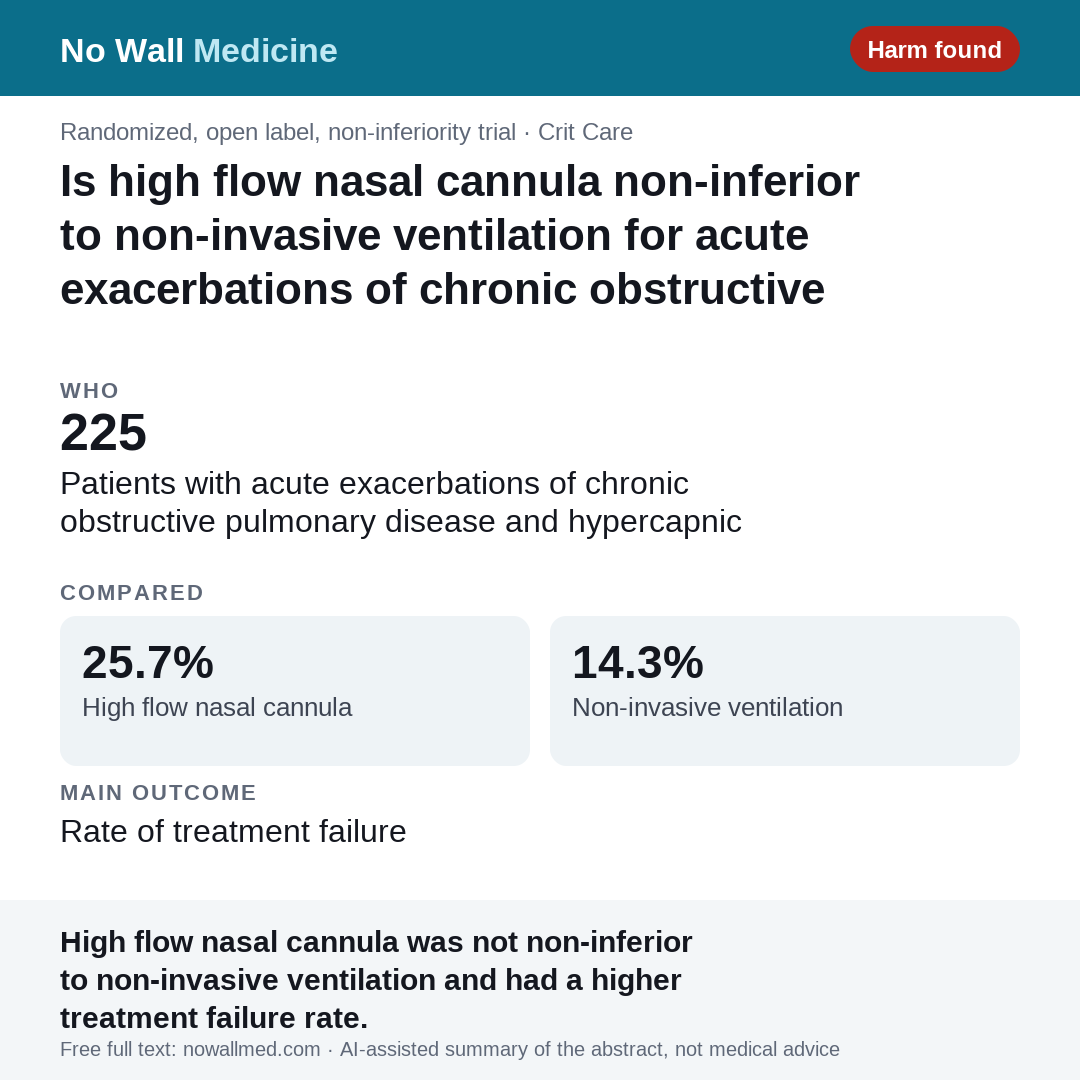
Is high flow nasal cannula non-inferior to non-invasive ventilation for acute exacerbations of chronic obstructive pulmonary disease?
Who
225
Patients with acute exacerbations of chronic obstructive pulmonary disease and hypercapnic respiratory failure · Two intensive care units at a large tertiary academic teaching hospital
Compared
25.7%High flow nasal cannula
14.3%Non-invasive ventilation
Main outcome
Rate of treatment failure
Result: risk difference 11.38% (95% CI 0.25-21.20)
Bottom line: High flow nasal cannula was not non-inferior to non-invasive ventilation and had a higher treatment failure rate.
Crit Care · 2024-07-18Download image
Clinical question: Is high flow nasal cannula non-inferior to non-invasive ventilation for acute exacerbations of chronic obstructive pulmonary disease?
Why it matters: It was unknown if high flow nasal cannula oxygen is as effective as non-invasive ventilation when used as the initial treatment for patients with acute-moderate hypercapnic respiratory failure.
Key points
- Researchers studied 225 patients with acute exacerbations of chronic obstructive pulmonary disease and acute-moderate hypercapnic respiratory failure, comparing high flow nasal cannula oxygen to non-invasive ventilation.
- The treatment failure rate was 25.7% for the high flow nasal cannula group and 14.3% for the non-invasive ventilation group, exceeding the non-inferiority threshold.
- The rate of needing a breathing tube through endotracheal intubation was 14.2% in the high flow nasal cannula group compared to 5.4% in the non-invasive ventilation group.
Headline and key points written with AI from the paper’s abstract, with every number checked against it. Read the paper before relying on them.
Was this summary helpful?
Subject terms
Cite this article
Tan D, Wang B, Cao P, Wang Y, Sun J, Geng P. High flow nasal cannula oxygen therapy versus non-invasive ventilation for acute exacerbations of chronic obstructive pulmonary disease with acute-moderate hypercapnic respiratory failure: a randomized controlled non-inferiority trial. Crit Care. 2024. doi:10.1186/s13054-024-05040-9
Spotted a mistake? Suggest a correction
Top studies every Monday
The week’s key trials and guidelines in your specialties, plus any topics you follow. By email, free.
Get the weekly digest