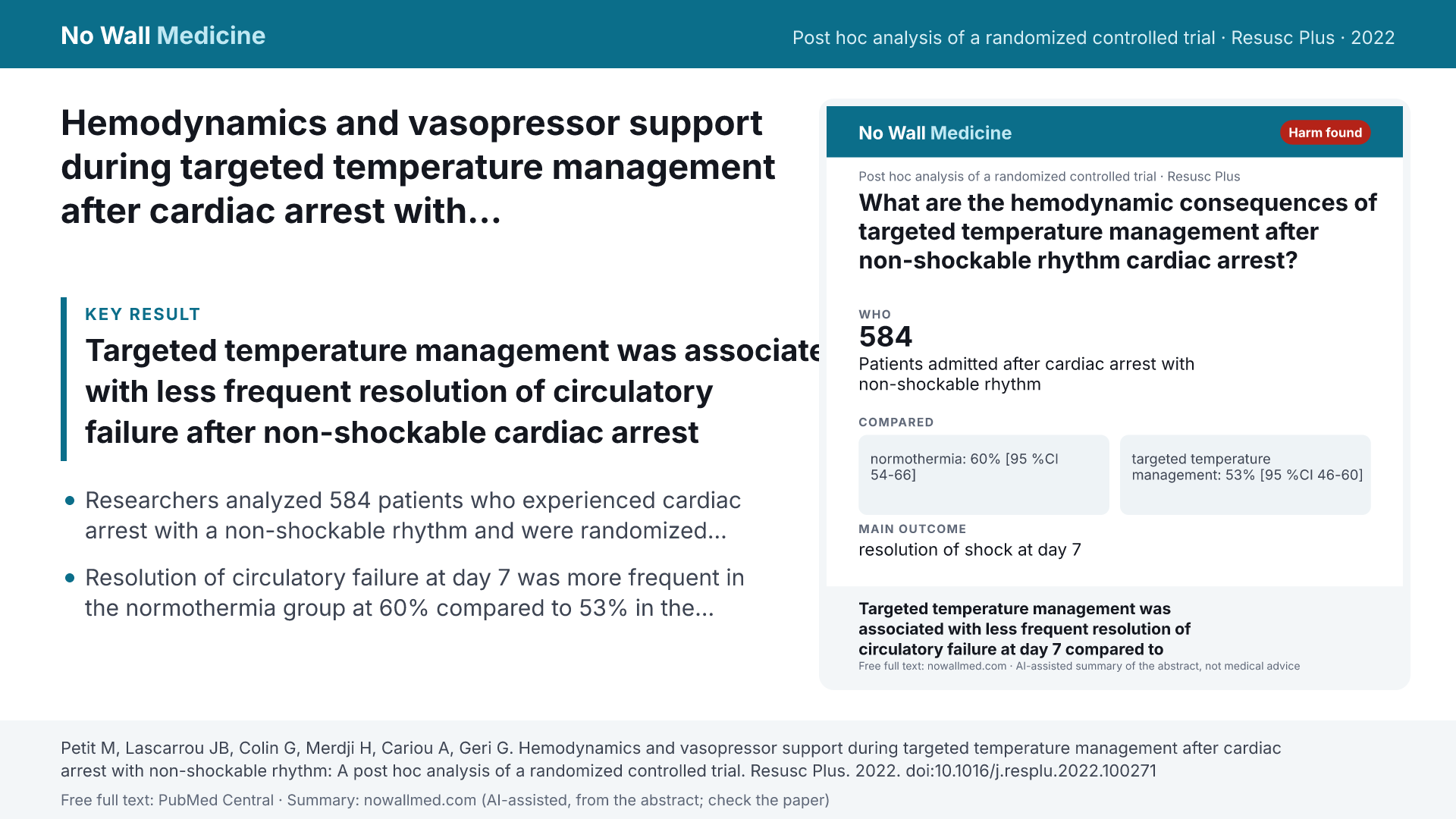
Targeted temperature management was associated with less frequent resolution of circulatory failure after non-shockable cardiac arrest
Hemodynamics and vasopressor support during targeted temperature management after cardiac arrest with non-shockable rhythm: A post hoc analysis of a randomized controlled trial
Post hoc analysis of a randomized controlled trialHarm found
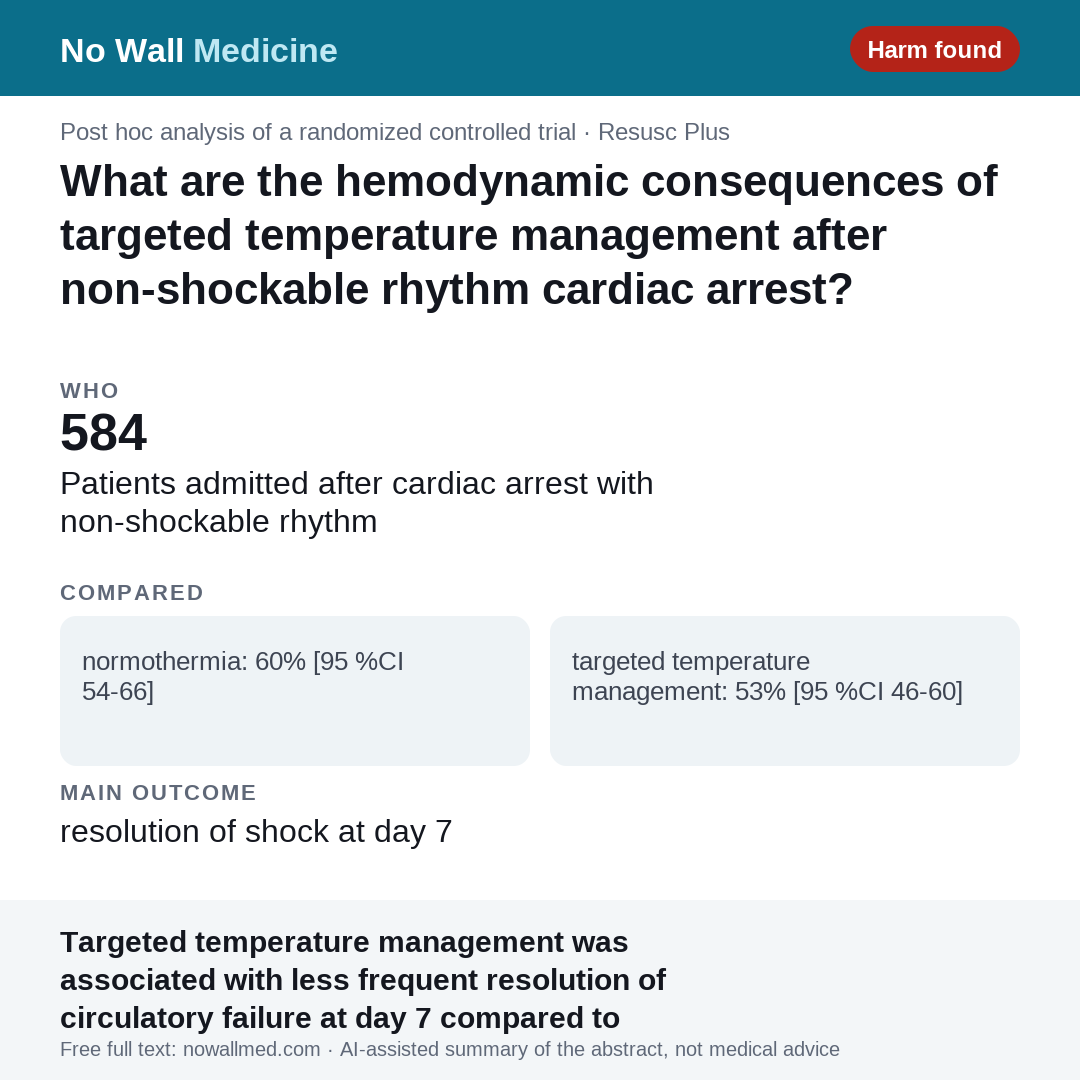
What are the hemodynamic consequences of targeted temperature management after non-shockable rhythm cardiac arrest?
Who
584
Patients admitted after cardiac arrest with non-shockable rhythm
Compared
normothermia: 60% [95 %CI 54-66]
targeted temperature management: 53% [95 %CI 46-60]
Main outcome
resolution of shock at day 7
Bottom line: Targeted temperature management was associated with less frequent resolution of circulatory failure at day 7 compared to normothermia.
Resusc Plus · 2022-07-12Download image
Clinical question: What are the hemodynamic consequences of targeted temperature management after non-shockable rhythm cardiac arrest?
Why it matters: It was unknown how targeted temperature management affects blood pressure and circulatory stability in patients who experience cardiac arrest with a non-shockable rhythm.
Key points
- Researchers analyzed 584 patients who experienced cardiac arrest with a non-shockable rhythm and were randomized to either hypothermia or normothermia, which is maintaining normal body temperature.
- Resolution of circulatory failure at day 7 was more frequent in the normothermia group at 60% compared to 53% in the targeted temperature management group.
- Patients with severe circulatory failure at randomization had a lower rate of resolution at day 7 compared to those with moderate failure, at 54% versus 76%.
Headline and key points written with AI from the paper’s abstract, with every number checked against it. Read the paper before relying on them.
Was this summary helpful?
Cite this article
Petit M, Lascarrou JB, Colin G, Merdji H, Cariou A, Geri G. Hemodynamics and vasopressor support during targeted temperature management after cardiac arrest with non-shockable rhythm: A post hoc analysis of a randomized controlled trial. Resusc Plus. 2022. doi:10.1016/j.resplu.2022.100271
Spotted a mistake? Suggest a correction