Liver cancer screening results were associated with varying levels of depression and anxiety in patients
Hepatocellular carcinoma surveillance may be associated with potential psychological harms in patients with cirrhosis
Multicenter randomized trialMixed results
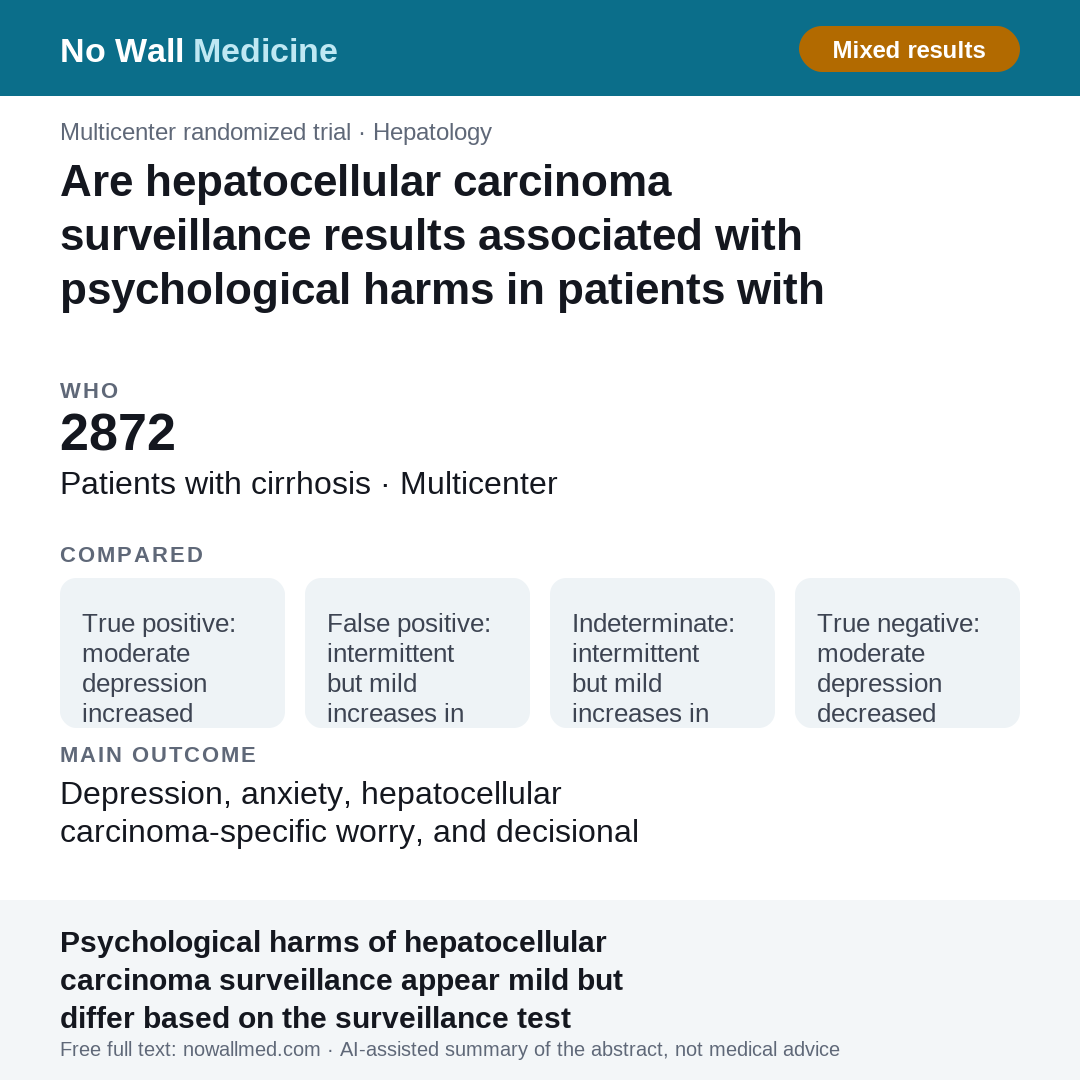
Are hepatocellular carcinoma surveillance results associated with psychological harms in patients with cirrhosis?
Who
2872
Patients with cirrhosis · Multicenter
Compared
True positive: moderate depression increased
False positive: intermittent but mild increases in moderate depression
Indeterminate: intermittent but mild increases in moderate depression
True negative: moderate depression decreased
Main outcome
Depression, anxiety, hepatocellular carcinoma-specific worry, and decisional regret
Bottom line: Psychological harms of hepatocellular carcinoma surveillance appear mild but differ based on the surveillance test result.
Limitation: Only 311 of 2872 patients completed one or more follow-up surveys.
Hepatology · 2023-07-04Download image
Clinical question: Are hepatocellular carcinoma surveillance results associated with psychological harms in patients with cirrhosis?
Why it matters: The balance between the benefits and harms of liver cancer surveillance is unknown because no studies have measured the potential psychological harms.
Key points
- Researchers surveyed 311 patients from a multicenter randomized trial of liver cancer surveillance to measure depression, anxiety, cancer-specific worry, and decisional regret.
- Moderate depression increased in patients with true positive results and showed intermittent mild increases in those with false positive or indeterminate results.
- High anxiety temporarily increased in patients with true positive results but remained stable in those with false positive or indeterminate results.
Limitation the authors note: The analysis was based on a subset of 311 patients who completed at least one follow-up survey out of 2872 total patients in the trial.
Headline and key points written with AI from the paper’s abstract, with every number checked against it. Read the paper before relying on them.
Was this summary helpful?
Subject terms
Cite this article
Narasimman M, Hernaez R, Cerda V, Lee M, Sood A, Yekkaluri S. Hepatocellular carcinoma surveillance may be associated with potential psychological harms in patients with cirrhosis. Hepatology. 2023. doi:10.1097/HEP.0000000000000528
Spotted a mistake? Suggest a correction
Top studies every Monday
The week’s key trials and guidelines in your specialties, plus any topics you follow. By email, free.
Get the weekly digest