Hepcidin-guided iron treatment was less effective than daily supplementation for children with anaemia
Hepcidin-guided screen-and-treat interventions for young children with iron-deficiency anaemia in The Gambia: an individually randomised, three-arm, double-blind, controlled, proof-of-concept, non-inferiority trial
Randomised, three-arm, double-blind, controlled, non-inferiority trialHarm found
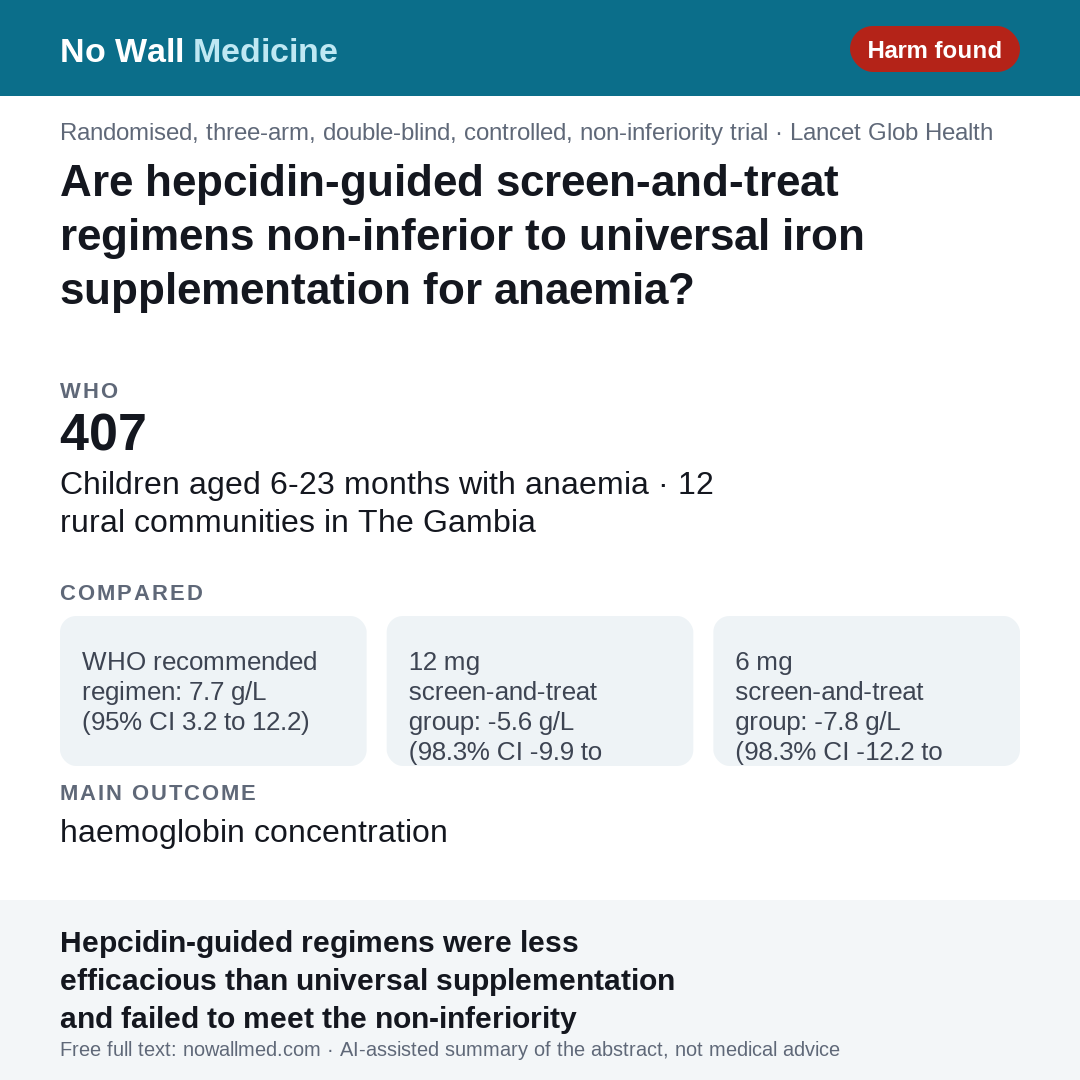
Are hepcidin-guided screen-and-treat regimens non-inferior to universal iron supplementation for anaemia?
Who
407
Children aged 6-23 months with anaemia · 12 rural communities in The Gambia
Compared
WHO recommended regimen: 7.7 g/L (95% CI 3.2 to 12.2)
12 mg screen-and-treat group: -5.6 g/L (98.3% CI -9.9 to -1.3)
6 mg screen-and-treat group: -7.8 g/L (98.3% CI -12.2 to -3.5)
Main outcome
haemoglobin concentration
Bottom line: Hepcidin-guided regimens were less efficacious than universal supplementation and failed to meet the non-inferiority margin.
Lancet Glob Health · 2022-12-15Download image
Clinical question: Are hepcidin-guided screen-and-treat regimens non-inferior to universal iron supplementation for anaemia?
Why it matters: Universal iron supplementation can cause gastrointestinal side-effects and serious adverse outcomes in children living in low-income settings.
Key points
- Researchers studied 407 children aged 6-23 months in The Gambia, comparing daily iron powder to two regimens guided by hepcidin, a hormone that regulates iron levels.
- The 12 mg screen-and-treat group had a mean haemoglobin change of -5.6 g/L and the 6 mg group had -7.8 g/L, failing to meet the non-inferiority margin of -5 g/L.
- The control group receiving daily iron saw a mean haemoglobin increase of 7.7 g/L, while eight serious adverse events requiring hospitalisation occurred across all groups.
Headline and key points written with AI from the paper’s abstract, with every number checked against it. Read the paper before relying on them.
Was this summary helpful?
Abstract
Background
Iron deficiency is the most prevalent nutritional disorder worldwide. Iron supplementation has modest efficacy, causes gastrointestinal side-effects that limit compliance, and has been associated with serious adverse outcomes in children across low-income settings. We aimed to compare two hepcidin-guided screen-and-treat regimens designed to reduce overall iron dosage by targeting its administration to periods when children were safe and ready to receive iron supplementation, with WHO's recommendation of universal iron supplementation. Methods
We conducted an individually randomised, three-arm, double-blind, controlled, proof-of-concept, non-inferiority trial in 12 rural communities across The Gambia. Eligible participants were children aged 6-23 months with anaemia. Participants were randomly assigned (1:1:1) to either the WHO recommended regimen of one sachet of multiple micronutrient powder (MMP) daily containing 12·0 mg iron as encapsulated ferrous fumarate (control group); to MMP with 12·0 mg per day iron for the next 7 days if plasma hepcidin concentration was less than 5·5 μg/L, or to MMP without iron for the next 7 days if plasma hepcidin concentration was at least 5·5 μg/L (12 mg screen-and-treat group); or to MMP with 6·0 mg per day iron for the next 7 days if plasma hepcidin concentration was less than 5·5 μg/L, or to MMP without iron for the next 7 days if plasma hepcidin concentration was at least 5·5 μg/L (6 mg screen-and-treat group). Randomisation was done by use of a permuted block design (block size of 9), with stratification by haemoglobin and age, using computer-generated numbers. Participants and the research team (except for the data manager) were masked to group allocation. The primary outcome was haemoglobin concentration, with a non-inferiority margin of -5 g/L. A per-protocol analysis, including only children who had consumed at least 90% of the supplements (ie, supplement intake on ≥75 days during the study), was done to assess non-inferiority of the primary outcome at day 84 using a one-sided t test adjusted for multiple comparisons. Safety was assessed by use of ex-vivo growth tests of Plasmodium falciparum in erythrocytes and three species of sentinel bacteria in plasma samples from participants. This trial is registered with the ISRCTN registry, ISRCTN07210906. Findings
Between April 23, 2014, and Aug 7, 2015, we prescreened 783 children, of whom 407 were enrolled into the study: 135 were randomly assigned to the control group, 136 to the 12 mg screen-and-treat group, and 136 to the 6 mg screen-and-treat group. 345 (85%) children were included in the per-protocol population: 115 in the control group, 116 in the 12 mg screen-and-treat group, and 114 in the 6 mg screen-and-treat group. Directly observed adherence was high across all groups (control group 94·8%, 12 mg screen-and-treat group 95·3%, and 6 mg screen-and-treat group 95·0%). 82 days of iron supplementation increased mean haemoglobin concentration by 7·7 g/L (95% CI 3·2 to 12·2) in the control group. Both screen-and-treat regimens were significantly less efficacious at improving haemoglobin (-5·6 g/L [98·3% CI -9·9 to -1·3] in the 12 mg screen-and-treat group and -7·8 g/L [98·3% CI -12·2 to -3·5] in the 6 mg screen-and-treat group) and neither regimen met the preset non-inferiority margin of -5 g/L. The 12 mg screen-and-treat regimen reduced iron dosage to 6·1 mg per day and the 6 mg screen-and-treat regimen reduced dosage to 3·0 mg per day. 580 adverse events were observed in 316 participants, of which eight were serious adverse events requiring hospitalisation mainly due to diarrhoeal disease (one [1%] participant in the control group, three [2%] in the 12 mg screen-and-treat group, and four [3%] in the 6 mg screen-and-treat group). The most common causes of non-serious adverse events (n=572) were diarrhoea (145 events [25%]), upper respiratory tract infections (194 [34%]), lower respiratory tract infections (62 [11%]), and skin infections (122 [21%]). No adverse events were deemed to be related to the study interventions. Interpretation
The hepcidin-guided screen-and-treat strategy to target iron administration succeeded in reducing overall iron dosage, but was considerably less efficacious at increasing haemoglobin and combating iron deficiency and anaemia than was WHO's standard of care, and showed no differences in morbidity or safety outcomes. Funding
Bill & Melinda Gates Foundation and UK Medical Research Council.
Abstract reproduced under the article’s CC BY licence.
Subject terms
Cite this article
Wegmüller R, Bah A, Kendall L, Goheen MM, Sanyang S, Danso E. Hepcidin-guided screen-and-treat interventions for young children with iron-deficiency anaemia in The Gambia: an individually randomised, three-arm, double-blind, controlled, proof-of-concept, non-inferiority trial. Lancet Glob Health. 2022. doi:10.1016/S2214-109X(22)00449-1
Spotted a mistake? Suggest a correction
Top studies every Monday
The week’s key trials and guidelines in your specialties, plus any topics you follow. By email, free.
Get the weekly digest