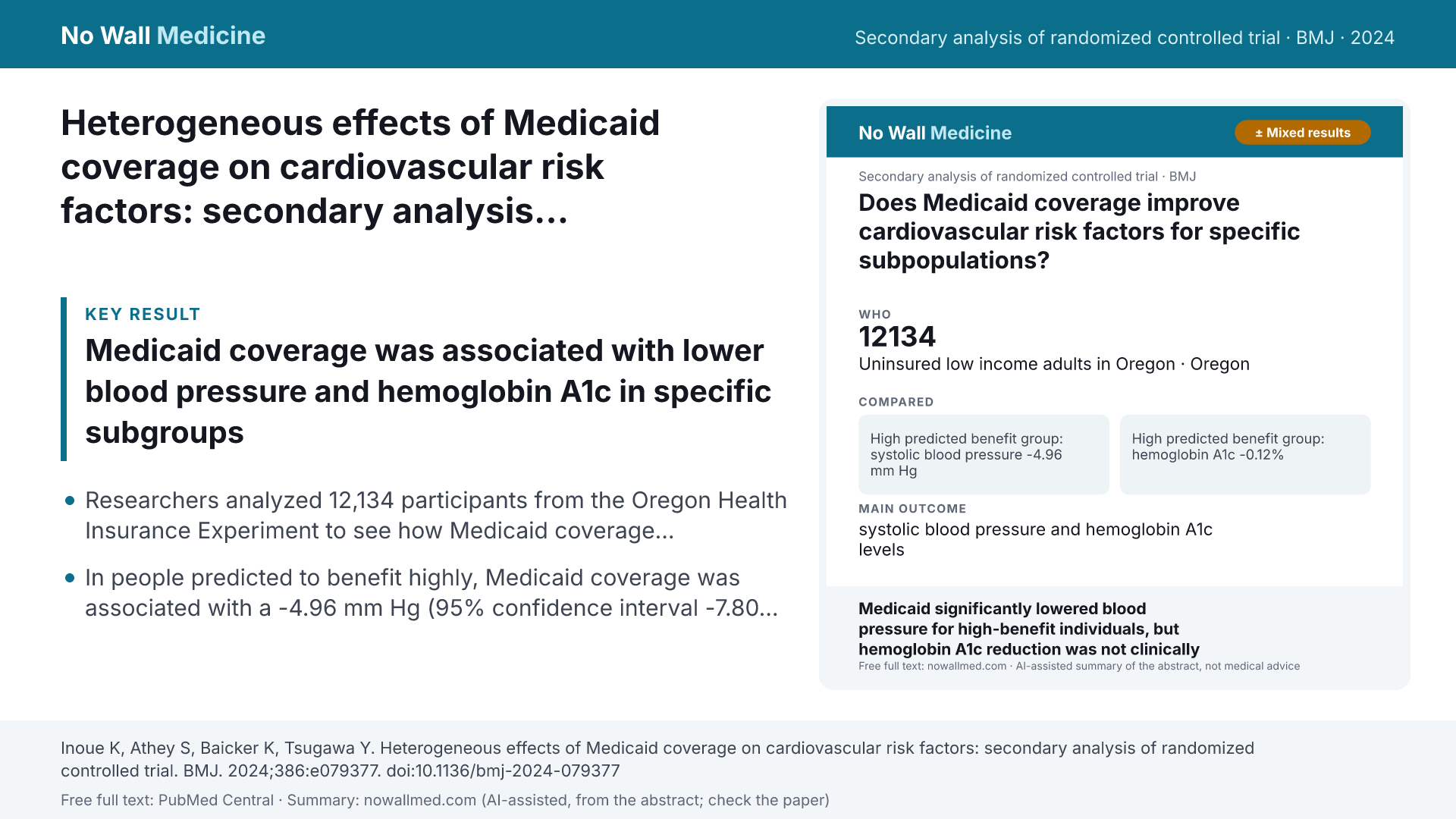
Medicaid coverage was associated with lower blood pressure and hemoglobin A1c in specific subgroups
Heterogeneous effects of Medicaid coverage on cardiovascular risk factors: secondary analysis of randomized controlled trial
Secondary analysis of randomized controlled trialMixed results
Does Medicaid coverage improve cardiovascular risk factors for specific subpopulations?
Who
12134
Uninsured low income adults in Oregon · Oregon
Compared
High predicted benefit group: systolic blood pressure -4.96 mm Hg
High predicted benefit group: hemoglobin A1c -0.12%
Main outcome
systolic blood pressure and hemoglobin A1c levels
Result: -4.96 mm Hg (95% confidence interval -7.80 to -2.48)
Bottom line: Medicaid significantly lowered blood pressure for high-benefit individuals, but hemoglobin A1c reduction was not clinically meaningful.
BMJ · 2024-09-23Download image
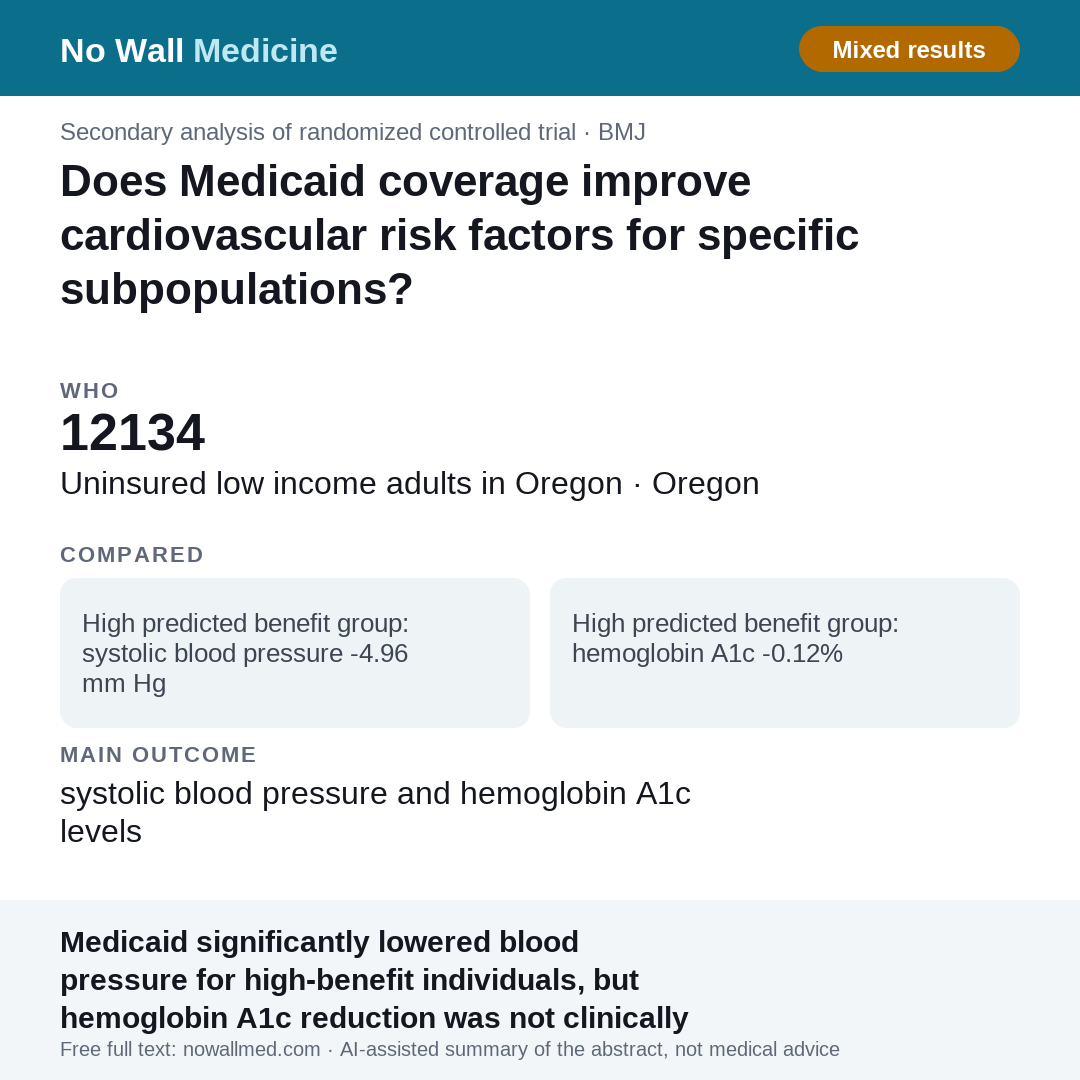
Clinical question: Does Medicaid coverage improve cardiovascular risk factors for specific subpopulations?
Why it matters: It is unclear if Medicaid coverage improves cardiovascular risk factors for all individuals or if benefits are concentrated in specific subpopulations.
Key points
- Researchers analyzed 12,134 participants from the Oregon Health Insurance Experiment to see how Medicaid coverage affected blood pressure and hemoglobin A1c, a measure of long-term blood sugar.
- In people predicted to benefit highly, Medicaid coverage was associated with a -4.96 mm Hg (95% confidence interval -7.80 to -2.48) reduction in systolic blood pressure.
- For the same high-benefit group, Medicaid coverage was associated with a -0.12% (-0.25% to -0.01%) reduction in hemoglobin A1c, though the size was not clinically meaningful.
Headline and key points written with AI from the paper’s abstract, with every number checked against it. Read the paper before relying on them.
Was this summary helpful?
Abstract
Objectives
To investigate whether health insurance generated improvements in cardiovascular risk factors (blood pressure and hemoglobin A1c (HbA1c) levels) for identifiable subpopulations, and using machine learning to identify characteristics of people predicted to benefit highly. Design
Secondary analysis of randomized controlled trial. Setting
Medicaid insurance coverage in 2008 for adults on low incomes (defined as lower than the federal-defined poverty line) in Oregon who were uninsured. Participants
12 134 participants from the Oregon Health Insurance Experiment with in-person data for health outcomes for both treatment and control groups. Interventions
Health insurance (Medicaid) coverage. Main outcomes measures
The conditional local average treatment effects of Medicaid coverage on systolic blood pressure and HbA1c using a machine learning causal forest algorithm (with instrumental variables). Characteristics of individuals with positive predicted benefits of Medicaid coverage based on the algorithm were compared with the characteristics of others. The effect of Medicaid coverage was calculated on blood pressure and HbA1c among individuals with high predicted benefits. Results
In the in-person interview survey, mean systolic blood pressure was 119 (standard deviation 17) mm Hg and mean HbA1c concentrations was 5.3% (standard deviation 0.6%). Our causal forest model showed heterogeneity in the effect of Medicaid coverage on systolic blood pressure and HbA1c. Individuals with lower baseline healthcare charges, for example, had higher predicted benefits from gaining Medicaid coverage. Medicaid coverage significantly lowered systolic blood pressure (-4.96 mm Hg (95% confidence interval -7.80 to -2.48)) for people predicted to benefit highly. HbA1c was also significantly reduced by Medicaid coverage for people with high predicted benefits, but the size was not clinically meaningful (-0.12% (-0.25% to -0.01%)). Conclusions
Although Medicaid coverage did not improve cardiovascular risk factors on average, substantial heterogeneity was noted in the effects within that population. Individuals with high predicted benefits were more likely to have no or low prior healthcare charges, for example. Our findings suggest that Medicaid coverage leads to improved cardiovascular risk factors for some, particularly for blood pressure, although those benefits may be diluted by individuals who did not experience benefits.
Abstract reproduced under the article’s CC BY NC licence.
Subject terms
Cite this article
Inoue K, Athey S, Baicker K, Tsugawa Y. Heterogeneous effects of Medicaid coverage on cardiovascular risk factors: secondary analysis of randomized controlled trial. BMJ. 2024. doi:10.1136/bmj-2024-079377
Spotted a mistake? Suggest a correction