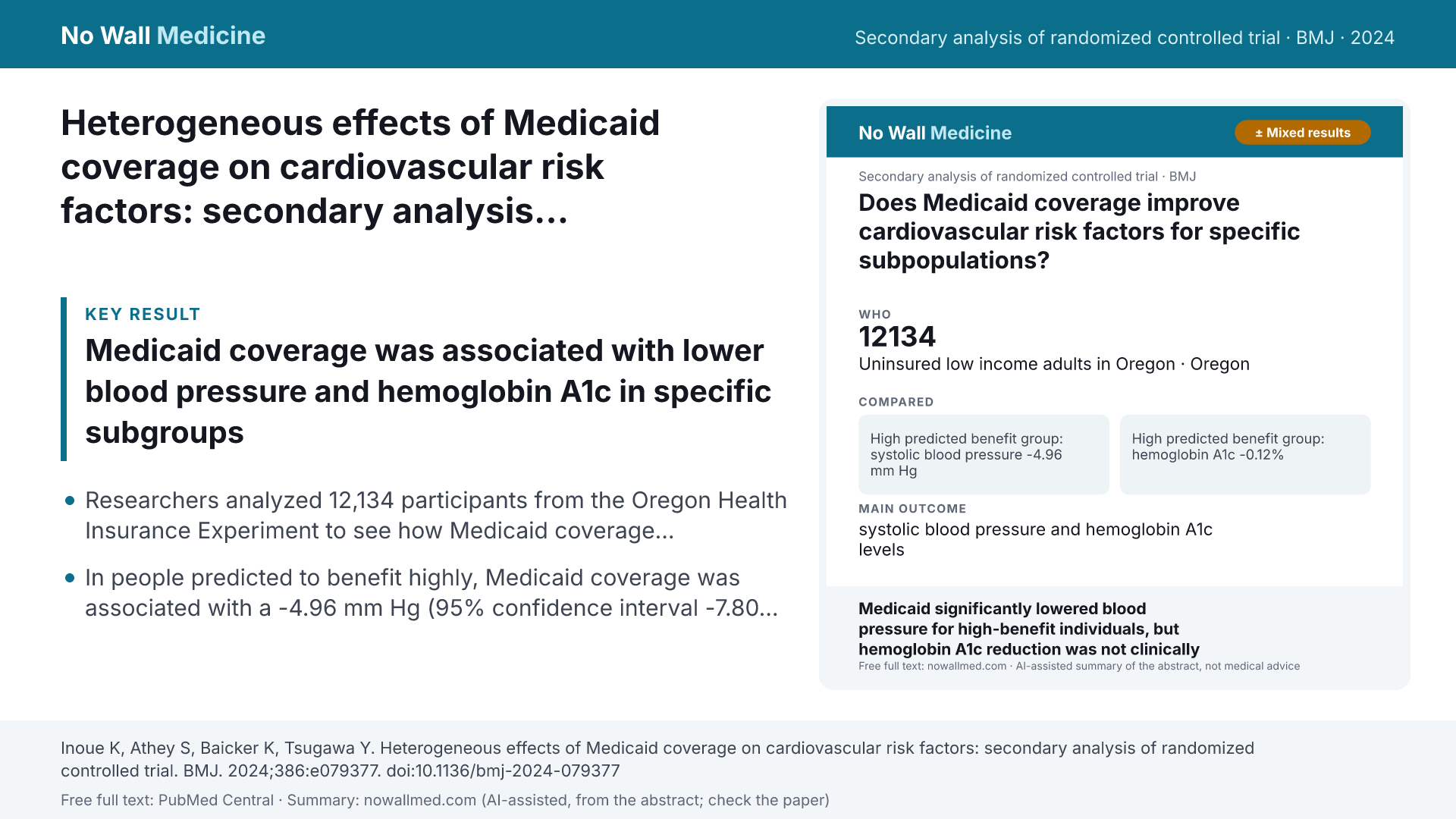
Heterogeneous effects of Medicaid coverage on cardiovascular risk factors: secondary analysis of randomized controlled trial
Key result: Medicaid coverage was associated with lower blood pressure and hemoglobin A1c in specific subgroups
Secondary analysis of randomized controlled trialMixed results
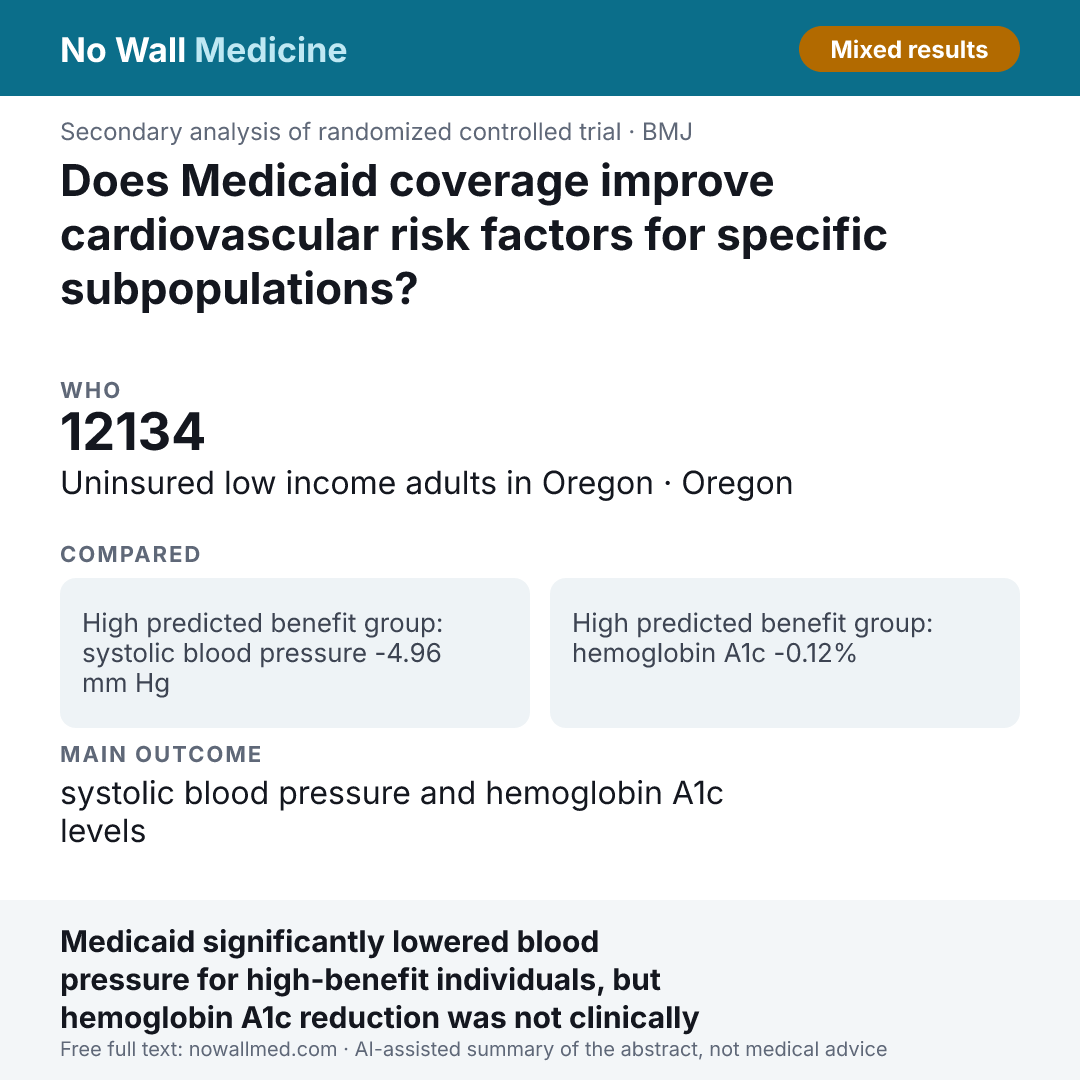
Does Medicaid coverage improve cardiovascular risk factors for specific subpopulations?
Who
12134
Uninsured low income adults in Oregon · Oregon
Compared
High predicted benefit group: systolic blood pressure -4.96 mm Hg
High predicted benefit group: hemoglobin A1c -0.12%
Main outcome
systolic blood pressure and hemoglobin A1c levels
Result: -4.96 mm Hg (95% confidence interval -7.80 to -2.48)
Bottom line: Medicaid significantly lowered blood pressure for high-benefit individuals, but hemoglobin A1c reduction was not clinically meaningful.
BMJ · 2024-09-23 · Save PNG
Key points
- Researchers analyzed 12,134 participants from the Oregon Health Insurance Experiment to see how Medicaid coverage affected blood pressure and hemoglobin A1c, a measure of long-term blood sugar.
- In people predicted to benefit highly, Medicaid coverage was associated with a -4.96 mm Hg (95% confidence interval -7.80 to -2.48) reduction in systolic blood pressure.
- For the same high-benefit group, Medicaid coverage was associated with a -0.12% (-0.25% to -0.01%) reduction in hemoglobin A1c, though the size was not clinically meaningful.
Discussion prompts
- Would these patients look like yours? Who was left out?
- Is the main outcome one that matters to patients?
- Is the difference large enough to change what you do?
Cite: Inoue K, Athey S, Baicker K, Tsugawa Y. Heterogeneous effects of Medicaid coverage on cardiovascular risk factors: secondary analysis of randomized controlled trial. BMJ. 2024;386:e079377. doi:10.1136/bmj-2024-079377
Free full text: PubMed Central · Summary and visual abstract: nowallmed.com/a/heterogeneous-effects-of-medicaid-coverage-on-cardiovascular-risk-16oj3za/ (AI-assisted from the abstract; check the paper before relying on it).