High Body Mass Index and Response to Anti-Tumor Necrosis Factor Therapy in Pediatric Crohn's Disease
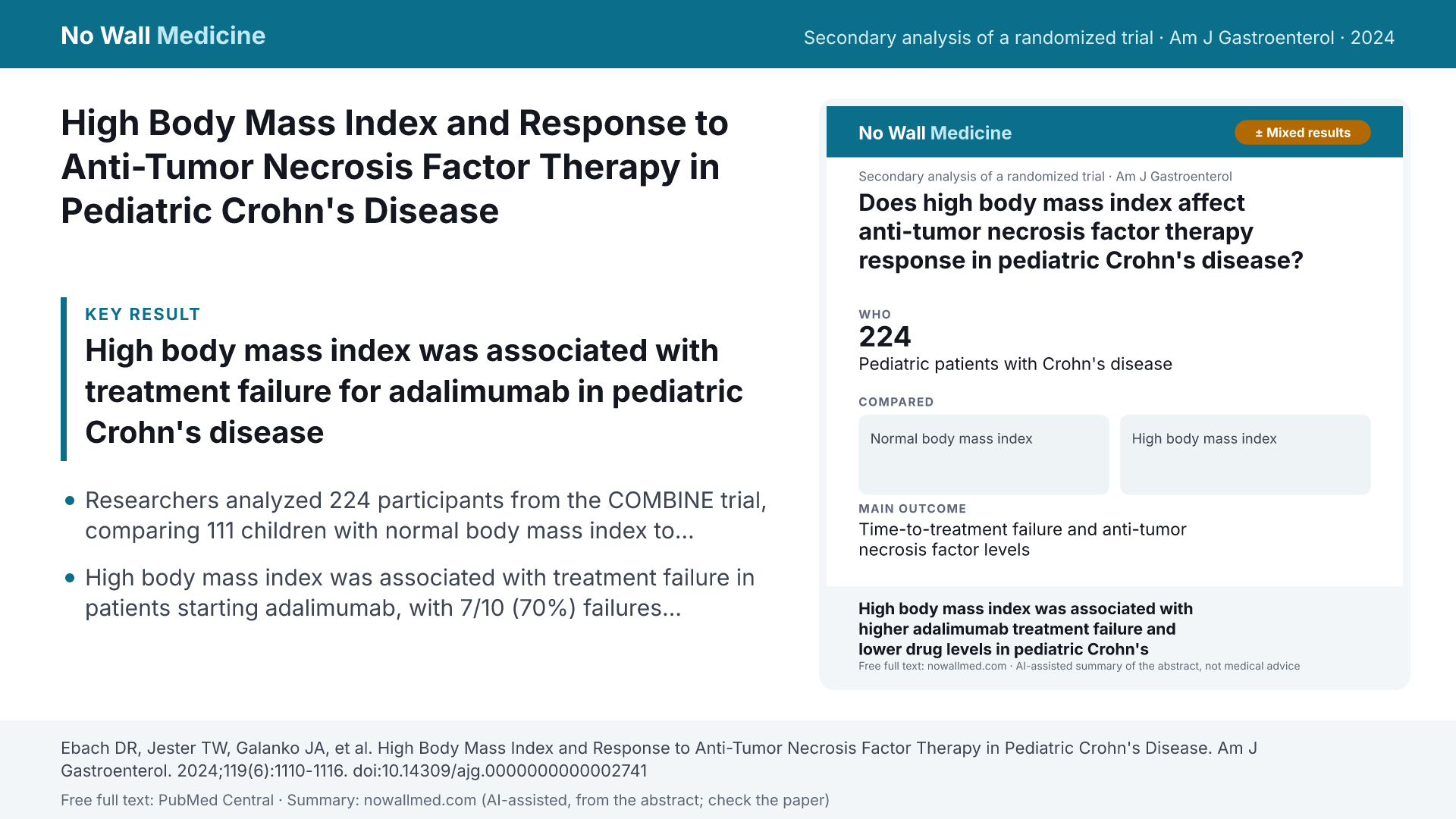
Key result: High body mass index was associated with treatment failure for adalimumab in pediatric Crohn's disease
Secondary analysis of a randomized trialMixed results
Does high body mass index affect anti-tumor necrosis factor therapy response in pediatric Crohn's disease?
Who
224
Pediatric patients with Crohn's disease
Compared
Normal body mass index
High body mass index
Main outcome
Time-to-treatment failure and anti-tumor necrosis factor levels
Result: hazard ratio 0.29, P = 0.007
Bottom line: High body mass index was associated with higher adalimumab treatment failure and lower drug levels in pediatric Crohn's disease.
Am J Gastroenterol · 2024-03-06
Key points
- Researchers analyzed 224 participants from the COMBINE trial, comparing 111 children with normal body mass index to 43 children with a high body mass index.
- High body mass index was associated with treatment failure in patients starting adalimumab, with 7/10 (70%) failures compared to 12/52 (23%) in those with normal body mass index.
- Patients using adalimumab with a high body mass index had lower median drug levels of 5.8 μg/mL compared to 12.8 μg/mL in those with normal body mass index.
Discussion prompts
- Would these patients look like yours? Who was left out?
- Is the main outcome one that matters to patients?
- Is the difference large enough to change what you do?
Cite: Ebach DR, Jester TW, Galanko JA, et al. High Body Mass Index and Response to Anti-Tumor Necrosis Factor Therapy in Pediatric Crohn's Disease. Am J Gastroenterol. 2024;119(6):1110-1116. doi:10.14309/ajg.0000000000002741
Free full text: PubMed Central · Summary and visual abstract: nowallmed.com/a/high-body-mass-index-and-response-to-anti-tumor-necrosis-factor-13a5mly/ (AI-assisted from the abstract; check the paper before relying on it).