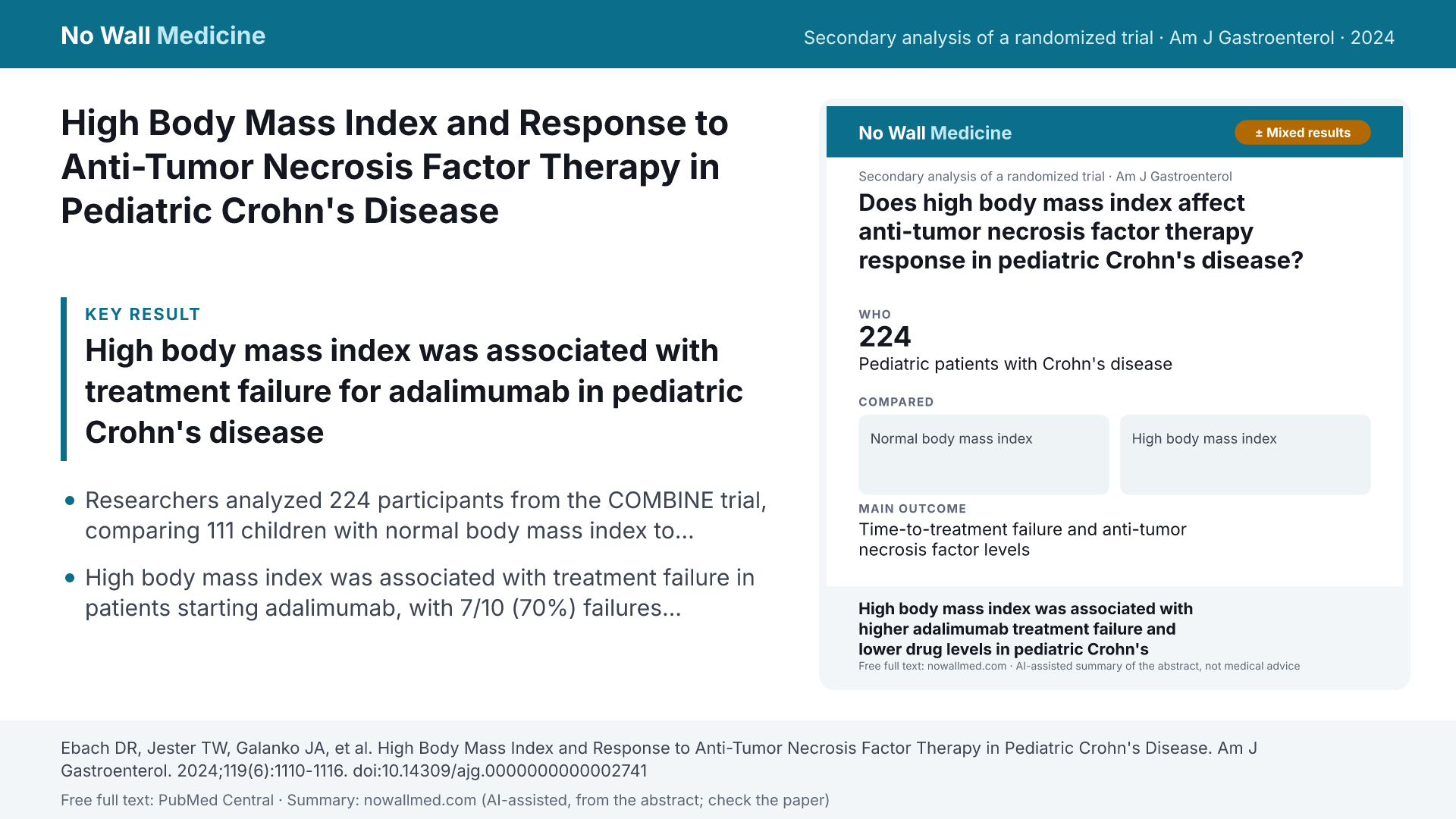
High body mass index was associated with treatment failure for adalimumab in pediatric Crohn's disease
High Body Mass Index and Response to Anti-Tumor Necrosis Factor Therapy in Pediatric Crohn's Disease
Secondary analysis of a randomized trialMixed results
Does high body mass index affect anti-tumor necrosis factor therapy response in pediatric Crohn's disease?
Who
224
Pediatric patients with Crohn's disease
Compared
Normal body mass index
High body mass index
Main outcome
Time-to-treatment failure and anti-tumor necrosis factor levels
Result: hazard ratio 0.29, P = 0.007
Bottom line: High body mass index was associated with higher adalimumab treatment failure and lower drug levels in pediatric Crohn's disease.
Am J Gastroenterol · 2024-03-06Download image

Clinical question: Does high body mass index affect anti-tumor necrosis factor therapy response in pediatric Crohn's disease?
Key points
- Researchers analyzed 224 participants from the COMBINE trial, comparing 111 children with normal body mass index to 43 children with a high body mass index.
- High body mass index was associated with treatment failure in patients starting adalimumab, with 7/10 (70%) failures compared to 12/52 (23%) in those with normal body mass index.
- Patients using adalimumab with a high body mass index had lower median drug levels of 5.8 μg/mL compared to 12.8 μg/mL in those with normal body mass index.
Headline and key points written with AI from the paper’s abstract, with every number checked against it. Read the paper before relying on them.
Was this summary helpful?
Subject terms
Headline, design, result, key points, caveat and citation as plain text.
Cite this article
Ebach DR, Jester TW, Galanko JA, et al. High Body Mass Index and Response to Anti-Tumor Necrosis Factor Therapy in Pediatric Crohn's Disease. Am J Gastroenterol. 2024;119(6):1110-1116. doi:10.14309/ajg.0000000000002741
Spotted a mistake? Suggest a correction