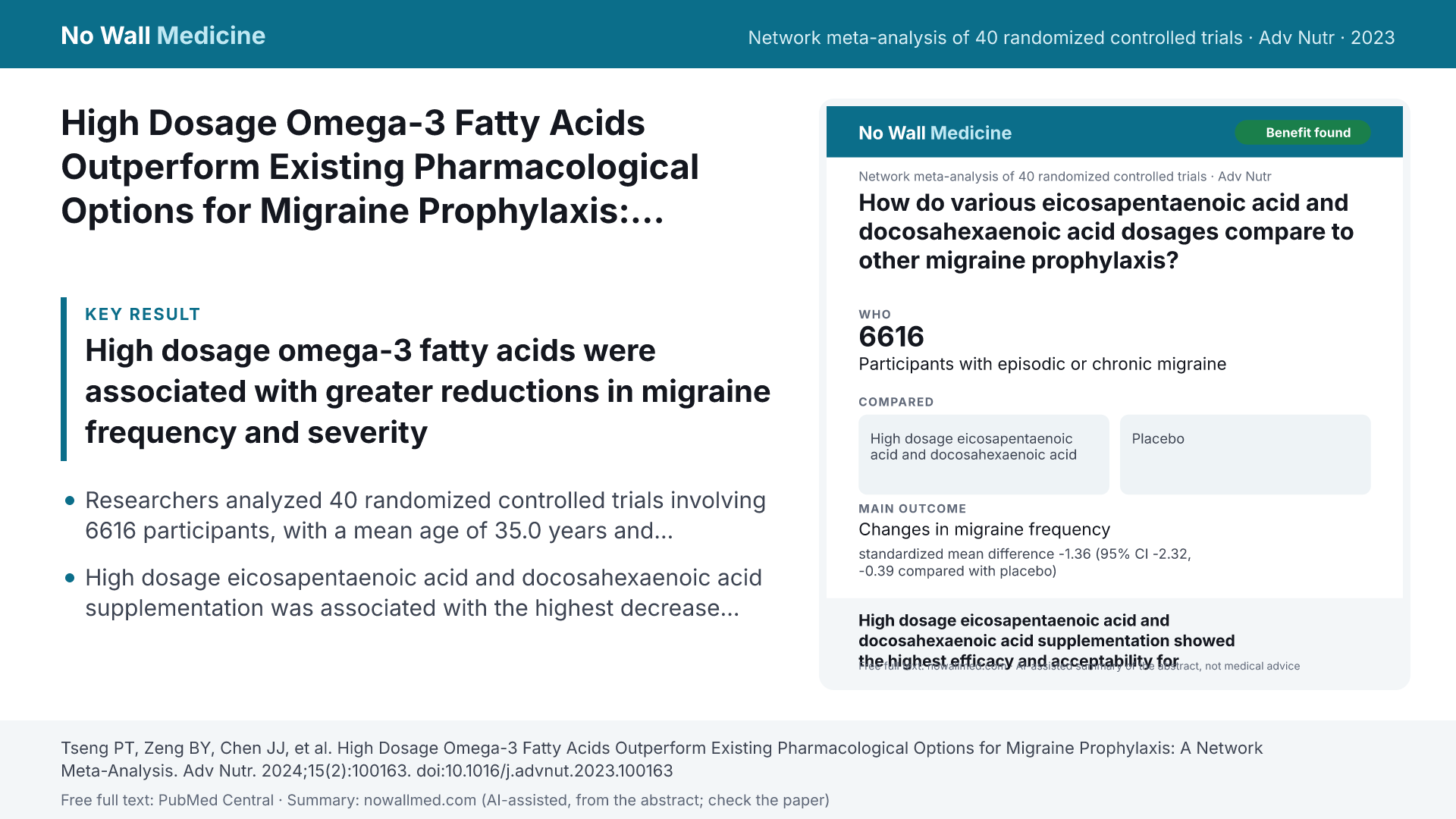
High dosage omega-3 fatty acids were associated with greater reductions in migraine frequency and severity
High Dosage Omega-3 Fatty Acids Outperform Existing Pharmacological Options for Migraine Prophylaxis: A Network Meta-Analysis
Network meta-analysis of 40 randomized controlled trialsBenefit found
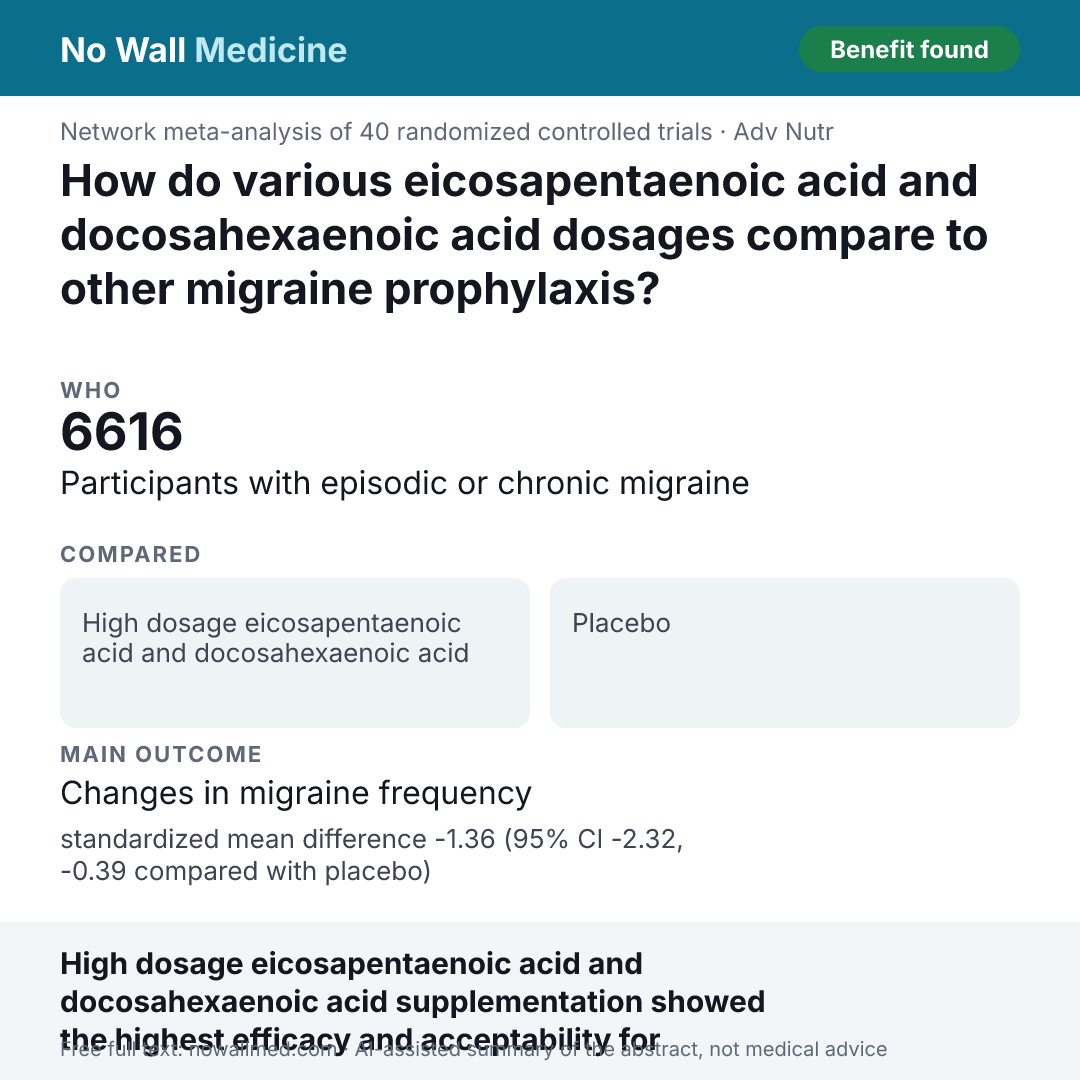
How do various eicosapentaenoic acid and docosahexaenoic acid dosages compare to other migraine prophylaxis?
Who
6616
Participants with episodic or chronic migraine
Compared
High dosage eicosapentaenoic acid and docosahexaenoic acid
Placebo
Main outcome
Changes in migraine frequency
Result: standardized mean difference -1.36 (95% CI -2.32, -0.39 compared with placebo)
Bottom line: High dosage eicosapentaenoic acid and docosahexaenoic acid supplementation showed the highest efficacy and acceptability for migraine prophylaxis.
Adv Nutr · 2023-12-16 · Save PNG
Clinical question: How do various eicosapentaenoic acid and docosahexaenoic acid dosages compare to other migraine prophylaxis?
Why it matters: Current migraine prevention drugs have limited efficacy and acceptability, with response rates only between 40% and 50%.
Key points
- Researchers analyzed 40 randomized controlled trials involving 6616 participants, with a mean age of 35.0 years and 78.9% women.
- High dosage eicosapentaenoic acid and docosahexaenoic acid supplementation was associated with the highest decrease in migraine frequency (SMD: -1.36; 95% CI: -2.32, -0.39) and severity (SMD: -2.23; 95% CI: -3.17, -1.30) compared to placebo.
- High dosage omega-3 fatty acids were associated with the most favorable acceptability rates (odds ratio: 1.00; 95% CI: 0.06, 17.41) compared to placebo.
Headline and key points written with AI from the paper’s abstract, with every number checked against it. Read the paper before relying on them.
Was this summary helpful?
Subject terms
Headline, design, result, key points, caveat and citation as plain text.
Cite this article
Tseng PT, Zeng BY, Chen JJ, et al. High Dosage Omega-3 Fatty Acids Outperform Existing Pharmacological Options for Migraine Prophylaxis: A Network Meta-Analysis. Adv Nutr. 2024;15(2):100163. doi:10.1016/j.advnut.2023.100163
Spotted a mistake? Suggest a correction