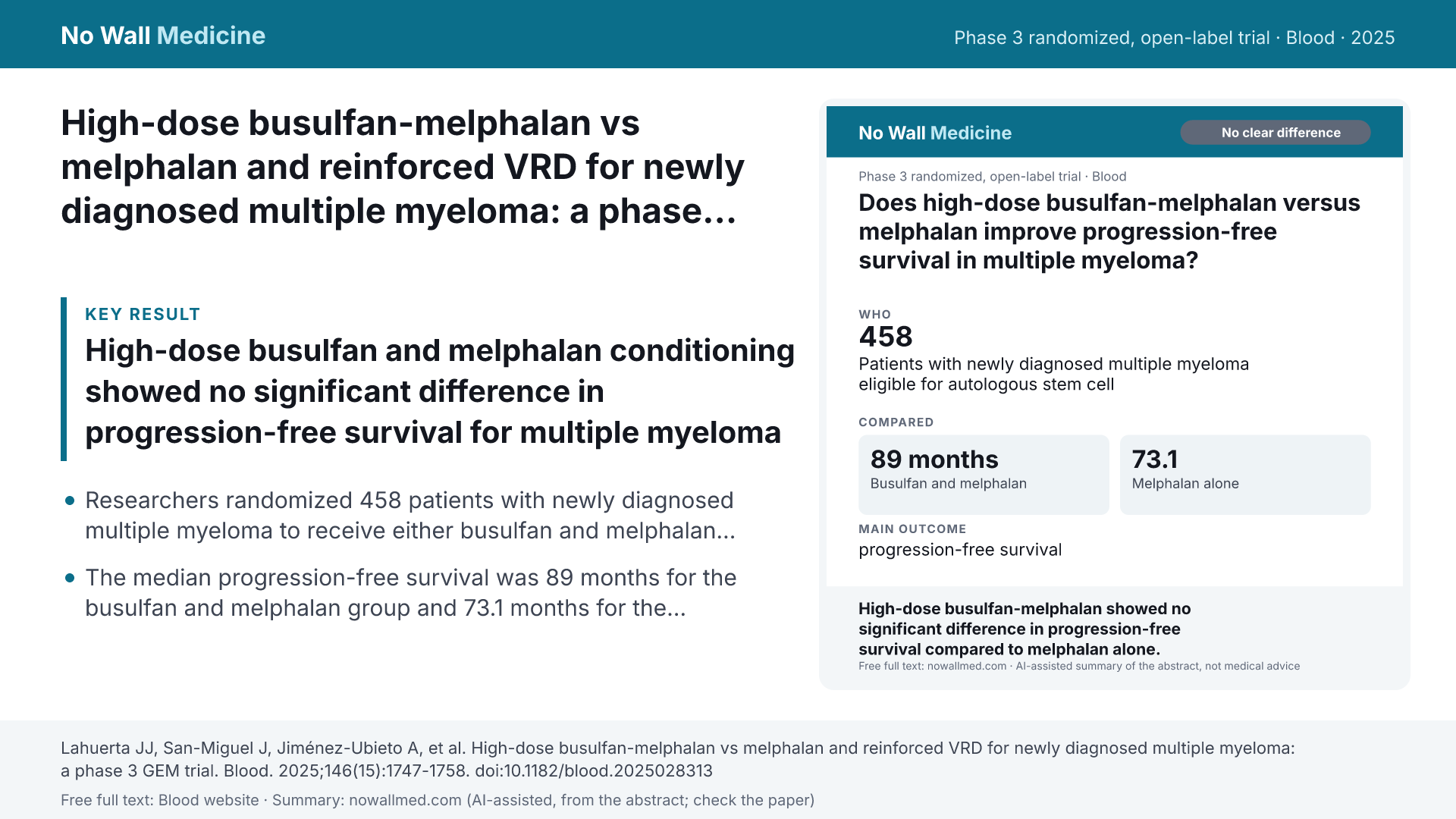
High-dose busulfan and melphalan conditioning showed no significant difference in progression-free survival for multiple myeloma
High-dose busulfan-melphalan vs melphalan and reinforced VRD for newly diagnosed multiple myeloma: a phase 3 GEM trial
Phase 3 randomized, open-label trialNo clear difference
Does high-dose busulfan-melphalan versus melphalan improve progression-free survival in multiple myeloma?
Who
458
Patients with newly diagnosed multiple myeloma eligible for autologous stem cell transplantation
Compared
89 monthsBusulfan and melphalan
73.1Melphalan alone
Main outcome
progression-free survival
Result: hazard ratio 0.89 (95% confidence interval, 0.70-1.14)
Bottom line: High-dose busulfan-melphalan showed no significant difference in progression-free survival compared to melphalan alone.
Blood · 2025-06-11Download image
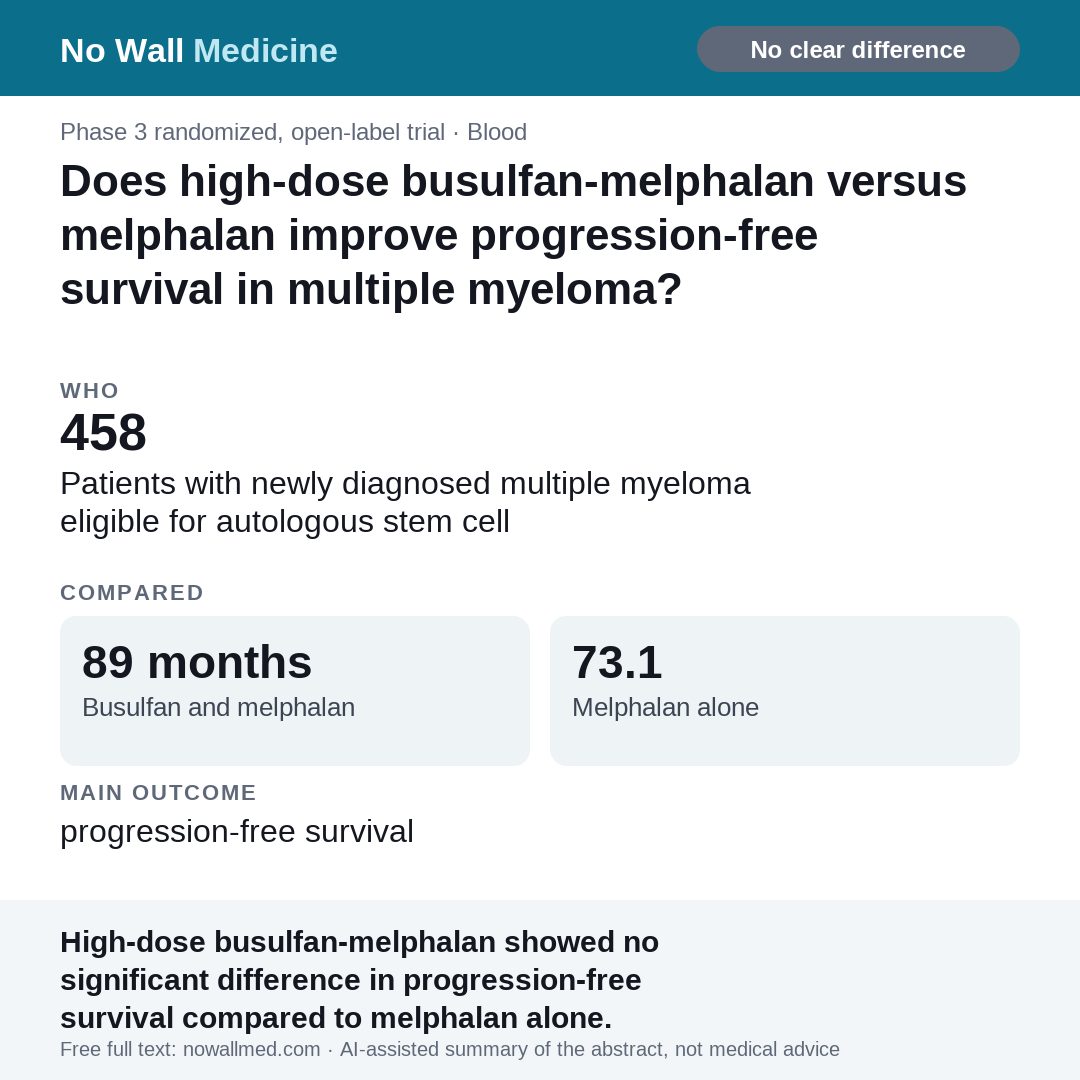
Clinical question: Does high-dose busulfan-melphalan versus melphalan improve progression-free survival in multiple myeloma?
Why it matters: It was unknown if adding busulfan to melphalan conditioning during stem cell transplantation improves long-term outcomes when combined with intensified induction and consolidation therapies.
Key points
- Researchers randomized 458 patients with newly diagnosed multiple myeloma to receive either busulfan and melphalan or melphalan alone after intensive drug therapy and stem cell transplantation.
- The median progression-free survival was 89 months for the busulfan and melphalan group and 73.1 months for the melphalan alone group, which was not a statistically significant difference.
- The rate of reaching minimal residual disease negativity, which means very few cancer cells remain, was 63% for busulfan and melphalan versus 58% for melphalan alone.
Headline and key points written with AI from the paper’s abstract, with every number checked against it. Read the paper before relying on them.
Was this summary helpful?
Subject terms
Cite this article
Lahuerta JJ, San-Miguel J, Jiménez-Ubieto A, et al. High-dose busulfan-melphalan vs melphalan and reinforced VRD for newly diagnosed multiple myeloma: a phase 3 GEM trial. Blood. 2025. doi:10.1182/blood.2025028313
Spotted a mistake? Suggest a correction