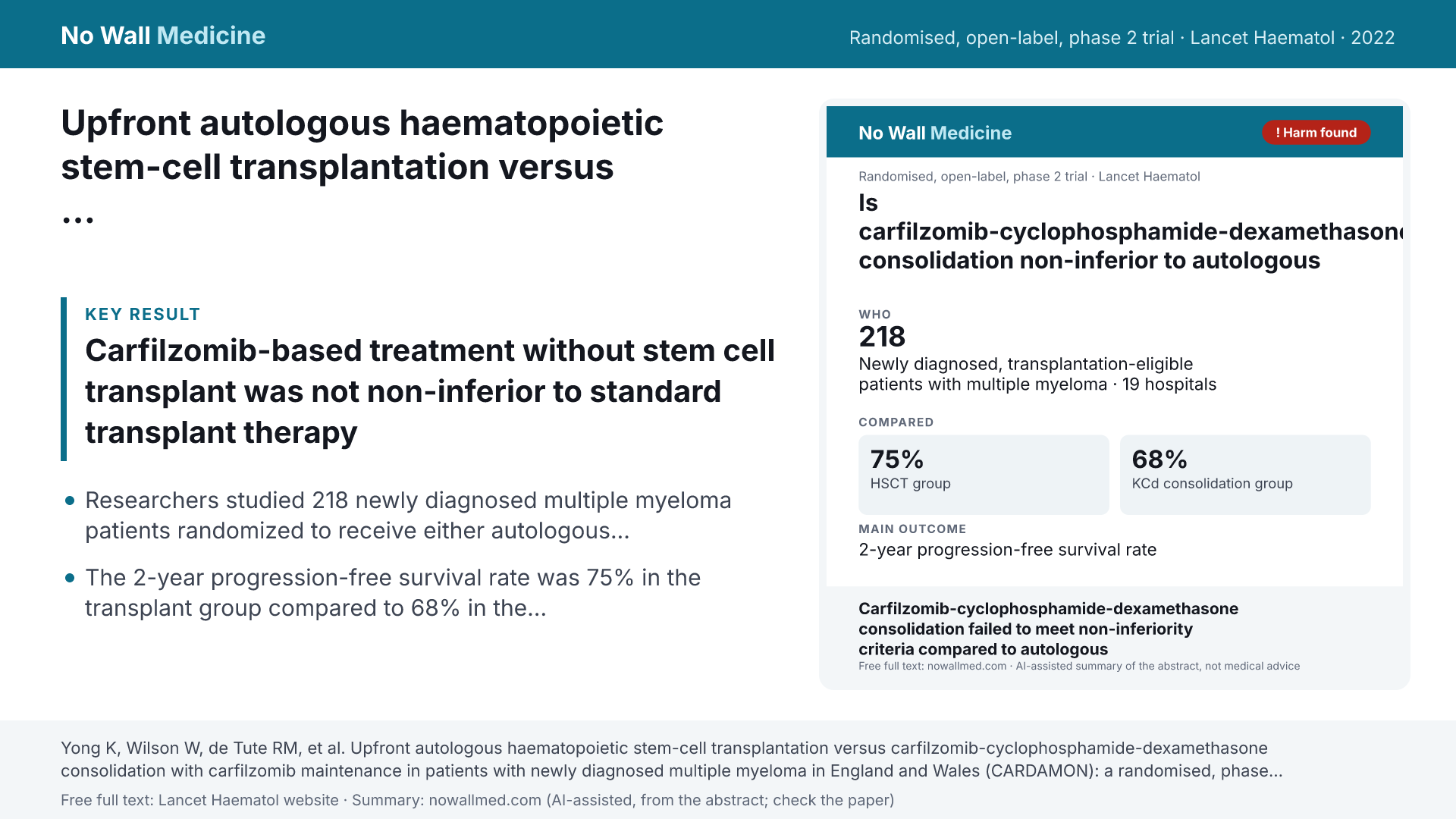
Carfilzomib-based treatment without stem cell transplant was not non-inferior to standard transplant therapy
Upfront autologous haematopoietic stem-cell transplantation versus carfilzomib-cyclophosphamide-dexamethasone consolidation with carfilzomib maintenance in patients with newly diagnosed multiple myeloma in England and Wales (CARDAMON): a randomised, phase 2, non-inferiority trial
Randomised, open-label, phase 2 trialHarm found
Is carfilzomib-cyclophosphamide-dexamethasone consolidation non-inferior to autologous haematopoietic stem-cell transplantation?
Who
218
Newly diagnosed, transplantation-eligible patients with multiple myeloma · 19 hospitals in England and Wales, UK
Compared
75%HSCT group (95% CI 65 to 82)
68%KCd consolidation group (95% CI 58 to 76)
Main outcome
2-year progression-free survival rate
Result: difference -7.2%, 70% CI -11.1 to -2.8
Bottom line: Carfilzomib-cyclophosphamide-dexamethasone consolidation failed to meet non-inferiority criteria compared to autologous haematopoietic stem-cell transplantation.
Lancet Haematol · 2022-12-15Download image
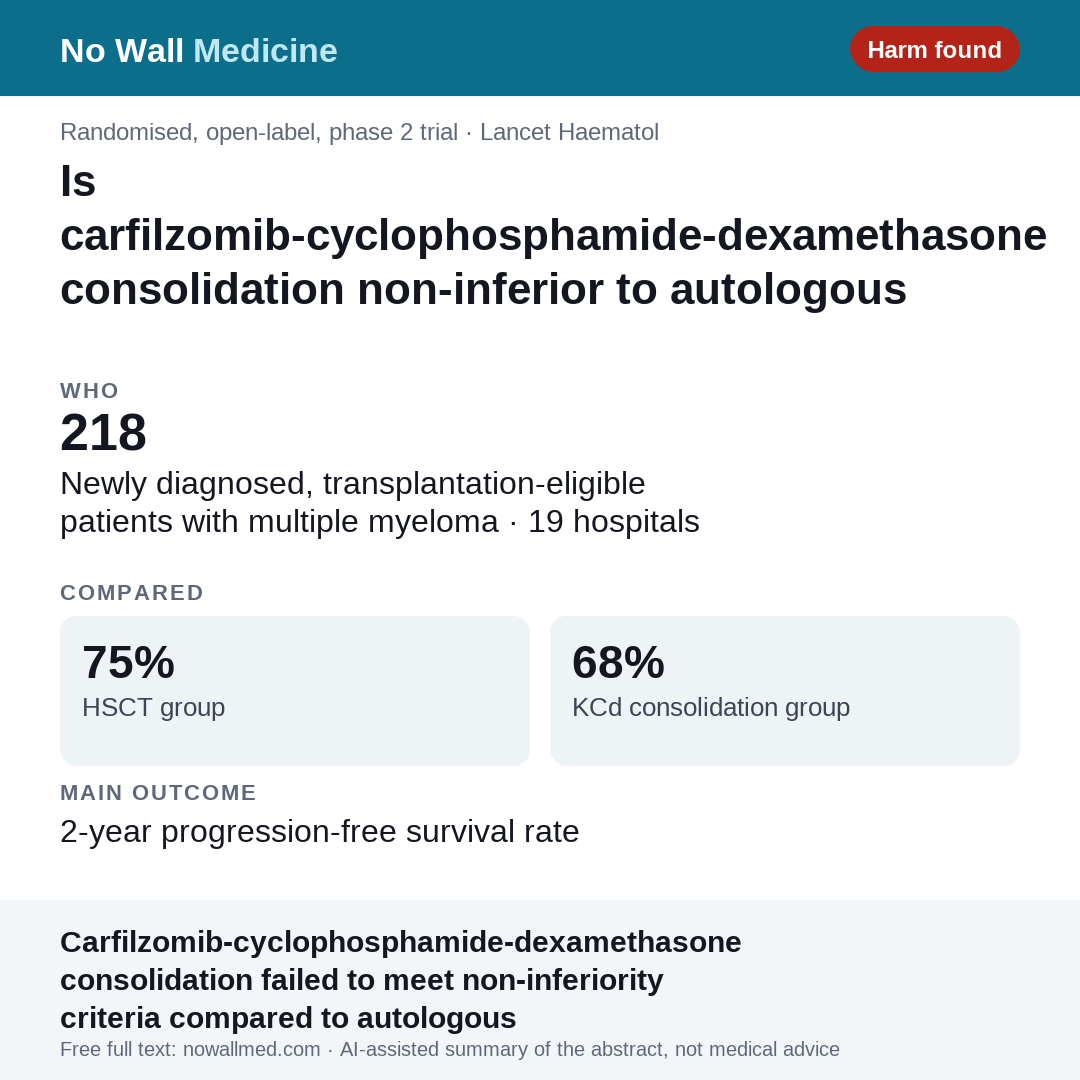
Clinical question: Is carfilzomib-cyclophosphamide-dexamethasone consolidation non-inferior to autologous haematopoietic stem-cell transplantation?
Why it matters: It was unknown if an immunomodulatory-free carfilzomib-based protocol without autologous haematopoietic stem-cell transplantation is non-inferior to the standard-of-care transplant regimen.
Key points
- Researchers studied 218 newly diagnosed multiple myeloma patients randomized to receive either autologous haematopoietic stem-cell transplantation or carfilzomib, cyclophosphamide, and dexamethasone consolidation.
- The 2-year progression-free survival rate was 75% in the transplant group compared to 68% in the carfilzomib-based group, which did not meet the non-inferiority margin.
- Common severe side effects included low white blood cell counts and infections during induction, and high blood pressure or infections during maintenance therapy.
Headline and key points written with AI from the paper’s abstract, with every number checked against it. Read the paper before relying on them.
Was this summary helpful?
Abstract
Background
Standard-of-care treatment for patients with newly diagnosed multiple myeloma is bortezomib-based induction followed by high-dose melphalan and autologous haematopoietic stem-cell transplantation (HSCT) and lenalidomide maintenance. We aimed to evaluate whether an immunomodulatory-free carfilzomib-based induction, consolidation, and maintenance protocol without autologous HSCT was non-inferior to the same induction regimen followed by autologous HSCT and maintenance. Methods
CARDAMON is a randomised, open-label, phase 2 trial in 19 hospitals in England and Wales, UK. Newly diagnosed, transplantation-eligible patients with multiple myeloma aged 18 years or older with an Eastern Cooperative Oncology Group (ECOG) performance status of 0-2 received four 28-day cycles of carfilzomib (56 mg/m2 intravenously on days 1, 2, 8, 9, 15, and 16), cyclophosphamide (500 mg orally on days 1, 8, and 15), and dexamethasone (40 mg orally on days 1, 8, 15, and 22; KCd), followed by peripheral blood stem cell mobilisation. Patients with at least a partial response were randomly assigned (1:1) to either high-dose melphalan and autologous HSCT or four cycles of KCd. All randomised patients received 18 cycles of carfilzomib maintenance (56 mg/m2 intravenously on days 1, 8, and 15). The primary outcomes were the proportion of patients with at least a very good partial response after induction and difference in progression-free survival rate at 2 years from randomisation (non-inferiority margin 10%), both assessed by intention to treat. Safety was assessed in all patients who started treatment. The trial is registered with ClinicalTrials.gov (NCT02315716); recruitment is complete and all patients are in follow-up. Findings
Between June 16, 2015, and July 8, 2019, 281 patients were enrolled, with 218 proceeding to randomisation (109 assigned to the KCd consolidation group [99 of whom completed consolidation] and 109 to the HSCT group [104 of whom underwent transplantation]). A further seven patients withdrew before initiation of carfilzomib maintenance (two in the KCd consolidation group vs five in the HSCT group). Median age was 59 years (IQR 52 to 64); 166 (59%) of 281 patients were male and 115 (41%) were female. 152 (71%) of 214 patients with known ethnicity were White, 37 (17%) were Black, 18 (8%) were Asian, 5 (2%) identified as Mixed, and 2 (1%) identified as other. Median follow-up from randomisation was 40·2 months (IQR 32·7 to 51·8). After induction, 162 (57·7%; 95% CI 51·6 to 63·5) of 281 patients had at least a very good partial response. The 2-year progression-free survival was 75% (95% CI 65 to 82) in the HSCT group versus 68% (95% CI 58 to 76) in the KCd group (difference -7·2%, 70% CI -11·1 to -2·8), exceeding the non-inferiority margin. The most common grade 3-4 events during KCd induction and consolidation were lymphocytopenia (72 [26%] of 278 patients who started induction; 15 [14%] of 109 patients who started consolidation) and infection (50 [18%] of 278 for induction; 15 [14%] of 109 for consolidation), and during carfilzomib maintenance were hypertension (20 [21%] of 97 patients in the KCd consolidation group vs 23 [23%] of 99 patients in the HSCT group) and infection (16 [16%] of 97 patients vs 25 [25%] of 99). Treatment-related serious adverse events at any point during the trial were reported in 109 (39%) of 278 patients who started induction, with infections (80 [29%]) being the most common. Treatment-emergent deaths were reported in five (2%) of 278 patients during induction (three from infection, one from cardiac event, and one from renal failure) and one of 99 patients during maintenance after autologous HSCT (oesophageal carcinoma). Interpretation
KCd did not meet the criteria for non-inferiority compared with autologous HSCT, but the marginal difference in progression-free survival suggests that further studies are warranted to explore deferred autologous HSCT in some subgroups, such as individuals who are MRD negative after induction. Funding
Cancer Research UK and Amgen.
Abstract reproduced under the article’s CC BY licence.
Subject terms
Cite this article
Yong K, Wilson W, de Tute RM, Camilleri M, Ramasamy K, Streetly M. Upfront autologous haematopoietic stem-cell transplantation versus carfilzomib-cyclophosphamide-dexamethasone consolidation with carfilzomib maintenance in patients with newly diagnosed multiple myeloma in England and Wales (CARDAMON): a randomised, phase 2, non-inferiority trial. Lancet Haematol. 2022. doi:10.1016/S2352-3026(22)00350-7
Spotted a mistake? Suggest a correction