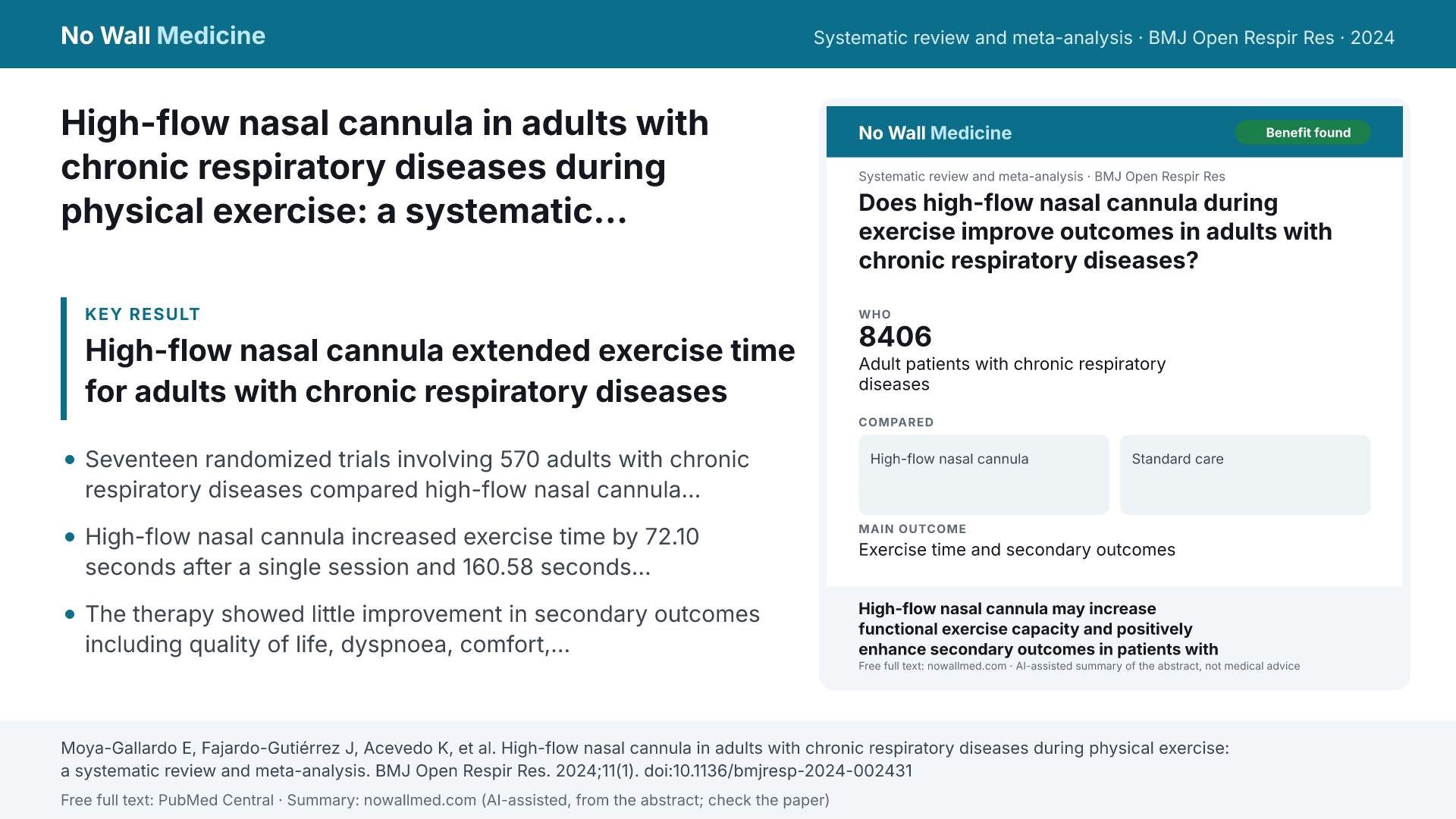
High-flow nasal cannula extended exercise time for adults with chronic respiratory diseases
High-flow nasal cannula in adults with chronic respiratory diseases during physical exercise: a systematic review and meta-analysis
Systematic review and meta-analysisBenefit found
Does high-flow nasal cannula during exercise improve outcomes in adults with chronic respiratory diseases?
Who
8406
Adult patients with chronic respiratory diseases
Compared
High-flow nasal cannula
Standard care
Main outcome
Exercise time and secondary outcomes
Result: weighted mean difference 160.58 s (95% CI 67.32 to 253.83)
Bottom line: High-flow nasal cannula may increase functional exercise capacity and positively enhance secondary outcomes in patients with chronic respiratory diseases.
BMJ Open Respir Res · 2024-10-22 · Save PNG
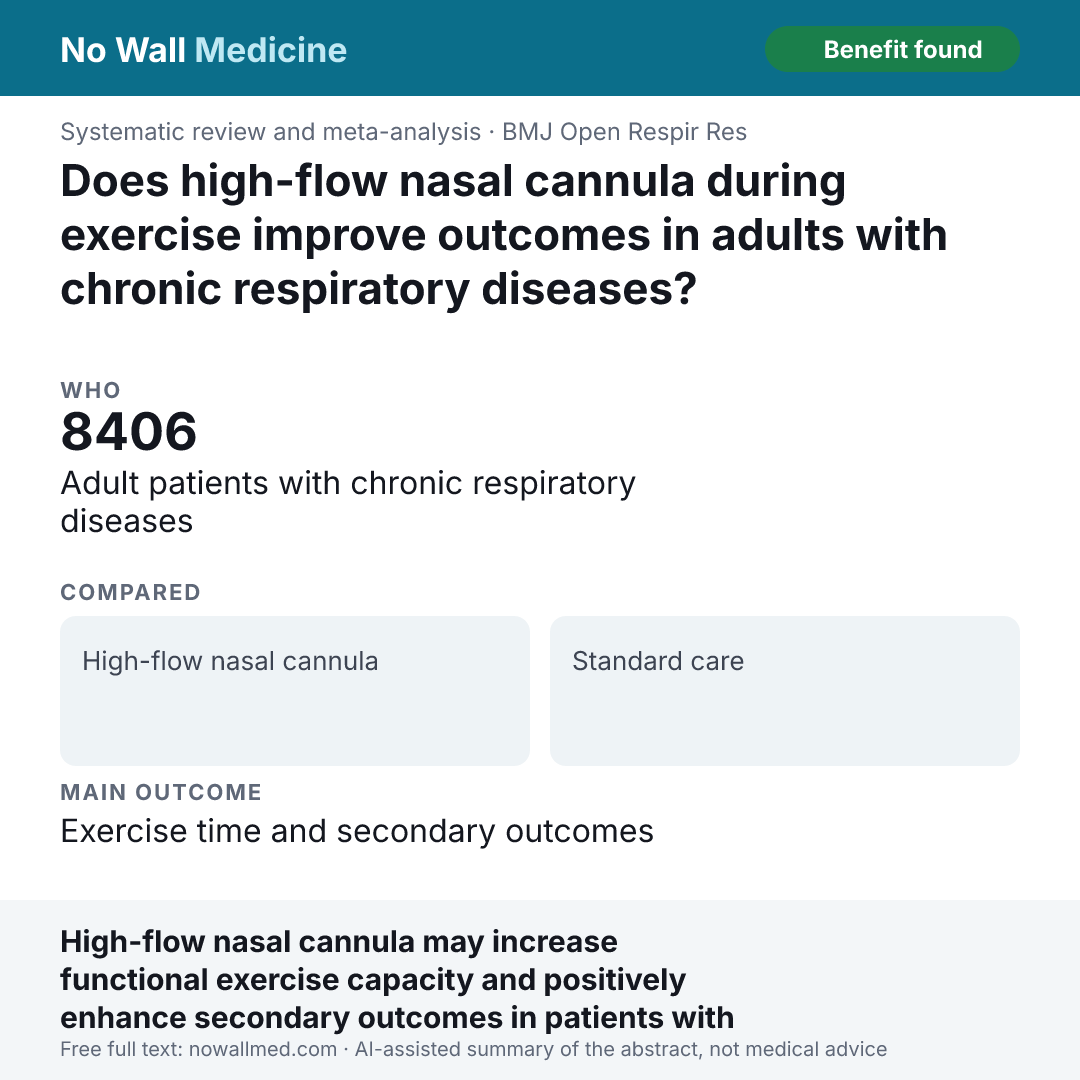
Clinical question: Does high-flow nasal cannula during exercise improve outcomes in adults with chronic respiratory diseases?
Key points
- Seventeen randomized trials involving 570 adults with chronic respiratory diseases compared high-flow nasal cannula with standard care during exercise.
- High-flow nasal cannula increased exercise time by 72.10 seconds after a single session and 160.58 seconds after multiple training sessions.
- The therapy showed little improvement in secondary outcomes including quality of life, dyspnoea, comfort, complications, and adherence.
Limitation the authors note: The evidence suggests that high-flow nasal cannula may result in little improvements in secondary outcomes such as quality of life and dyspnoea.
Headline and key points written with AI from the paper’s abstract, with every number checked against it. Read the paper before relying on them.
Was this summary helpful?
Abstract
Background
Chronic respiratory diseases (CRDs) affect at least 545 million people globally, leading to symptoms such as dyspnoea, fatigue and limited physical activity. Pulmonary rehabilitation (PR) programmes aim to improve the exercise capacity and quality of life of patients with CRD through exercise training. High-flow nasal cannula (HFNC) therapy shows potential as an adjunct treatment during exercise, but its effects on CRD populations are unclear. The purpose of this systematic review was to evaluate the effects of HFNC during exercise in people with CRD. Methods
A systematic review was conducted and eight databases and other resources were searched from inception (28 June 2022) to 4 April 2023. Studies that used adult patients with CRD and randomised controlled trial that compared the effect of HFNC versus standard care (conventional oxygen therapy or room air) during exercise were included. Two authors independently selected trials, extracted the data, assessed risks of bias and employed the GRADE (Grading of Recommendations Assessment, Development, and Evaluation) approach to judging the certainty of evidence. We pooled trials using random-effect models and inverse variance estimation. Results
Seventeen studies (n=8406) were included in the review (570 patients). The evidence suggests that HFNC increases exercise time after multiple training sessions (weighted mean difference (WMD)=160.58 s; 95% 95% CI=67.32-253.83, 2 studies) and increase after a single session (WMD=72.10 s; 95% CI=28.95-115.24, 11 studies). HFNC may result in little improvements in secondary outcomes (quality of life, dyspnoea, comfort, complications and adherence). Discussion
The evidence suggests that HFNC may increase functional exercise capacity and positively enhance secondary outcomes. Continued research is justified to elucidate the role of HFNC in PR during exercise training. Prospero registration number
CRD42022336263.
Abstract reproduced under the article’s CC BY NC licence.
Subject terms
Headline, design, result, key points, caveat and citation as plain text.
Cite this article
Moya-Gallardo E, Fajardo-Gutiérrez J, Acevedo K, et al. High-flow nasal cannula in adults with chronic respiratory diseases during physical exercise: a systematic review and meta-analysis. BMJ Open Respir Res. 2024;11(1). doi:10.1136/bmjresp-2024-002431
Spotted a mistake? Suggest a correction