Automated oxygen titration improved functional capacity and reduced breathlessness during daily activities in COPD patients
Optimised oxygenation improves functional capacity during daily activities in patients with COPD on long-term oxygen therapy: a randomised crossover trial
Double-blinded, randomised crossover trialBenefit found
Does automated oxygen titration improve functional capacity during daily activities in COPD patients?
Who
31
Patients with chronic obstructive pulmonary disease on long-term oxygen therapy
Compared
Automated oxygen titration: median (IQR) 38 (12-73) s reduction in test time
Fixed oxygen flow
Main outcome
Functional capacity of everyday activities using GlittreADL tests
Bottom line: Automated oxygen titration improved functional capacity and reduced dyspnoea during daily activities in COPD patients.
Thorax · 2025-10-15Download image
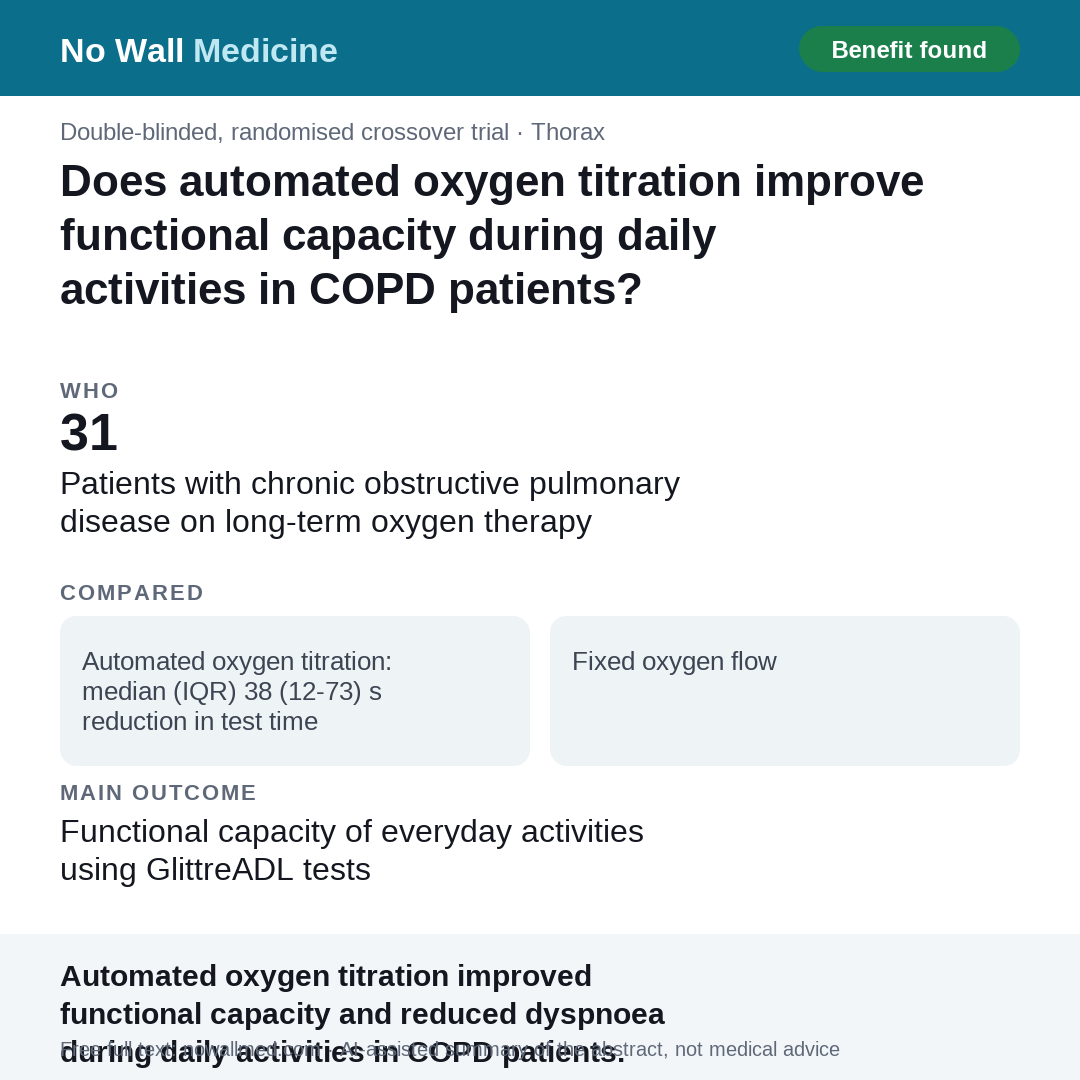
Clinical question: Does automated oxygen titration improve functional capacity during daily activities in COPD patients?
Why it matters: It was unknown if maintaining a specific target oxygen saturation during everyday tasks using automated titration would impact functional capacity compared to conventional fixed oxygen flow.
Key points
- The study involved 31 patients with chronic obstructive pulmonary disease on long-term oxygen therapy who were compared using fixed oxygen flow versus automated titration.
- Using automated titration, patients reduced the time to complete daily activity tests by a median of 38 (12-73) s compared to fixed oxygen flow.
- Automated titration increased the time spent within the target oxygen saturation range from 19% to 49% and was associated with lower breathlessness scores.
Headline and key points written with AI from the paper’s abstract, with every number checked against it. Read the paper before relying on them.
Abstract
Background
Minimising hypoxaemia during submaximal walking tests has a positive effect on exercise capacity and dyspnoea in patients with chronic obstructive pulmonary disease (COPD) on long-term oxygen therapy (LTOT). However, the impact of optimising oxygenation during everyday tasks remains unexplored. Therefore, we investigated the effects of maintaining a target saturation on activities of daily living (ADL) using automated oxygen titration compared with conventional fixed oxygen flow. Methods
In a double-blinded, randomised crossover trial, patients with COPD on LTOT performed two GlittreADL tests to assess the functional capacity of everyday activities using (1) their fixed oxygen dose and (2) an adjusted flow from 0 to 8 L/min targeting a peripheral oxygen saturation (SpO2) of 90-94%. A closed-loop device automatically titrated the oxygen based on information from a Bluetooth wrist pulse oximeter. Results
31 patients (mean±SD age: 72.8±5.9 years, forced expiratory volume in 1 s of % predicted: 36.7±12.7) were included. The patients reduced the time to perform the ADL test by median (IQR) 38 (12-73) s, p<0.001, using automated titration compared with the fixed oxygen flow. The oxygen flow in the automated arm more than tripled to 5.4 (4.1-6.8) versus 1.6 (1.1-2.1) L/min (fixed) during the test, p<0.001, while the time spent within SpO2-target was increased from 19% to 49%, p=0.002. Correspondingly, the patients experienced less dyspnoea (BorgCR10); 5 (3-7) versus 6 (4-8), p<0.001, in favour of the automated oxygen titration. Conclusions
Improving oxygenation and extending the time spent within target saturation reduced dyspnoea and improved functional capacity in ADL in patients with COPD on LTOT. Trial registration number
NCT05553847.
Abstract reproduced under the article’s CC BY NC licence.
Topics
Cite this article
Kofod LM, Hansen EF, Brocki BC, Kristensen MT, Roberts NB, Westerdahl E. Optimised oxygenation improves functional capacity during daily activities in patients with COPD on long-term oxygen therapy: a randomised crossover trial. Thorax. 2025. doi:10.1136/thorax-2024-221883
Spotted a mistake? Suggest a correction