Automated versus manual oxygen control in preterm babies undergoing respiratory support trial protocol
Automated oxygen control in preterm babies on respiratory support: protocol for a randomised crossover trial
Single-centre, non-blinded, randomised crossover trialUnclear result
Is automated oxygen control more effective than manual control in preterm babies?
Who
26
Preterm babies needing invasive or non-invasive respiratory support · Aga Khan University Hospital Karachi
Compared
Automated oxygen control
Manual oxygen control
Main outcome
Efficacy to keep oxygen saturation in target range
Bottom line: This is a study protocol to compare automated versus manual oxygen control in preterm babies.
BMJ Paediatr Open · 2025-05-14Download image
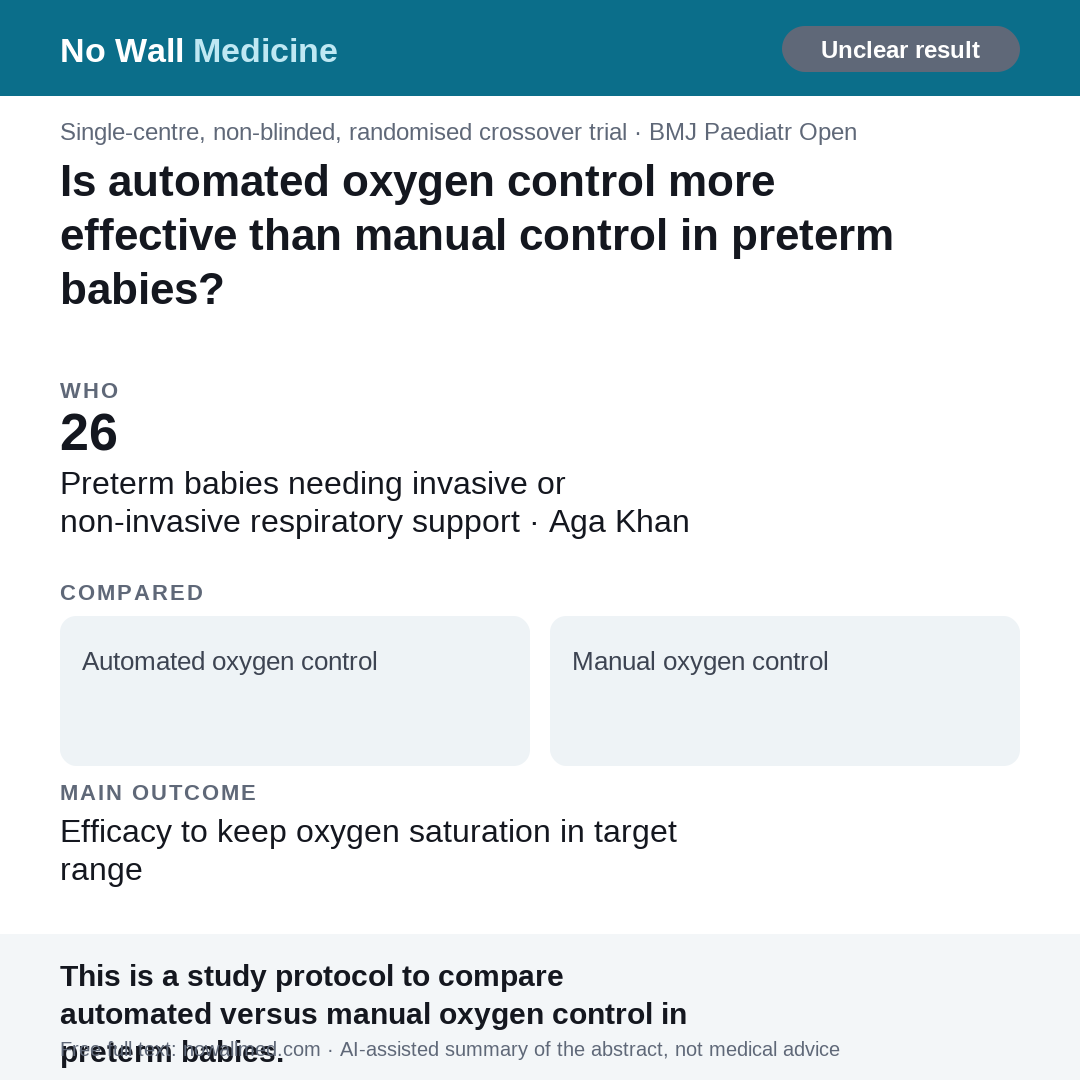
Clinical question: Is automated oxygen control more effective than manual control in preterm babies?
Why it matters: Medical staff currently use manual adjustments of the fraction of inspired oxygen to maintain target oxygen levels in preterm babies.
Key points
- The study protocol describes a randomized crossover trial aiming to recruit 26 preterm babies requiring invasive or non-invasive breathing support.
- Researchers will compare 12-hour periods of automated oxygen control by a ventilator against 12 hours of manual oxygen control by nurses.
- The trial will assess the ability to keep oxygen saturation in a target range and measure abnormal high or low oxygen levels.
Headline and key points written with AI from the paper’s abstract, with every number checked against it. Read the paper before relying on them.
Was this summary helpful?
Abstract
Introduction
Respiratory support is frequently needed for babies admitted to the neonatal intensive care unit. Among them, preterm babies are most likely to have issues of respiratory distress, and they may need invasive or non-invasive breathing support. Providing respiratory support, keeping the oxygen saturation (SpO2) in the target range (TR) and preventing abnormal high and low oxygen levels should be the aim of providing respiratory therapy. Usually, this control is achieved by manual adjustment of FiO2 (fraction of inspired oxygen) by bedside staff nurses to keep SpO2 in TR. However, the latest ventilators have automated oxygen control devices that adjust the FiO2 to keep SpO2 in TR. This study protocol is prepared to assess the effectiveness of automated versus manual oxygen control in keeping SpO2 in TR. Methods and analysis
This is a single-centre, non-blinded, randomised crossover trial that aims to recruit 26 preterm babies who may need invasive or non-invasive respiratory support. The 12-hour periods of automated oxygen control by ventilator will be compared with 12 hours of manual oxygen control by bedside staff nurse. The primary outcome will compare both interventions and will assess their efficacy to keep SpO2 in TR. Secondary outcomes will compare abnormal high and low SpO2 levels, and number and duration of fluctuations in both interventions. Median FiO2 values and median number of manual adjustments of FiO2 will also be compared. Secondary outcomes will also look for the impact of sedative and respiratory stimulant medications on target oxygen saturation. Ethics and dissemination
The ethics review committee at Aga Khan University Hospital Karachi has given ethical approval for this trial (approval number: 2024-10189-30775). Results from this trial will be published in journals. Trial registration number
NCT06622161.
Abstract reproduced under the article’s CC BY NC licence.
Subject terms
Cite this article
Aamir Yousuf HM, Hussain AS, Schmolzer GM, Hoodbhoy Z, Munir R, Rizvi A. Automated oxygen control in preterm babies on respiratory support: protocol for a randomised crossover trial. BMJ Paediatr Open. 2025. doi:10.1136/bmjpo-2024-003210
Spotted a mistake? Suggest a correction
Top studies every Monday
The week’s key trials and guidelines in your specialties, plus any topics you follow. By email, free.
Get the weekly digest