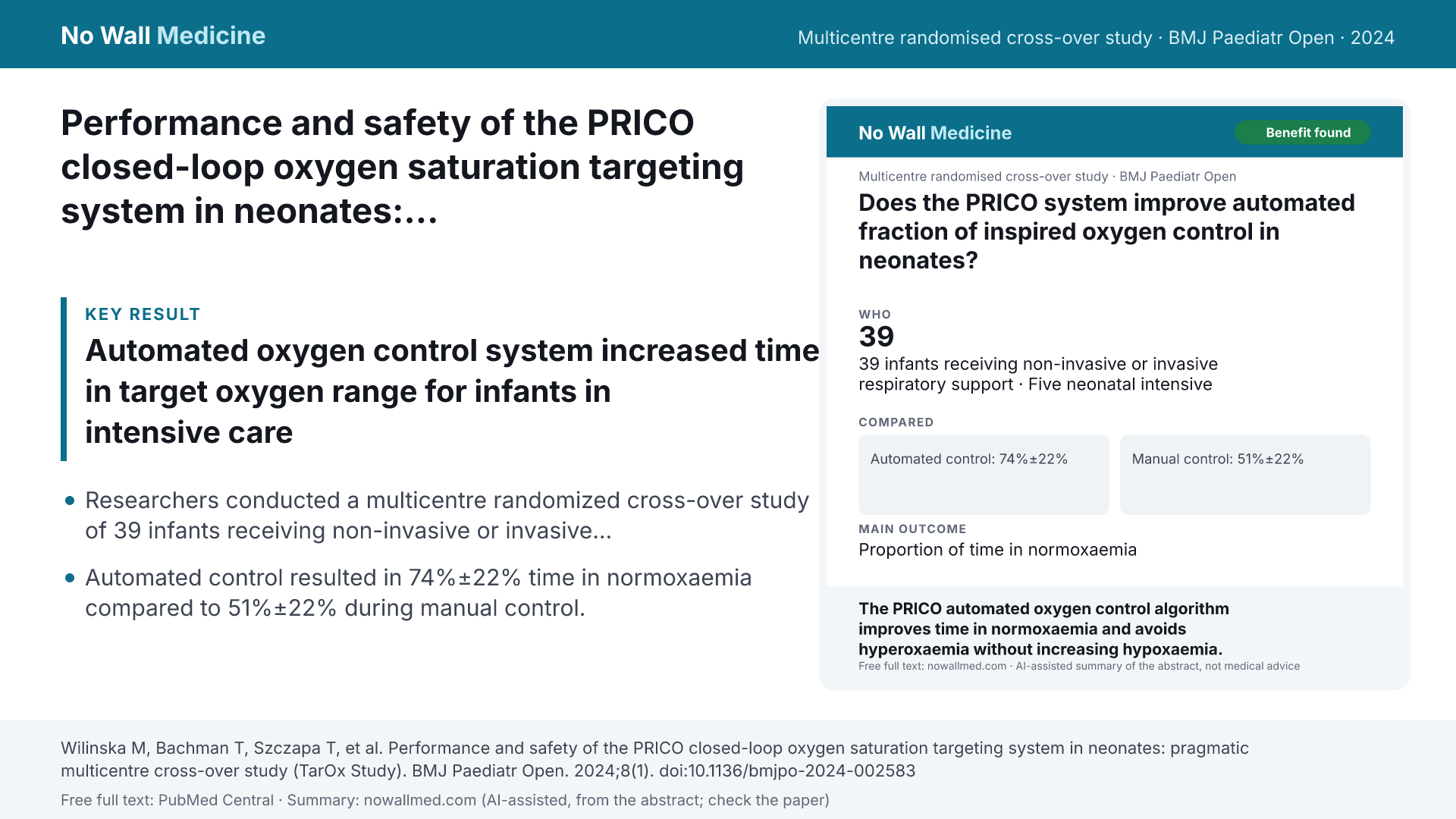
Automated oxygen control system increased time in target oxygen range for infants in intensive care
Performance and safety of the PRICO closed-loop oxygen saturation targeting system in neonates: pragmatic multicentre cross-over study (TarOx Study)
Multicentre randomised cross-over studyBenefit found
Does the PRICO system improve automated fraction of inspired oxygen control in neonates?
Who
39
39 infants receiving non-invasive or invasive respiratory support · Five neonatal intensive care units
Compared
Automated control: 74%±22%
Manual control: 51%±22%
Main outcome
Proportion of time in normoxaemia
Bottom line: The PRICO automated oxygen control algorithm improves time in normoxaemia and avoids hyperoxaemia without increasing hypoxaemia.
BMJ Paediatr Open · 2024-07-16Download image
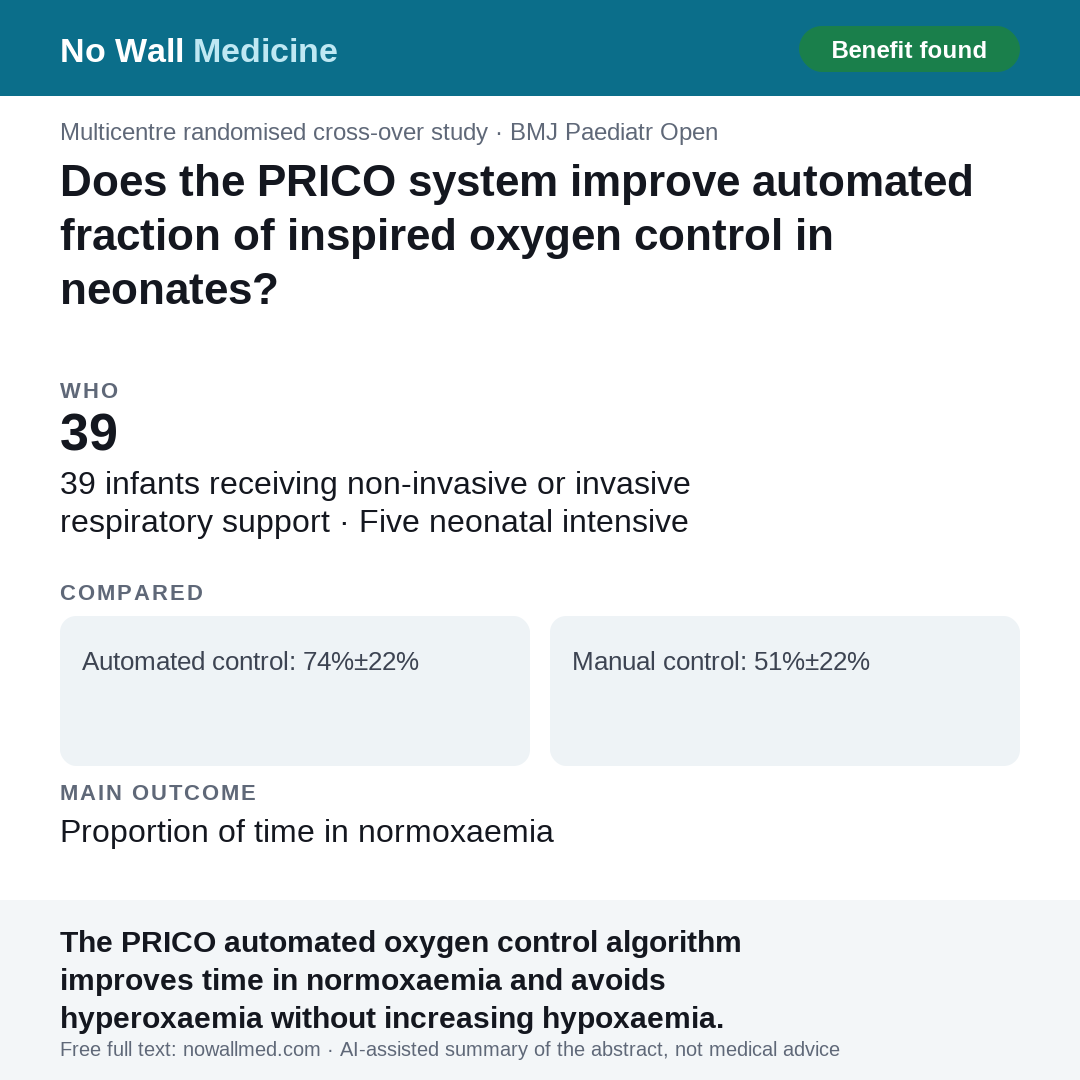
Clinical question: Does the PRICO system improve automated fraction of inspired oxygen control in neonates?
Why it matters: It was unknown if the PRICO automated oxygen control system could effectively maintain target oxygen saturation levels in neonates compared to manual control.
Key points
- Researchers conducted a multicentre randomized cross-over study of 39 infants receiving non-invasive or invasive respiratory support.
- Automated control resulted in 74%±22% time in normoxaemia compared to 51%±22% during manual control.
- The automated system was associated with less time spent in severe hyperoxaemia, which is oxygen levels above 98%.
Headline and key points written with AI from the paper’s abstract, with every number checked against it. Read the paper before relying on them.
Was this summary helpful?
Abstract
Objective
This study aims to evaluate the performance of the fabian-Predictive-Intelligent-Control-of-Oxygenation (PRICO) system for automated control of the fraction of inspired oxygen (FiO2). Design
Multicentre randomised cross-over study. Setting
Five neonatal intensive care units experienced with automated control of FiO2 and the fabian ventilator. Patients
39 infants: median gestational age of 27 weeks (IQR: 26-30), postnatal age 7 days (IQR: 2-17), weight 1120 g (IQR: 915-1588), FiO2 0.32 (IQR: 0.22-0.43) receiving both non-invasive (27) and invasive (12) respiratory support. Intervention
Randomised sequential 24-hour periods of automated and manual FiO2 control. Main outcome measures
Proportion (%) of time in normoxaemia (90%-95% with FiO2>0.21 and 90%-100% when FiO2=0.21) was the primary endpoint. Secondary endpoints were severe hypoxaemia (<80%) and severe hyperoxaemia (>98% with FiO2>0.21) and prevalence of episodes ≥60 s at these two SpO2 extremes. Results
During automated control, subjects spent more time in normoxaemia (74%±22% vs 51%±22%, p<0.001) with less time above and below (<90% (9%±8% vs 12%±11%, p<0.001) and >95% with FiO2>0.21 (16%±19% vs 35%±24%) p<0.001). They spent less time in severe hyperoxaemia (1% (0%-3.5%) vs 5% (1%-10%), p<0.001) but exposure to severe hypoxaemia was low in both arms and not different. The differences in prolonged episodes of SpO2 were consistent with the times at extremes. Conclusions
This study demonstrates the ability of the PRICO automated oxygen control algorithm to improve the maintenance of SpO2 in normoxaemia and to avoid hyperoxaemia without increasing hypoxaemia.
Abstract reproduced under the article’s CC BY NC licence.
Subject terms
Cite this article
Wilinska M, Bachman T, Szczapa T, Wroblewska-Seniuk K, Chojnacka K, Loniewska B. Performance and safety of the PRICO closed-loop oxygen saturation targeting system in neonates: pragmatic multicentre cross-over study (TarOx Study). BMJ Paediatr Open. 2024. doi:10.1136/bmjpo-2024-002583
Spotted a mistake? Suggest a correction
Top studies every Monday
The week’s key trials and guidelines in your specialties, plus any topics you follow. By email, free.
Get the weekly digest