High-flow nasal oxygen was associated with lower rates of ventilation escalation in respiratory failure patients
High-flow nasal oxygen therapy compared with conventional oxygen therapy in hospitalised patients with respiratory illness: a systematic review and meta-analysis
Systematic review and meta-analysisMixed results
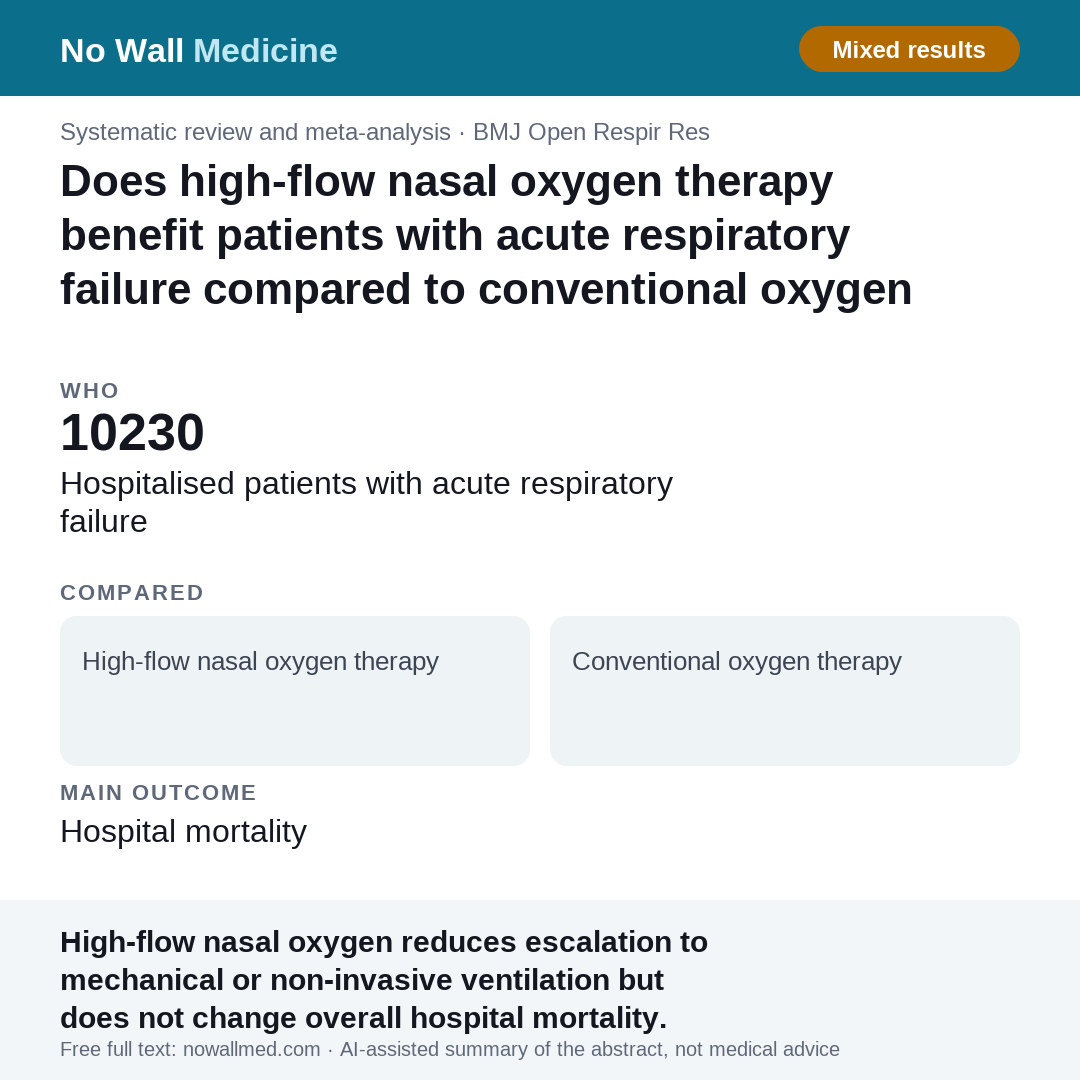
Does high-flow nasal oxygen therapy benefit patients with acute respiratory failure compared to conventional oxygen therapy?
Who
10230
Hospitalised patients with acute respiratory failure
Compared
High-flow nasal oxygen therapy
Conventional oxygen therapy
Main outcome
Hospital mortality
Result: risk ratio 1.08 (95% CI 0.93 to 1.26)
Bottom line: High-flow nasal oxygen reduces escalation to mechanical or non-invasive ventilation but does not change overall hospital mortality.
BMJ Open Respir Res · 2024-07-15Download image
Clinical question: Does high-flow nasal oxygen therapy benefit patients with acute respiratory failure compared to conventional oxygen therapy?
Why it matters: It is unclear if high-flow nasal oxygen therapy provides clinical benefits over conventional oxygen therapy for patients experiencing acute respiratory failure.
Key points
- Researchers analyzed 63 studies involving 10,230 participants to compare high-flow nasal oxygen therapy with conventional oxygen therapy for acute respiratory failure.
- High-flow nasal oxygen was associated with a lower need for invasive mechanical ventilation (RR 0.85, 95% CI 0.76 to 0.95) and non-invasive ventilation (RR 0.70, 95% CI 0.50 to 0.98).
- There was no significant difference in hospital mortality for all causes of acute respiratory failure (RR 1.08, 95% CI 0.93 to 1.26).
Headline and key points written with AI from the paper’s abstract, with every number checked against it. Read the paper before relying on them.
Was this summary helpful?
Abstract
Background
High-flow nasal oxygen therapy (HFNO) is used in diverse hospital settings to treat patients with acute respiratory failure (ARF). This systematic review aims to summarise the evidence regarding any benefits HFNO therapy has compared with conventional oxygen therapy (COT) for patients with ARF. Methods
Three databases (Embase, Medline and CENTRAL) were searched on 22 March 2023 for studies evaluating HFNO compared with COT for the treatment of ARF, with the primary outcome being hospital mortality and secondary outcomes including (but not limited to) escalation to invasive mechanical ventilation (IMV) or non-invasive ventilation (NIV). Risk of bias was assessed using the Cochrane risk-of-bias tool (randomised controlled trials (RCTs)), ROBINS-I (non-randomised trials) or Newcastle-Ottawa Scale (observational studies). RCTs and observational studies were pooled together for primary analyses, and secondary analyses used RCT data only. Treatment effects were pooled using the random effects model. Results
63 studies (26 RCTs, 13 cross-over and 24 observational studies) were included, with 10 230 participants. There was no significant difference in the primary outcome of hospital mortality (risk ratio, RR 1.08, 95% CI 0.93 to 1.26; p=0.29; 17 studies, n=5887) between HFNO and COT for all causes ARF. However, compared with COT, HFNO significantly reduced the overall need for escalation to IMV (RR 0.85, 95% CI 0.76 to 0.95 p=0.003; 39 studies, n=8932); and overall need for escalation to NIV (RR 0.70, 95% CI 0.50 to 0.98; p=0.04; 16 studies, n=3076). In subgroup analyses, when considering patients by illness types, those with acute-on-chronic respiratory failure who received HFNO compared with COT had a significant reduction in-hospital mortality (RR 0.58, 95% CI 0.37 to 0.91; p=0.02). Discussion
HFNO was superior to COT in reducing the need for escalation to both IMV and NIV but had no impact on the primary outcome of hospital mortality. These findings support recommendations that HFNO may be considered as first-line therapy for ARF. Prospero registration number
CRD42021264837.
Abstract reproduced under the article’s CC BY NC licence.
Subject terms
Cite this article
Seow D, Khor YH, Khung SW, Smallwood DM, Ng Y, Pascoe A. High-flow nasal oxygen therapy compared with conventional oxygen therapy in hospitalised patients with respiratory illness: a systematic review and meta-analysis. BMJ Open Respir Res. 2024. doi:10.1136/bmjresp-2024-002342
Spotted a mistake? Suggest a correction
Top studies every Monday
The week’s key trials and guidelines in your specialties, plus any topics you follow. By email, free.
Get the weekly digest