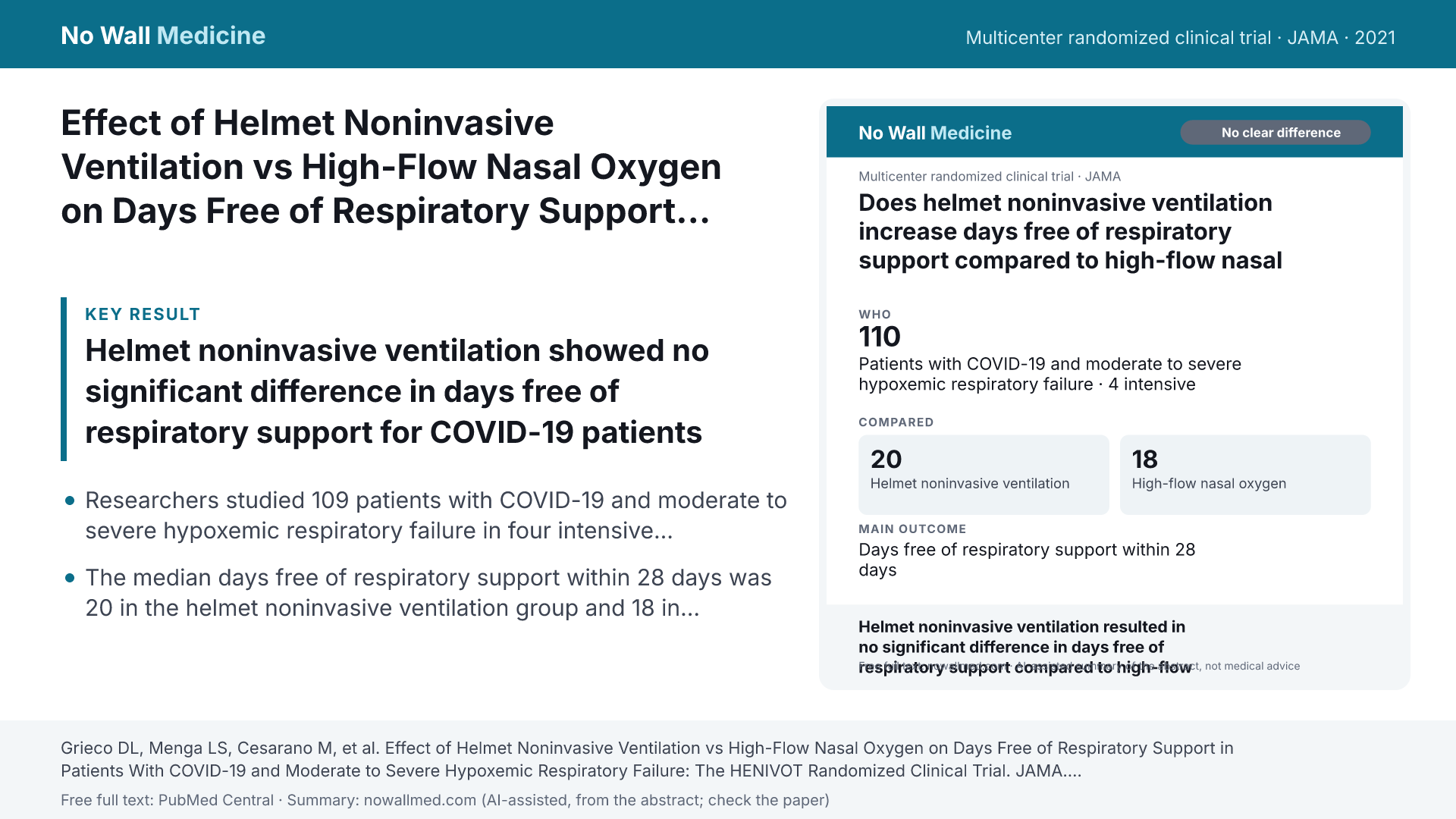
Helmet noninvasive ventilation showed no significant difference in days free of respiratory support for COVID-19 patients
Effect of Helmet Noninvasive Ventilation vs High-Flow Nasal Oxygen on Days Free of Respiratory Support in Patients With COVID-19 and Moderate to Severe Hypoxemic Respiratory Failure: The HENIVOT Randomized Clinical Trial
Multicenter randomized clinical trialNo clear difference
Does helmet noninvasive ventilation increase days free of respiratory support compared to high-flow nasal oxygen?
Who
110
Patients with COVID-19 and moderate to severe hypoxemic respiratory failure · 4 intensive care units in Italy
Compared
20Helmet noninvasive ventilation (IQR, 0-25)
18High-flow nasal oxygen (IQR, 0-22)
Main outcome
Days free of respiratory support within 28 days
Result: mean difference, 2 days (95% CI, -2 to 6)
Bottom line: Helmet noninvasive ventilation resulted in no significant difference in days free of respiratory support compared to high-flow nasal oxygen.
JAMA · 2021-03-26 · Save PNG
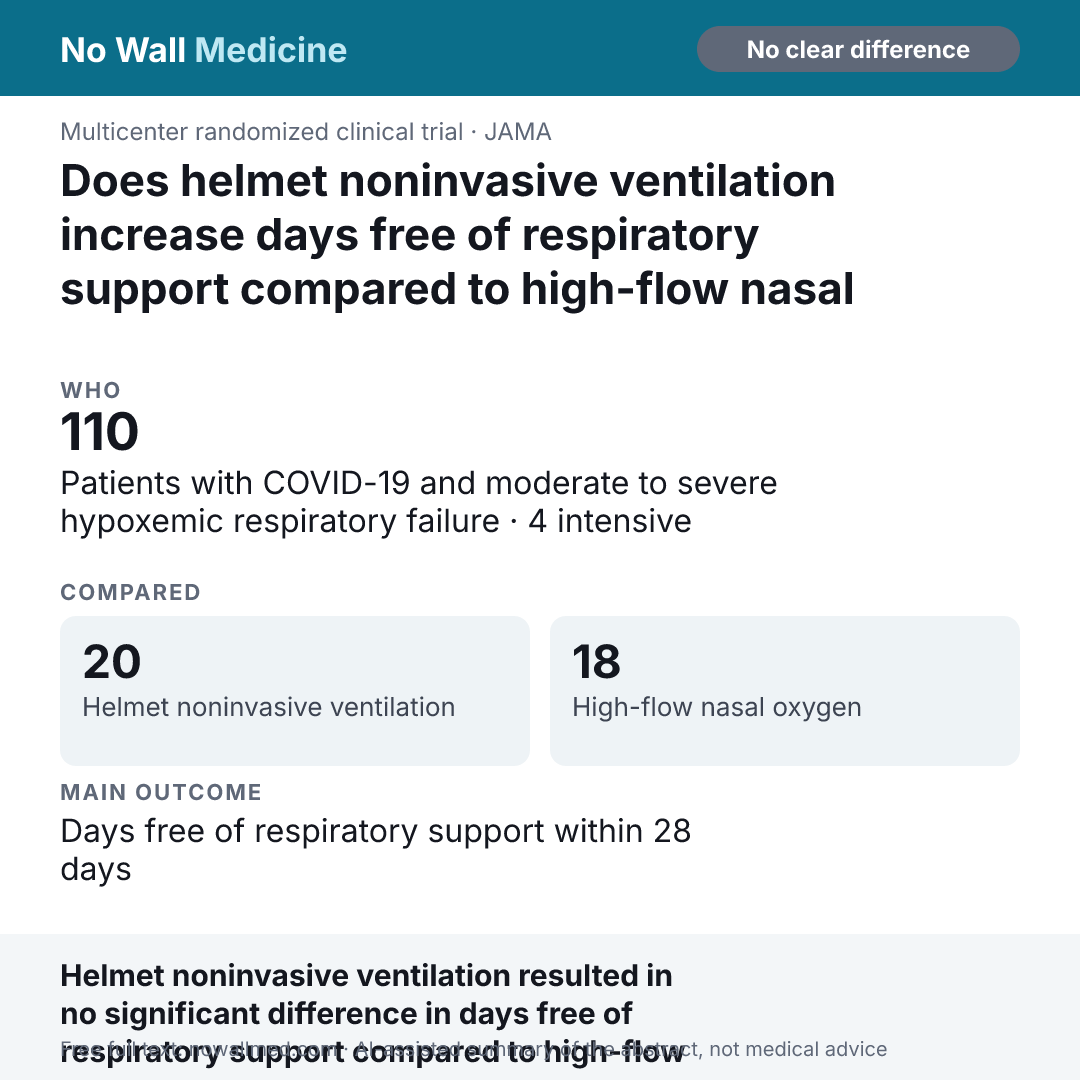
Clinical question: Does helmet noninvasive ventilation increase days free of respiratory support compared to high-flow nasal oxygen?
Key points
- Researchers studied 109 patients with COVID-19 and moderate to severe hypoxemic respiratory failure in four intensive care units in Italy.
- The median days free of respiratory support within 28 days was 20 in the helmet noninvasive ventilation group and 18 in the high-flow nasal oxygen group.
- While the primary outcome was not significant, the rate of endotracheal intubation was lower in the helmet group at 30% compared to 51% in the high-flow group.
Headline and key points written with AI from the paper’s abstract, with every number checked against it. Read the paper before relying on them.
Was this summary helpful?
Subject terms
Headline, design, result, key points, caveat and citation as plain text.
Cite this article
Grieco DL, Menga LS, Cesarano M, et al. Effect of Helmet Noninvasive Ventilation vs High-Flow Nasal Oxygen on Days Free of Respiratory Support in Patients With COVID-19 and Moderate to Severe Hypoxemic Respiratory Failure: The HENIVOT Randomized Clinical Trial. JAMA. 2021;325(17):1731-1743. doi:10.1001/jama.2021.4682
Spotted a mistake? Suggest a correction