Combined high-intensity interval and resistance training improves pain and fatigue in systemic sclerosis patients
High-intensity interval and resistance training programme improves pain and fatigue outcomes in people with systemic sclerosis: a European multicentre randomised controlled trial
European multicentre randomised controlled trialBenefit found
Does a tailored exercise programme improve pain and fatigue in people with systemic sclerosis?
Who
170
170 people with systemic sclerosis · European multicentre
Compared
exercise intervention group: fatigue -10.4 (95% CI 19.4 to -1.4), pain 0.48 (95% CI 0.21 to 0.76)
usual care group
Main outcome
pain and fatigue
Bottom line: A 12-week supervised high-intensity interval and resistance training programme improves pain, fatigue, and quality of life.
RMD Open · 2025-11-11Download image
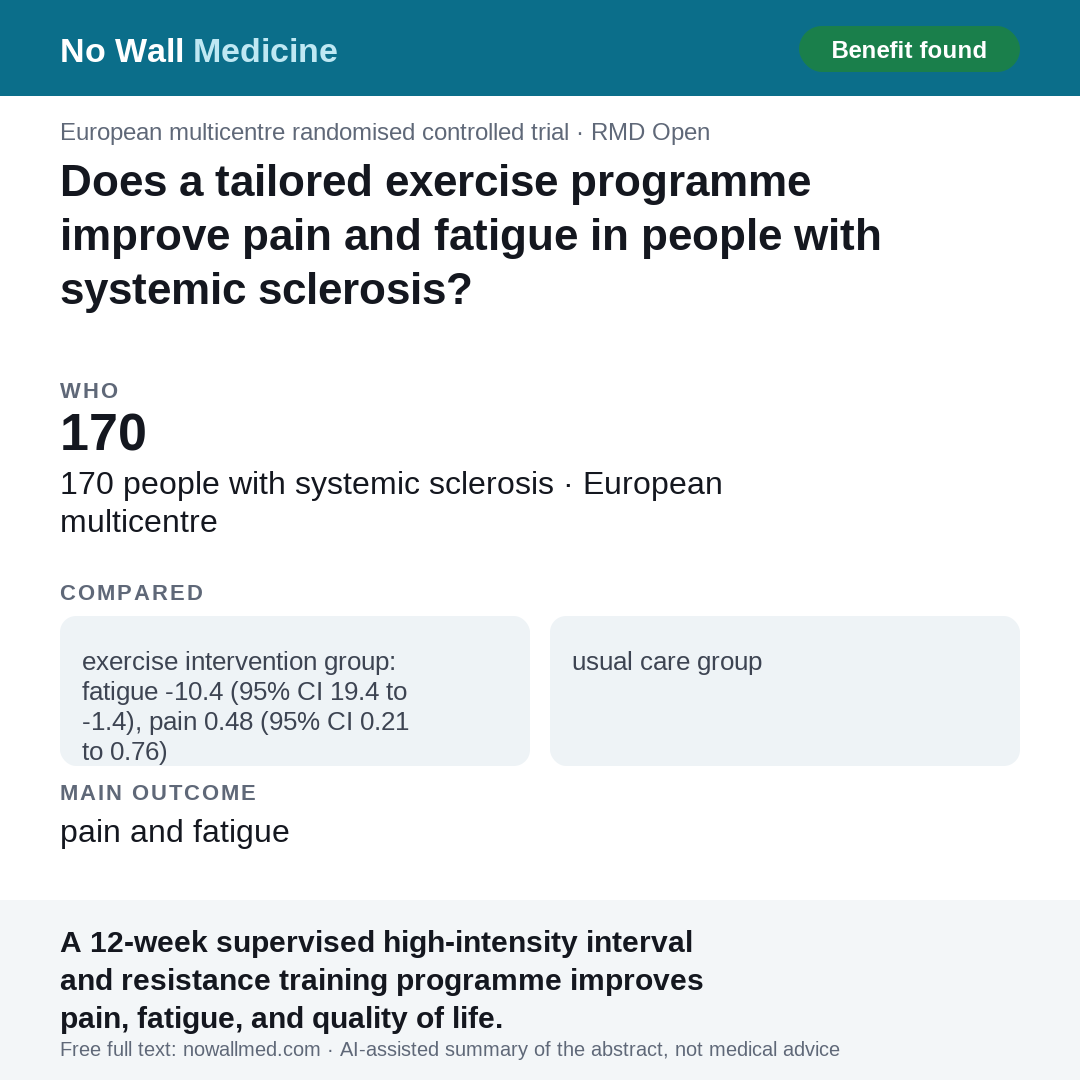
Clinical question: Does a tailored exercise programme improve pain and fatigue in people with systemic sclerosis?
Why it matters: Pharmacological management for pain and fatigue in systemic sclerosis is often inadequate and evidence regarding exercise interventions is limited.
Key points
- Researchers conducted a multicentre randomized controlled trial with 170 people with systemic sclerosis, where 89% had limited cutaneous systemic sclerosis.
- A 12-week supervised exercise program of high-intensity interval training and resistance training improved fatigue by -10.4 and pain by 0.48 compared to usual care.
- The exercise group also showed significant improvements in depression, quality of life, self-reported function, musculoskeletal strength, and cardiorespiratory fitness.
Headline and key points written with AI from the paper’s abstract, with every number checked against it. Read the paper before relying on them.
Abstract
Background
Pain and fatigue are among the most debilitating symptoms of systemic sclerosis (SSc), severely impairing quality of life (QoL). Pharmacological management is often inadequate, and evidence on exercise is limited. This study aimed to evaluate the effects of a tailored exercise programme on pain and fatigue in people with SSc (PwSSc). Methods
This European multicentre randomised controlled trial (n=6) recruited 170 PwSSc (89% limited cutaneous SSc), randomised to an exercise intervention group (EIG) or usual care group (UCG). The EIG completed a 12-week, twice-weekly supervised programme combining 30 min of high-intensity interval training (HIIT) and 15 min of resistance training (RT), in addition to usual care. The UCG received usual care alone. Outcomes were assessed at baseline, 12 weeks (primary endpoint) and 24 weeks, with pain and fatigue as primary outcomes, and QoL, depression, functional ability, musculoskeletal strength/endurance and cardiorespiratory fitness as secondary outcomes. Results
At 12 weeks, the mean group differences for the primary, fatigue (-10.4 (95% CI 19.4 to -1.4), p<0.05) and pain (0.48 (95% CI 0.21 to 0.76), p<0.05), secondary, depression (p<0.001), QoL and self-reported function (p<0.05) and exploratory outcomes musculoskeletal strength and endurance (p<0.01), and cardiorespiratory fitness (p<0.001) were significantly improved in EIG compared with UCG. Conclusions
A 12-week supervised combined upper body exercise programme can improve pain, fatigue, depression, QoL, function, strength and cardiorespiratory fitness in PwSSc. HIIT combined with RT is safe for the study population and may serve as an effective non-pharmacological adjunct to pharmacotherapy to manage SSc symptoms and enhance QoL. Trial registration number
NCT05234671.
Abstract reproduced under the article’s CC BY NC licence.
Topics
Cite this article
Mitropoulos A, Jensen KY, Kouidi E, Boström C, Cuomo G, Diederichsen LP. High-intensity interval and resistance training programme improves pain and fatigue outcomes in people with systemic sclerosis: a European multicentre randomised controlled trial. RMD Open. 2025. doi:10.1136/rmdopen-2025-005946
Spotted a mistake? Suggest a correction