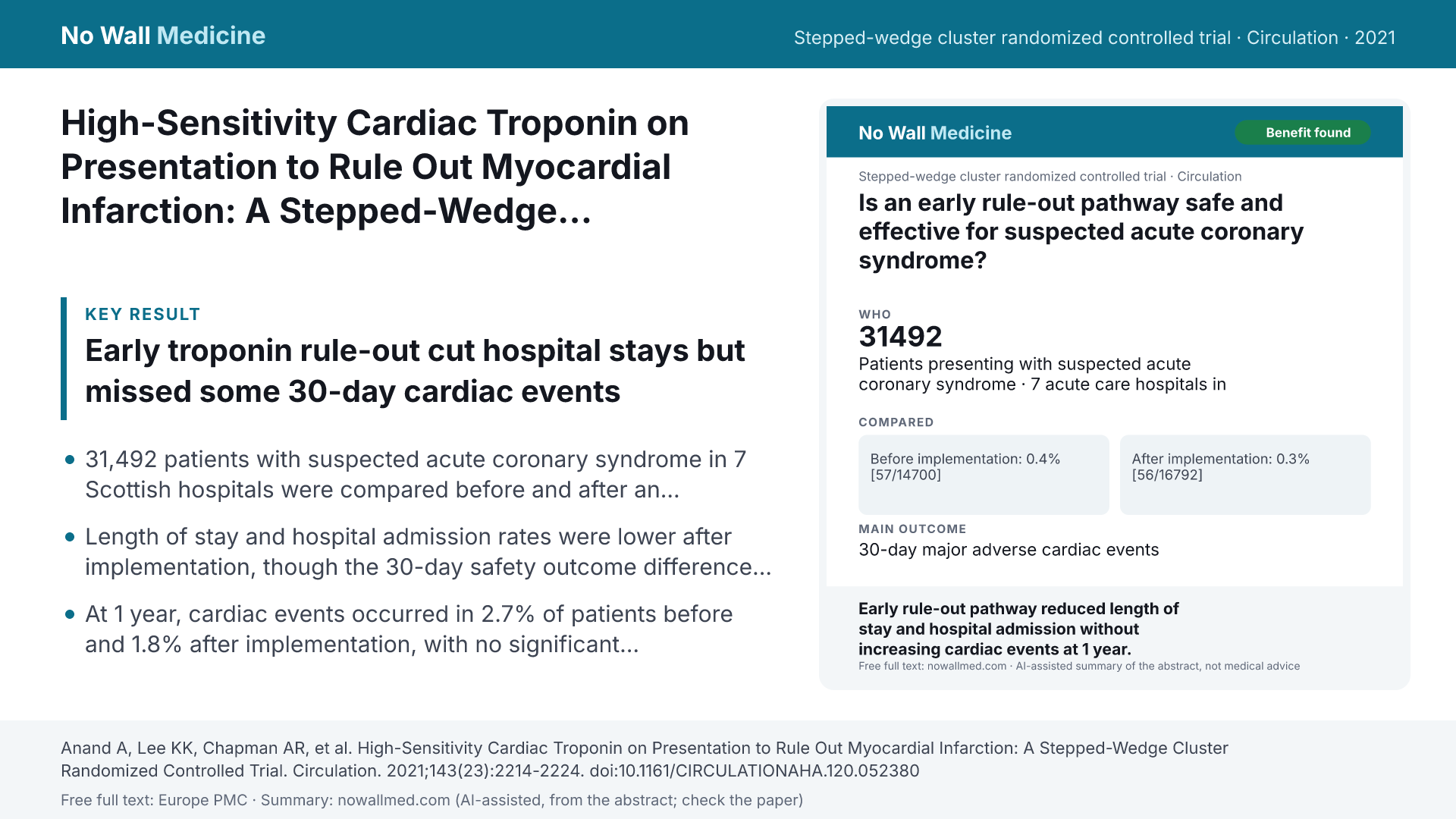
Early troponin rule-out cut hospital stays but missed some 30-day cardiac events
High-Sensitivity Cardiac Troponin on Presentation to Rule Out Myocardial Infarction: A Stepped-Wedge Cluster Randomized Controlled Trial
Stepped-wedge cluster randomized controlled trialBenefit found
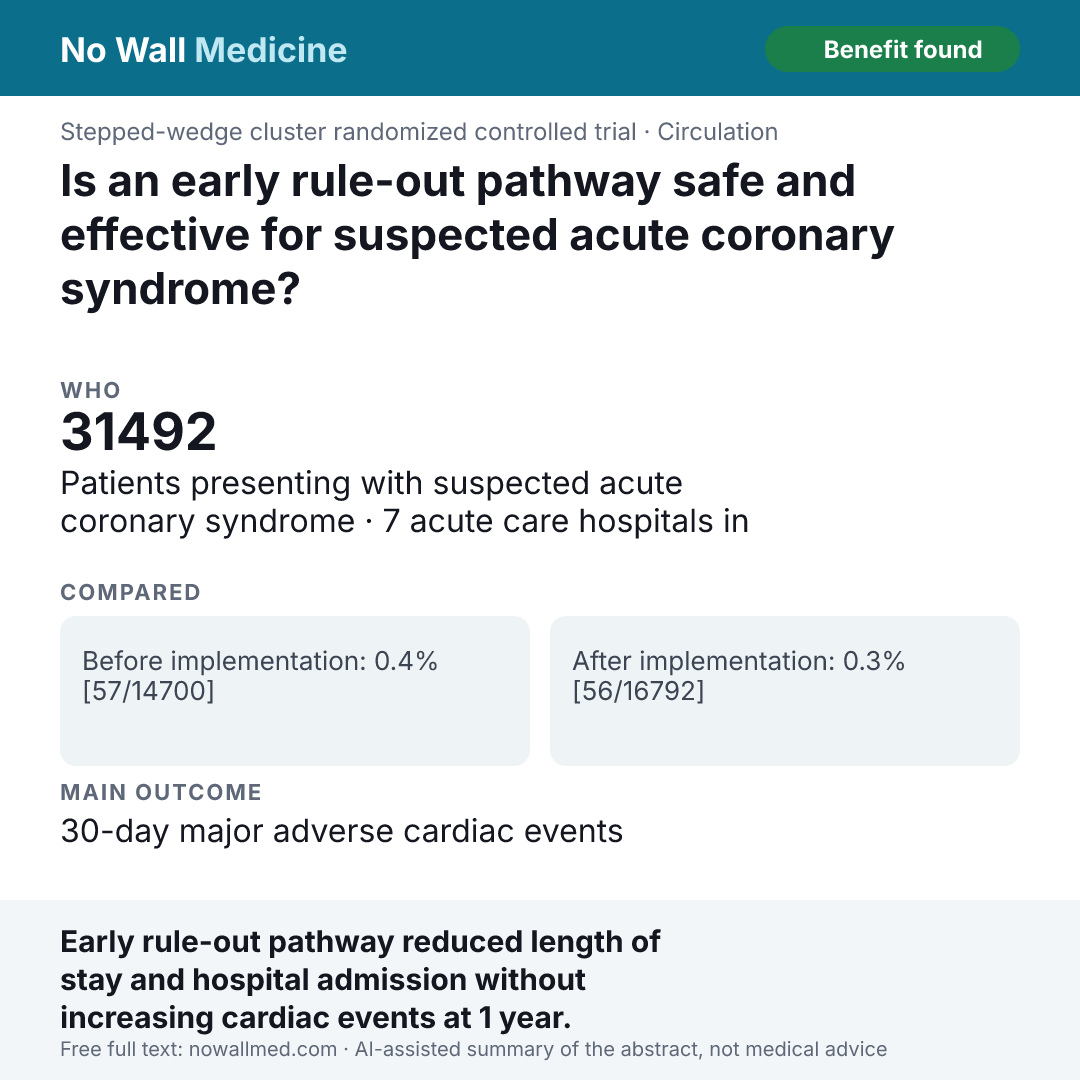
Is an early rule-out pathway safe and effective for suspected acute coronary syndrome?
Who
31492
Patients presenting with suspected acute coronary syndrome · 7 acute care hospitals in Scotland
Compared
Before implementation: 0.4% [57/14700]
After implementation: 0.3% [56/16792]
Main outcome
30-day major adverse cardiac events
Result: adjusted odds ratio, 1.02 [95% CI, 0.74-1.40]
Bottom line: Early rule-out pathway reduced length of stay and hospital admission without increasing cardiac events at 1 year.
Circulation · 2021-03-23 · Save PNG
Same trial (NCT03005158)
Papers we list that report this registered trial, oldest first. Read a secondary analysis alongside the main results.
- Main results Benefit found
This paper Circulation 2021-03 - Secondary analysis Benefit found
Troponin risk stratification reduces hospital stay and increases emergency department discharge for suspected heart attack patients JACC 2025-11
Clinical question: Is an early rule-out pathway safe and effective for suspected acute coronary syndrome?
Key points
- 31,492 patients with suspected acute coronary syndrome in 7 Scottish hospitals were compared before and after an early rule-out pathway.
- Length of stay and hospital admission rates were lower after implementation, though the 30-day safety outcome difference was not statistically significant.
- At 1 year, cardiac events occurred in 2.7% of patients before and 1.8% after implementation, with no significant difference in mortality.
Headline and key points written with AI from the paper’s abstract, with every number checked against it. Read the paper before relying on them.
Was this summary helpful?
Abstract
Background
High-sensitivity cardiac troponin assays enable myocardial infarction to be ruled out earlier, but the safety and efficacy of this approach is uncertain. We investigated whether an early rule-out pathway is safe and effective for patients with suspected acute coronary syndrome.Methods
We performed a stepped-wedge cluster randomized controlled trial in the emergency departments of 7 acute care hospitals in Scotland. Consecutive patients presenting with suspected acute coronary syndrome between December 2014 and December 2016 were included. Sites were randomized to implement an early rule-out pathway where myocardial infarction was excluded if high-sensitivity cardiac troponin I concentrations were Results
We enrolled 31 492 patients (59±17 years of age [mean±SD]; 45% women) with troponin concentrations PP=0.068), but the observed differences favored the early rule-out pathway (0.4% [57/14 700] versus 0.3% [56/16 792]). At 1 year, the safety outcome occurred in 2.7% (396/14 700) and 1.8% (307/16 792) of patients before and after implementation (adjusted odds ratio, 1.02 [95% CI, 0.74-1.40]; P=0.894), and there were no differences in hospital reattendance or all-cause mortality.Conclusions
Implementation of an early rule-out pathway for myocardial infarction reduced length of stay and hospital admission. Although noninferiority for the safety outcome was not demonstrated at 30 days, there was no increase in cardiac events at 1 year. Adoption of this pathway would have major benefits for patients and health care providers. Registration: URL: https://www.clinicaltrials.gov; Unique identifier: NCT03005158.
Abstract reproduced under the article’s CC BY-NC-ND licence.
Subject terms
Headline, design, result, key points, caveat and citation as plain text.
Cite this article
Anand A, Lee KK, Chapman AR, et al. High-Sensitivity Cardiac Troponin on Presentation to Rule Out Myocardial Infarction: A Stepped-Wedge Cluster Randomized Controlled Trial. Circulation. 2021;143(23):2214-2224. doi:10.1161/CIRCULATIONAHA.120.052380
Spotted a mistake? Suggest a correction