Troponin risk stratification reduces hospital stay and increases emergency department discharge for suspected heart attack patients
Safety of Using Risk Stratification Along With High-Sensitivity Cardiac Troponin in the Emergency Department: A Secondary Analysis
Secondary analysis of a stepped-wedge cluster-randomized controlled trialBenefit found
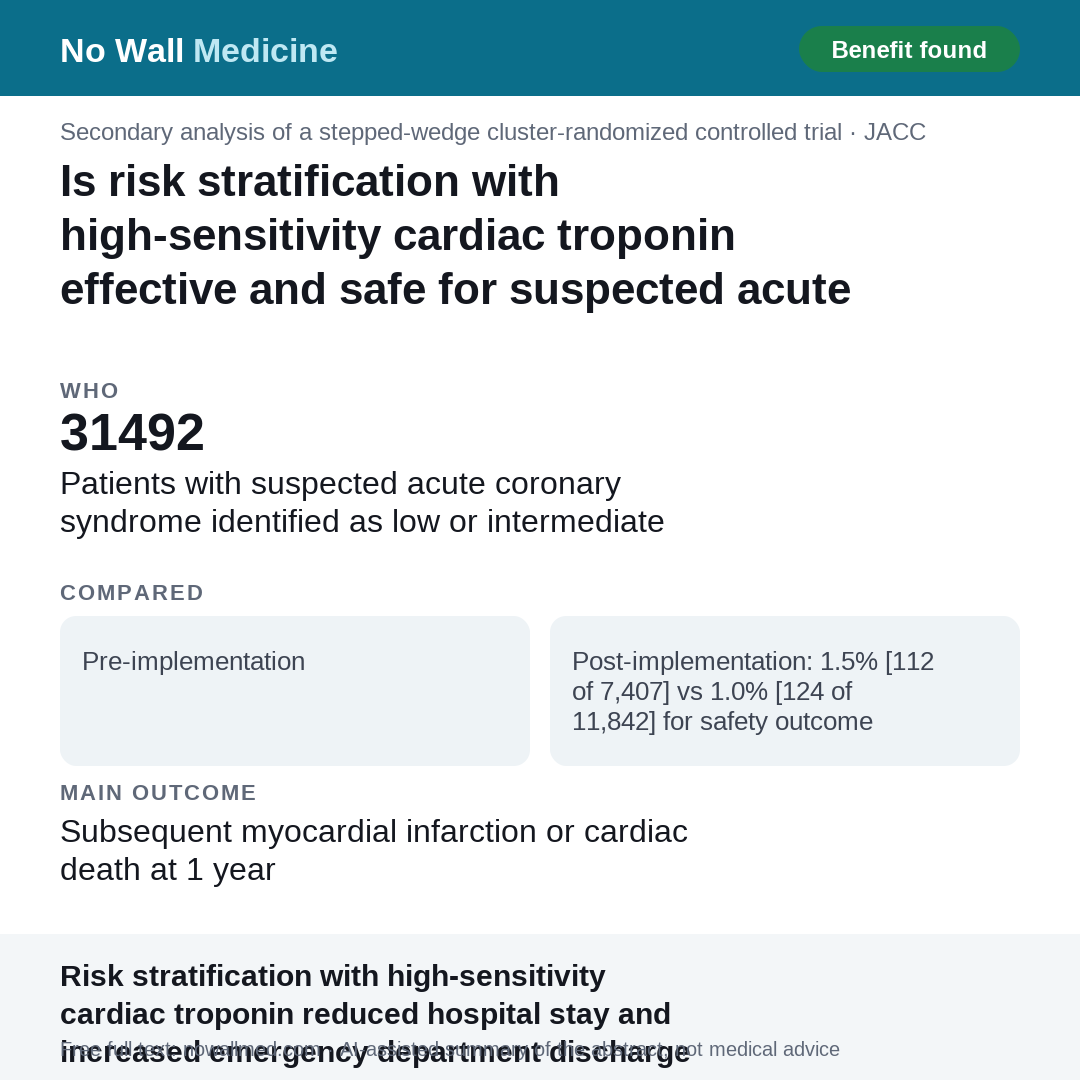
Is risk stratification with high-sensitivity cardiac troponin effective and safe for suspected acute coronary syndrome?
Who
31492
Patients with suspected acute coronary syndrome identified as low or intermediate risk
Compared
Pre-implementation
Post-implementation: 1.5% [112 of 7,407] vs 1.0% [124 of 11,842] for safety outcome
Main outcome
Subsequent myocardial infarction or cardiac death at 1 year
Result: adjusted hazard ratio 0.65 (95% CI 0.50-0.86)
Bottom line: Risk stratification with high-sensitivity cardiac troponin reduced hospital stay and increased emergency department discharge safely.
JACC · 2025-11-06Download image
Clinical question: Is risk stratification with high-sensitivity cardiac troponin effective and safe for suspected acute coronary syndrome?
Why it matters: It is uncertain if using high-sensitivity cardiac troponin to risk stratify patients provides similar benefits for low- and intermediate-risk groups or if discharged patients remain safe.
Key points
- Researchers analyzed 31,492 patients with suspected acute coronary syndrome, comparing low-risk and intermediate-risk groups before and after implementing a troponin-based rule-out pathway.
- Implementation was associated with a reduction in hospital stay for low-risk (4.7 ± 2.8 vs 6.9 ± 3.2 hours) and intermediate-risk (11.0 ± 4.9 vs 15.8 ± 4.7 hours) patients.
- Discharged patients had a lower risk of myocardial infarction or cardiac death at 1 year, with rates of 1.5% compared to 1.0%.
Headline and key points written with AI from the paper’s abstract, with every number checked against it. Read the paper before relying on them.
Topics
Cite this article
Li Z, Doudesis D, Bularga A, Wereski R, Taggart C, Lowry MTH. Safety of Using Risk Stratification Along With High-Sensitivity Cardiac Troponin in the Emergency Department: A Secondary Analysis. JACC. 2025. doi:10.1016/j.jacc.2025.08.059
Spotted a mistake? Suggest a correction