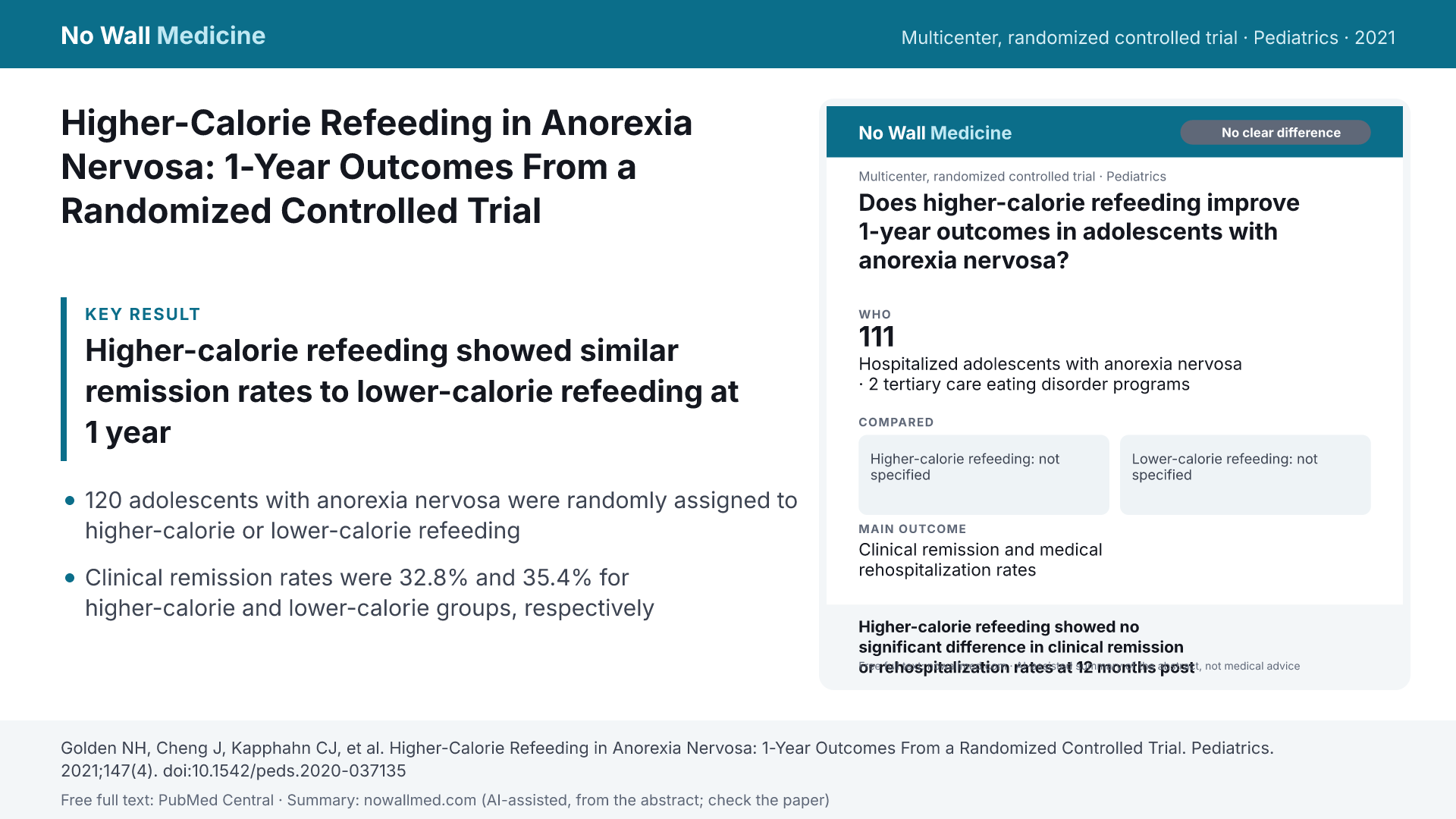
Higher-calorie refeeding showed similar remission rates to lower-calorie refeeding at 1 year
Higher-Calorie Refeeding in Anorexia Nervosa: 1-Year Outcomes From a Randomized Controlled Trial
Multicenter, randomized controlled trialNo clear difference
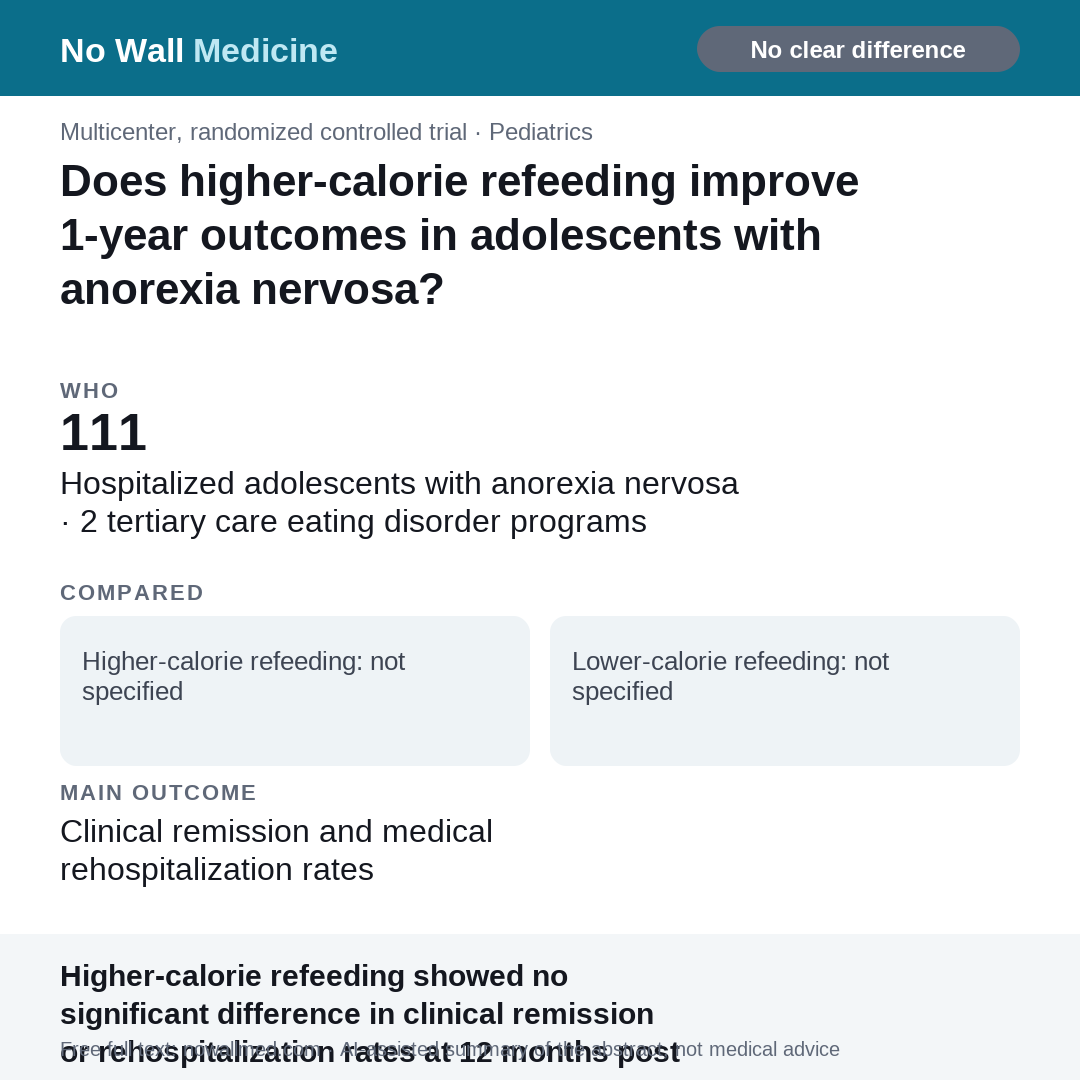
Does higher-calorie refeeding improve 1-year outcomes in adolescents with anorexia nervosa?
Who
111
Hospitalized adolescents with anorexia nervosa · 2 tertiary care eating disorder programs
Compared
Higher-calorie refeeding: not specified
Lower-calorie refeeding: not specified
Main outcome
Clinical remission and medical rehospitalization rates
Bottom line: Higher-calorie refeeding showed no significant difference in clinical remission or rehospitalization rates at 12 months post discharge.
Pediatrics · 2021-03-22Download image
Clinical question: Does higher-calorie refeeding improve 1-year outcomes in adolescents with anorexia nervosa?
Why it matters: Optimal calorie intake for refeeding in anorexia nervosa was unknown
Key points
- 120 adolescents with anorexia nervosa were randomly assigned to higher-calorie or lower-calorie refeeding.
- Clinical remission rates were 32.8% and 35.4% for higher-calorie and lower-calorie groups, respectively.
- Rehospitalization rates and days rehospitalized did not differ between the two groups.
Headline and key points written with AI from the paper’s abstract, with every number checked against it. Read the paper before relying on them.
Was this summary helpful?
Subject terms
Cite this article
Golden NH, Cheng J, Kapphahn CJ, et al. Higher-Calorie Refeeding in Anorexia Nervosa: 1-Year Outcomes From a Randomized Controlled Trial. Pediatrics. 2021. doi:10.1542/peds.2020-037135
Spotted a mistake? Suggest a correction