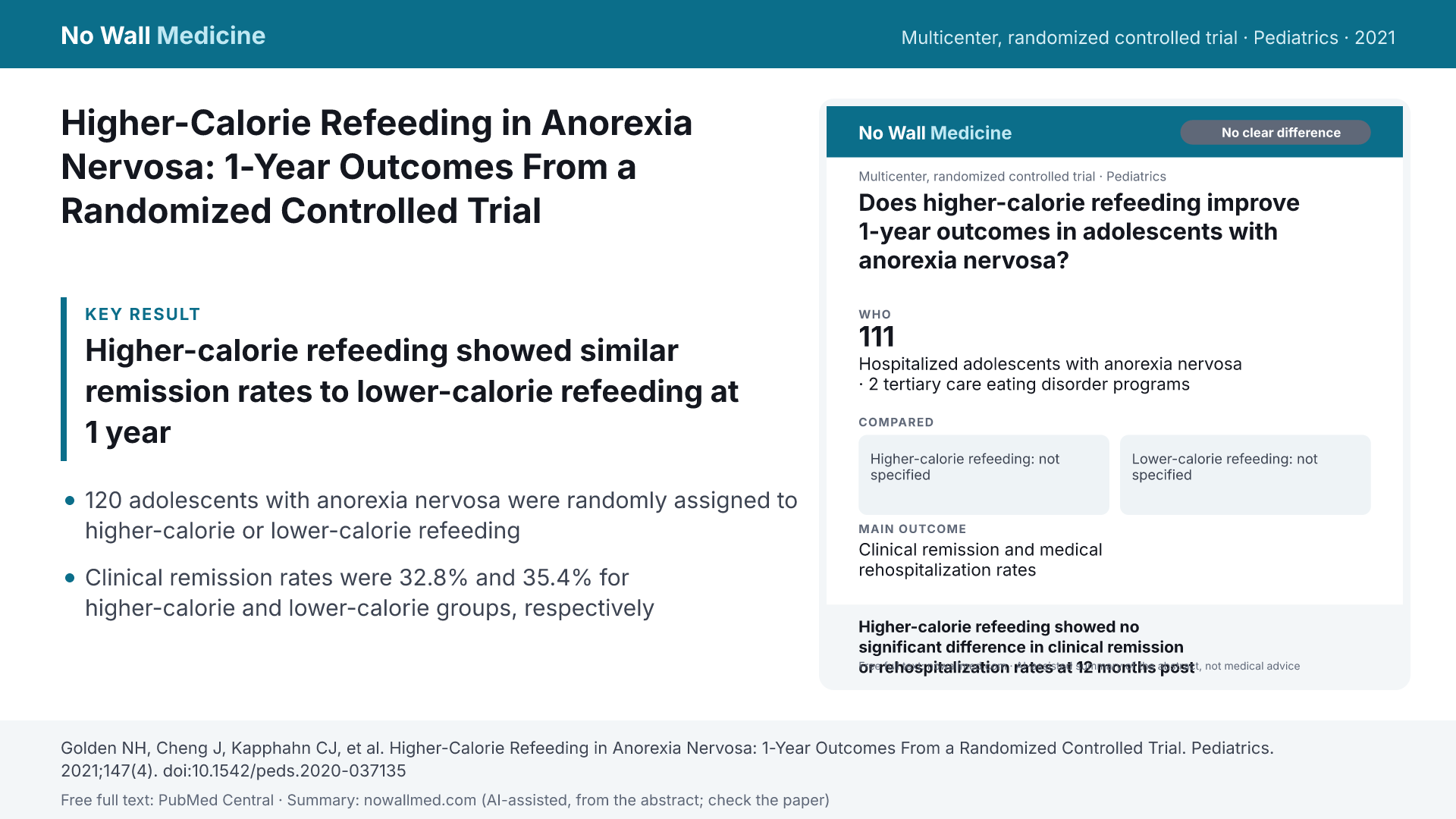
Higher-Calorie Refeeding in Anorexia Nervosa: 1-Year Outcomes From a Randomized Controlled Trial
Key result: Higher-calorie refeeding showed similar remission rates to lower-calorie refeeding at 1 year
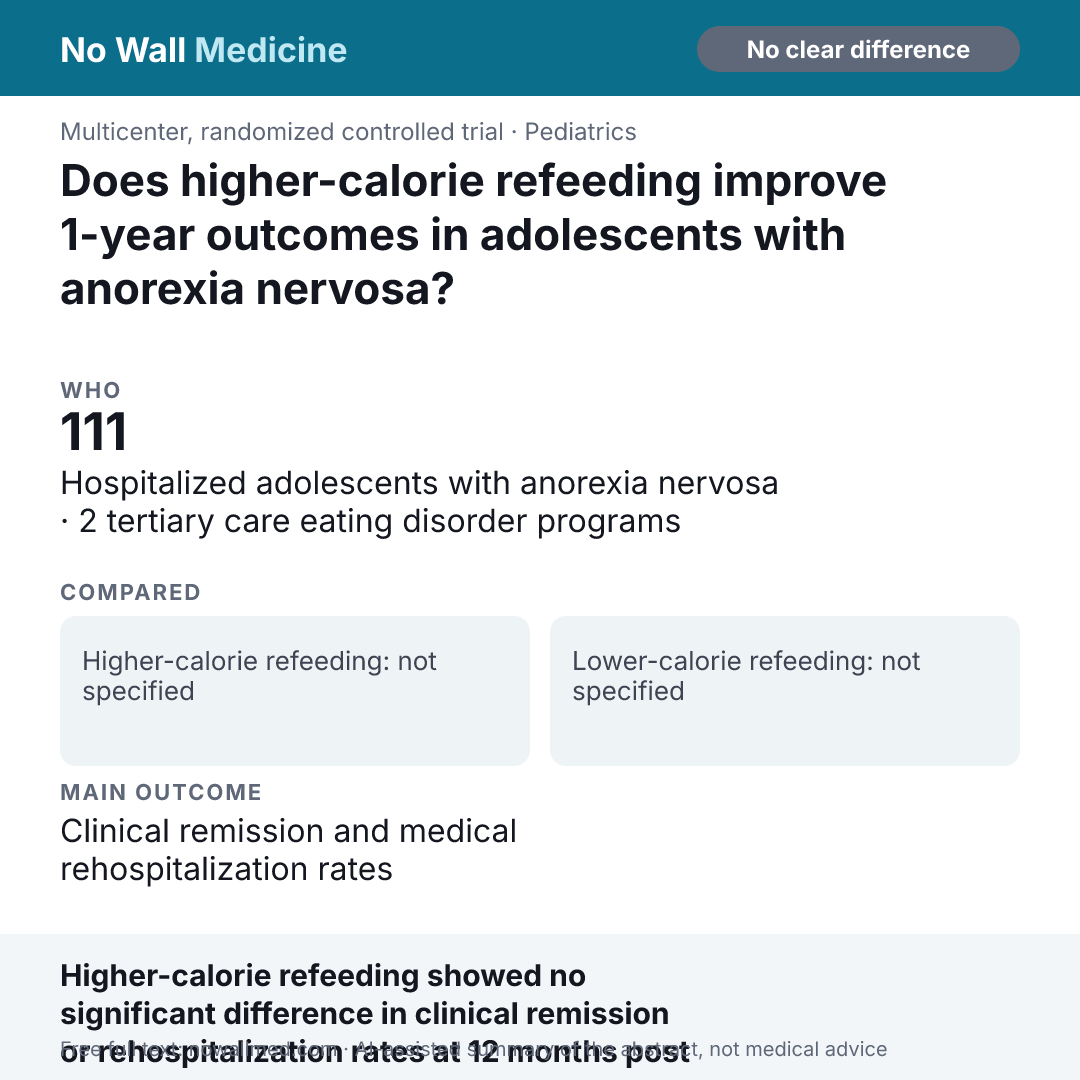
Multicenter, randomized controlled trialNo clear difference
Does higher-calorie refeeding improve 1-year outcomes in adolescents with anorexia nervosa?
Who
111
Hospitalized adolescents with anorexia nervosa · 2 tertiary care eating disorder programs
Compared
Higher-calorie refeeding: not specified
Lower-calorie refeeding: not specified
Main outcome
Clinical remission and medical rehospitalization rates
Bottom line: Higher-calorie refeeding showed no significant difference in clinical remission or rehospitalization rates at 12 months post discharge.
Pediatrics · 2021-03-22 · Save PNG
Key points
- 120 adolescents with anorexia nervosa were randomly assigned to higher-calorie or lower-calorie refeeding.
- Clinical remission rates were 32.8% and 35.4% for higher-calorie and lower-calorie groups, respectively.
- Rehospitalization rates and days rehospitalized did not differ between the two groups.
Discussion prompts
- Would these patients look like yours? Who was left out?
- Is the main outcome one that matters to patients?
- Is the difference large enough to change what you do?
Cite: Golden NH, Cheng J, Kapphahn CJ, et al. Higher-Calorie Refeeding in Anorexia Nervosa: 1-Year Outcomes From a Randomized Controlled Trial. Pediatrics. 2021;147(4). doi:10.1542/peds.2020-037135
Free full text: PubMed Central · Summary and visual abstract: nowallmed.com/a/higher-calorie-refeeding-in-anorexia-nervosa-1-year-outcomes-from-a-d840hx/ (AI-assisted from the abstract; check the paper before relying on it).