Oropharyngeal swabs had higher detection rates than nasopharyngeal swabs or saliva for COVID-19 testing
Higher SARS-CoV-2 detection of oropharyngeal compared with nasopharyngeal or saliva specimen for molecular testing: a multicentre randomised comparative accuracy study
Multicentre randomised comparative accuracy studyBenefit found
Which specimen collection method has the highest SARS-CoV-2 detection rate?
Who
23102
Adults undergoing SARS-CoV-2 molecular testing · Two COVID-19 outpatient test centres
Compared
78.7%Oropharyngeal swab (95% CI 74.3 to 82.7)
72.7%Nasopharyngeal swab (95% CI 67.9 to 77.1)
61.9%Saliva specimen (95% CI 56.9 to 66.8)
Main outcome
SARS-CoV-2 detection rate
Bottom line: Oropharyngeal swabs provided higher SARS-CoV-2 detection and lower discomfort than nasopharyngeal swabs.
Thorax · 2023-05-19Download image
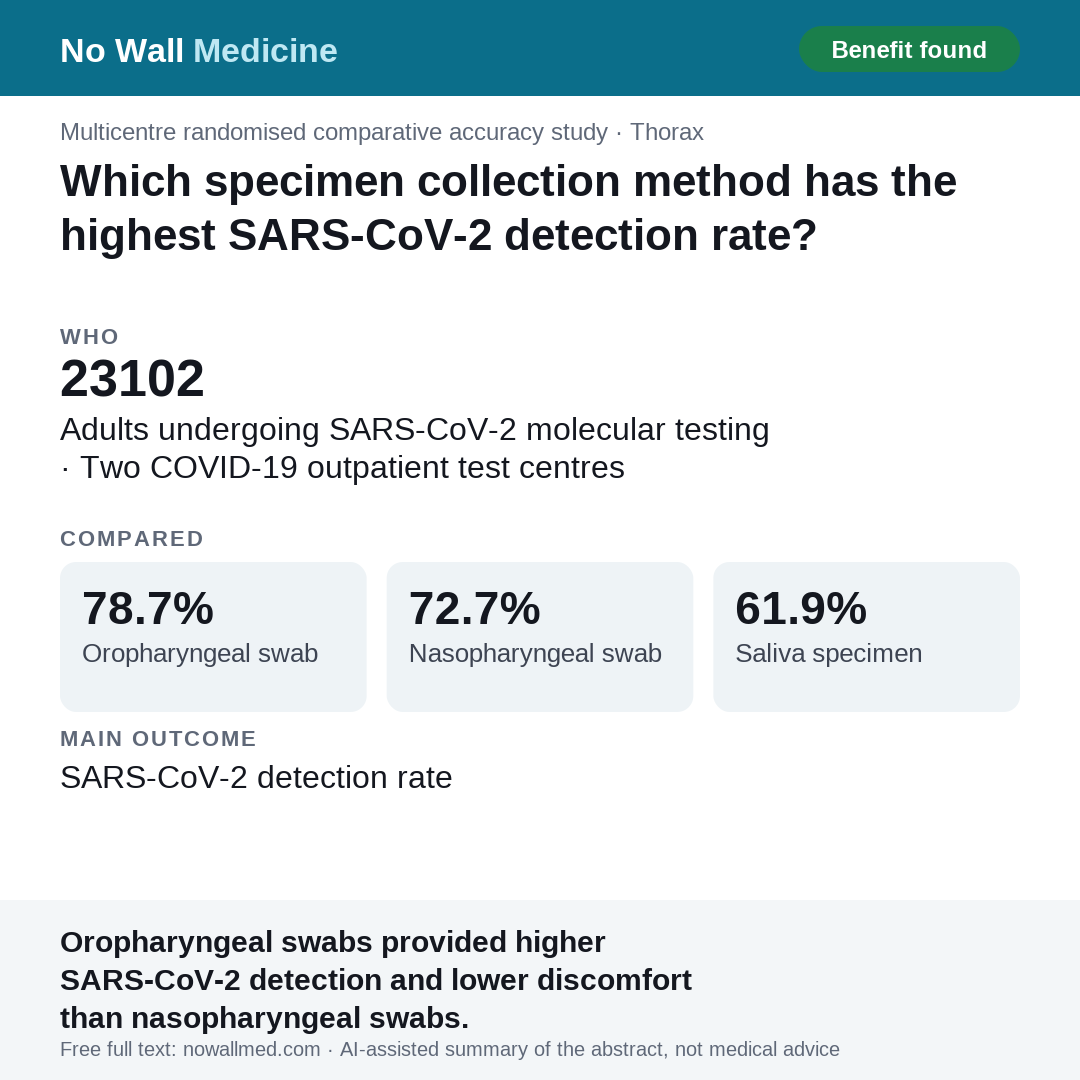
Clinical question: Which specimen collection method has the highest SARS-CoV-2 detection rate?
Why it matters: The best sampling method for detecting SARS-CoV-2 infection through molecular testing remains unclear.
Key points
- Researchers conducted a randomized trial with 23,102 adults to compare detection rates of nasopharyngeal swabs, oropharyngeal swabs, and saliva using molecular testing.
- The detection rate was 78.7% for oropharyngeal swabs, compared to 72.7% for nasopharyngeal swabs and 61.9% for saliva specimens.
- Oropharyngeal swabs were associated with lower discomfort than nasopharyngeal swabs, while saliva specimens were associated with the lowest cost.
Headline and key points written with AI from the paper’s abstract, with every number checked against it. Read the paper before relying on them.
Was this summary helpful?
Abstract
Background
Testing is critical for detecting SARS-CoV-2 infection, but the best sampling method remains unclear. Objectives
To determine whether nasopharyngeal swab (NPS), oropharyngeal swab (OPS) or saliva specimen collection has the highest detection rate for SARS-CoV-2 molecular testing. Methods
We conducted a randomised clinical trial at two COVID-19 outpatient test centres where NPS, OPS and saliva specimens were collected by healthcare workers in different orders for reverse transcriptase PCR testing. The SARS-CoV-2 detection rate was calculated as the number positive by a specific sampling method divided by the number in which any of the three sampling methods was positive. As secondary outcomes, test-related discomfort was measured with an 11-point numeric scale and cost-effectiveness was calculated. Results
Among 23 102 adults completing the trial, 381 (1.65%) were SARS-CoV-2 positive. The SARS-CoV-2 detection rate was higher for OPSs, 78.7% (95% CI 74.3 to 82.7), compared with NPSs, 72.7% (95% CI 67.9 to 77.1) (p=0.049) and compared with saliva sampling, 61.9% (95% CI 56.9 to 66.8) (p<0.001). The discomfort score was highest for NPSs, at 5.76 (SD, 2.52), followed by OPSs, at 3.16 (SD 3.16) and saliva samples, at 1.03 (SD 18.8), p<0.001 between all measurements. Saliva specimens were associated with the lowest cost, and the incremental costs per detected SARS-CoV-2 infection for NPSs and OPSs were US$3258 and US$1832, respectively. Conclusions
OPSs were associated with higher SARS-CoV-2 detection and lower test-related discomfort than NPSs for SARS-CoV-2 testing. Saliva sampling had the lowest SARS-CoV-2 detection but was the least costly strategy for mass testing. Trial registration number
NCT04715607.
Abstract reproduced under the article’s CC BY NC licence.
Subject terms
Cite this article
Todsen T, Tolsgaard MG, Benfield T, Folke F, Jakobsen KK, Gredal NT. Higher SARS-CoV-2 detection of oropharyngeal compared with nasopharyngeal or saliva specimen for molecular testing: a multicentre randomised comparative accuracy study. Thorax. 2023. doi:10.1136/thorax-2022-219599
Spotted a mistake? Suggest a correction
Top studies every Monday
The week’s key trials and guidelines in your specialties, plus any topics you follow. By email, free.
Get the weekly digest