Home-based brain stimulation combined with exercise reduces pain interference in women with fibromyalgia
Home-Based Transcranial Direct Current Stimulation vs Placebo for Fibromyalgia: A Randomized Clinical Trial
Double-blind, sham-controlled randomized clinical trialBenefit found
Is home-based anodal transcranial direct current stimulation more effective than sham for fibromyalgia?
Who
112
Women aged 18 to 65 years with fibromyalgia · Home and Porto Alegre, Brazil
Compared
38.76%Anodal transcranial direct current stimulation (95% CI, -41.90% to -30.92%)
16.08%Sham transcranial direct current stimulation (95% CI, -21.42% to -10.41%)
Main outcome
Change in Multidimensional Pain Interference Index
Result: mean difference 22.68%; 95% CI, 12.79%-40.00%
Bottom line: Home-based anodal transcranial direct current stimulation combined with exercise and education improved pain interference in fibromyalgia patients.
JAMA Netw Open · 2025-06-02Download image
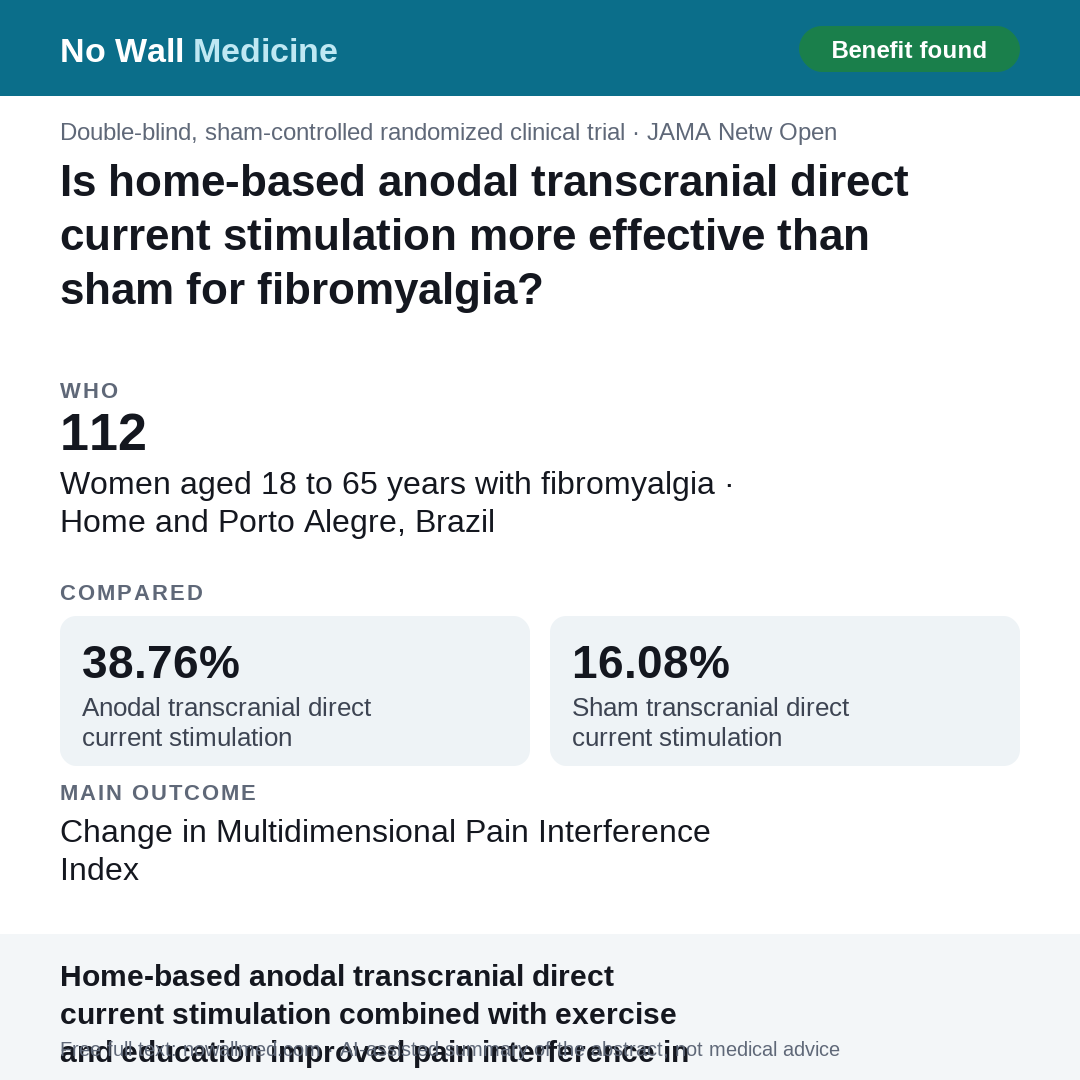
Clinical question: Is home-based anodal transcranial direct current stimulation more effective than sham for fibromyalgia?
Why it matters: It is unclear how long the effects of home-based brain stimulation last and how placebo responses or exercise influence pain and disability in fibromyalgia patients.
Key points
- The study randomized 112 women with fibromyalgia to receive either active transcranial direct current stimulation (a type of electrical brain stimulation) or a sham treatment combined with exercise and pain neuroscience education.
- The active stimulation group showed a 38.76% reduction in the Multidimensional Pain Interference Index compared to a 16.08% reduction in the sham group.
- An improvement of 50% or more in the pain interference scale was achieved by 62.5% of participants in the active stimulation group versus 37.5% in the sham group.
Headline and key points written with AI from the paper’s abstract, with every number checked against it. Read the paper before relying on them.
Topics
Cite this article
Caumo W, Franca BR, Orzechowski R, Bueno G, França de Souza A, Dos Santos da Silva JV. Home-Based Transcranial Direct Current Stimulation vs Placebo for Fibromyalgia: A Randomized Clinical Trial. JAMA Netw Open. 2025. doi:10.1001/jamanetworkopen.2025.14262
Spotted a mistake? Suggest a correction