Homoharringtonine-based induction therapy was associated with higher remission and survival in childhood acute myeloid leukemia
Homoharringtonine-Based Induction Regimen Improved the Remission Rate and Survival Rate in Chinese Childhood AML: A Report From the CCLG-AML 2015 Protocol Study
Open-label, multicenter, randomized trialBenefit found
Does homoharringtonine-based induction improve remission and survival in childhood acute myeloid leukemia?
Who
1253
Patients with newly diagnosed childhood acute myeloid leukemia · 35 centers in China
Compared
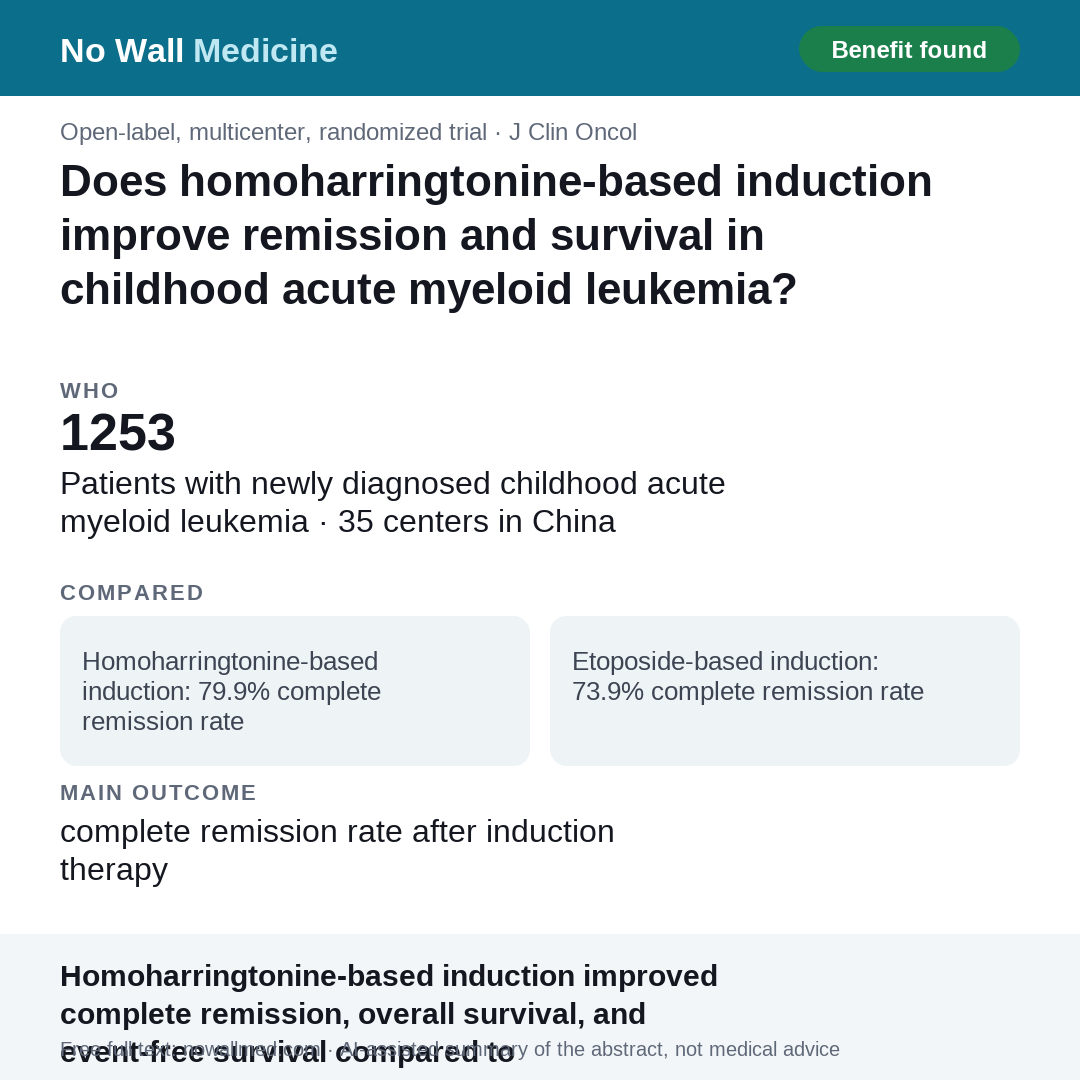
Homoharringtonine-based induction: 79.9% complete remission rate
Etoposide-based induction: 73.9% complete remission rate
Main outcome
complete remission rate after induction therapy
Result: 3-year overall survival 69.2% (95% CI, 65.1 to 72.9) vs 62.8% (95% CI, 58.7 to 66.6)
Bottom line: Homoharringtonine-based induction improved complete remission, overall survival, and event-free survival compared to etoposide-based induction in childhood acute myeloid leukemia.
J Clin Oncol · 2023-08-02Download image
Clinical question: Does homoharringtonine-based induction improve remission and survival in childhood acute myeloid leukemia?
Why it matters: The efficacy and safety of homoharringtonine-based induction therapy and all-trans retinoic acid-based maintenance therapy for childhood acute myeloid leukemia were not confirmed.
Key points
- Researchers studied 1,253 children with newly diagnosed acute myeloid leukemia, comparing induction regimens using homoharringtonine or etoposide and maintenance therapy using all-trans retinoic acid or cytarabine.
- The homoharringtonine induction group had a 79.9% complete remission rate compared to 73.9% for the etoposide group, and a 3-year overall survival rate of 69.2% versus 62.8%.
- Among patients receiving maintenance therapy, 3-year event-free survival did not differ significantly between the four treatment combinations.
Headline and key points written with AI from the paper’s abstract, with every number checked against it. Read the paper before relying on them.
Was this summary helpful?
Subject terms
Cite this article
Li J, Gao J, Liu A, Liu W, Xiong H, Liang C. Homoharringtonine-Based Induction Regimen Improved the Remission Rate and Survival Rate in Chinese Childhood AML: A Report From the CCLG-AML 2015 Protocol Study. J Clin Oncol. 2023. doi:10.1200/JCO.22.02836
Spotted a mistake? Suggest a correction
Top studies every Monday
The week’s key trials and guidelines in your specialties, plus any topics you follow. By email, free.
Get the weekly digest