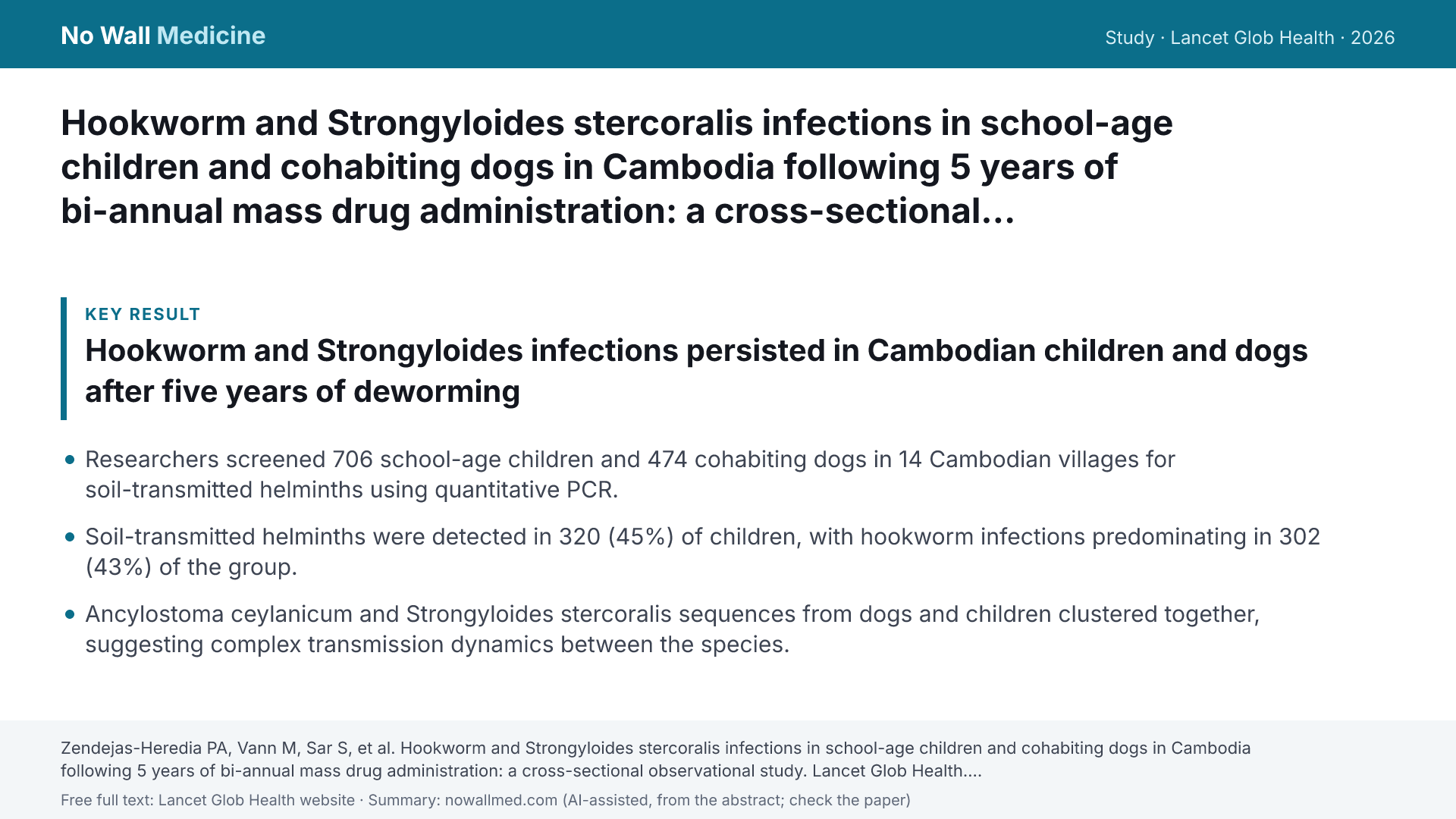
Hookworm and Strongyloides infections persisted in Cambodian children and dogs after five years of deworming
Hookworm and Strongyloides stercoralis infections in school-age children and cohabiting dogs in Cambodia following 5 years of bi-annual mass drug administration: a cross-sectional observational study
Key points
- Researchers screened 706 school-age children and 474 cohabiting dogs in 14 Cambodian villages for soil-transmitted helminths using quantitative PCR.
- Soil-transmitted helminths were detected in 320 (45%) of children, with hookworm infections predominating in 302 (43%) of the group.
- Ancylostoma ceylanicum and Strongyloides stercoralis sequences from dogs and children clustered together, suggesting complex transmission dynamics between the species.
Limitation the authors note: The study was cross-sectional and observational, so it could only show links between infections and not prove causation or the direction of transmission.
Study type: Observational study: it can show a link, but not prove that one thing causes another.
Headline and key points written with AI from the paper’s abstract, with every number checked against it. Read the paper before relying on them.
Was this summary helpful?
Subject terms
Headline, design, result, key points, caveat and citation as plain text.
Cite this article
Zendejas-Heredia PA, Vann M, Sar S, et al. Hookworm and Strongyloides stercoralis infections in school-age children and cohabiting dogs in Cambodia following 5 years of bi-annual mass drug administration: a cross-sectional observational study. Lancet Glob Health. 2026;14(11):104033. doi:10.1016/j.langlo.2026.104033
Spotted a mistake? Suggest a correction