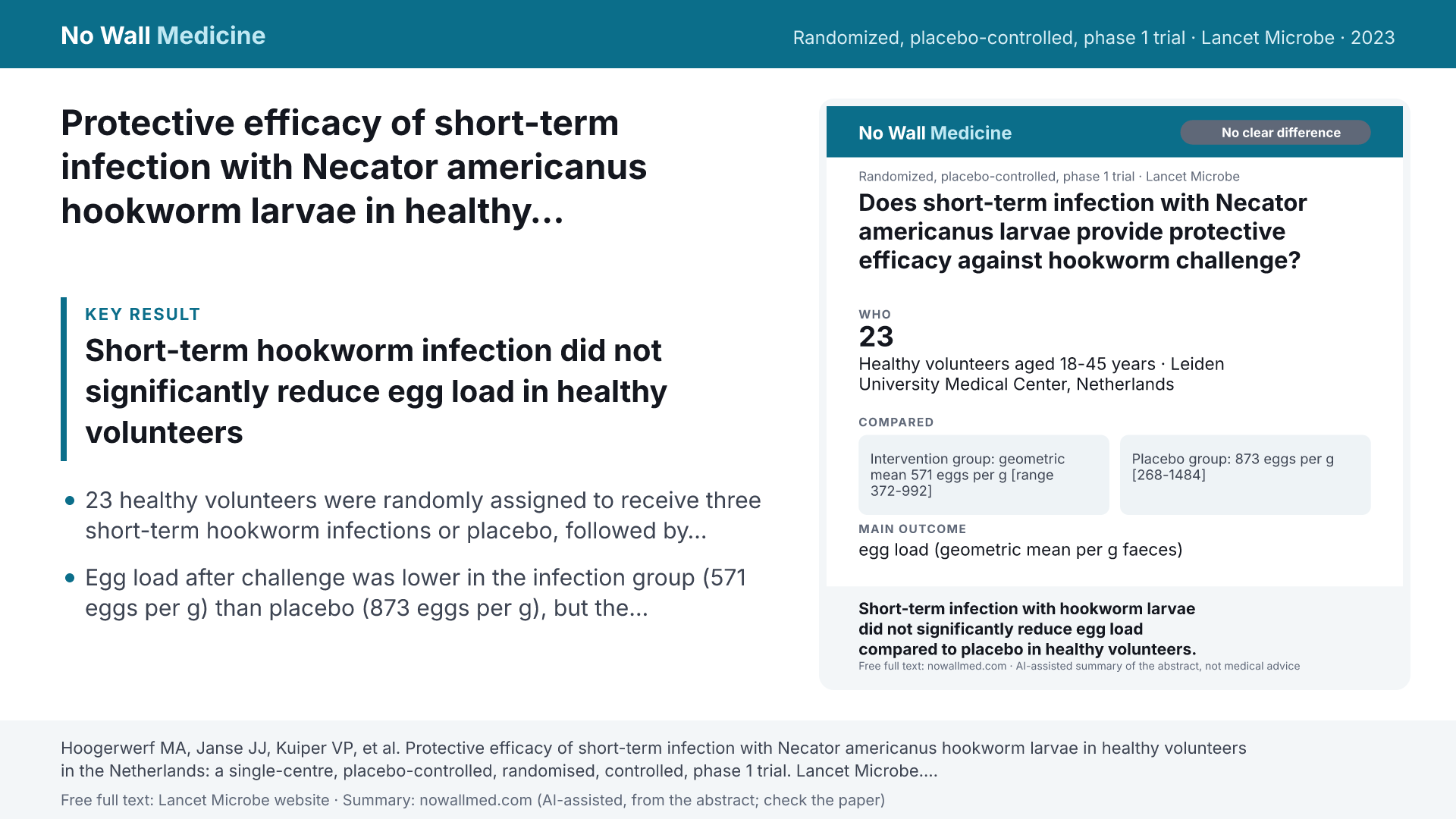
Short-term hookworm infection did not significantly reduce egg load in healthy volunteers
Protective efficacy of short-term infection with Necator americanus hookworm larvae in healthy volunteers in the Netherlands: a single-centre, placebo-controlled, randomised, controlled, phase 1 trial
Randomized, placebo-controlled, phase 1 trialNo clear difference
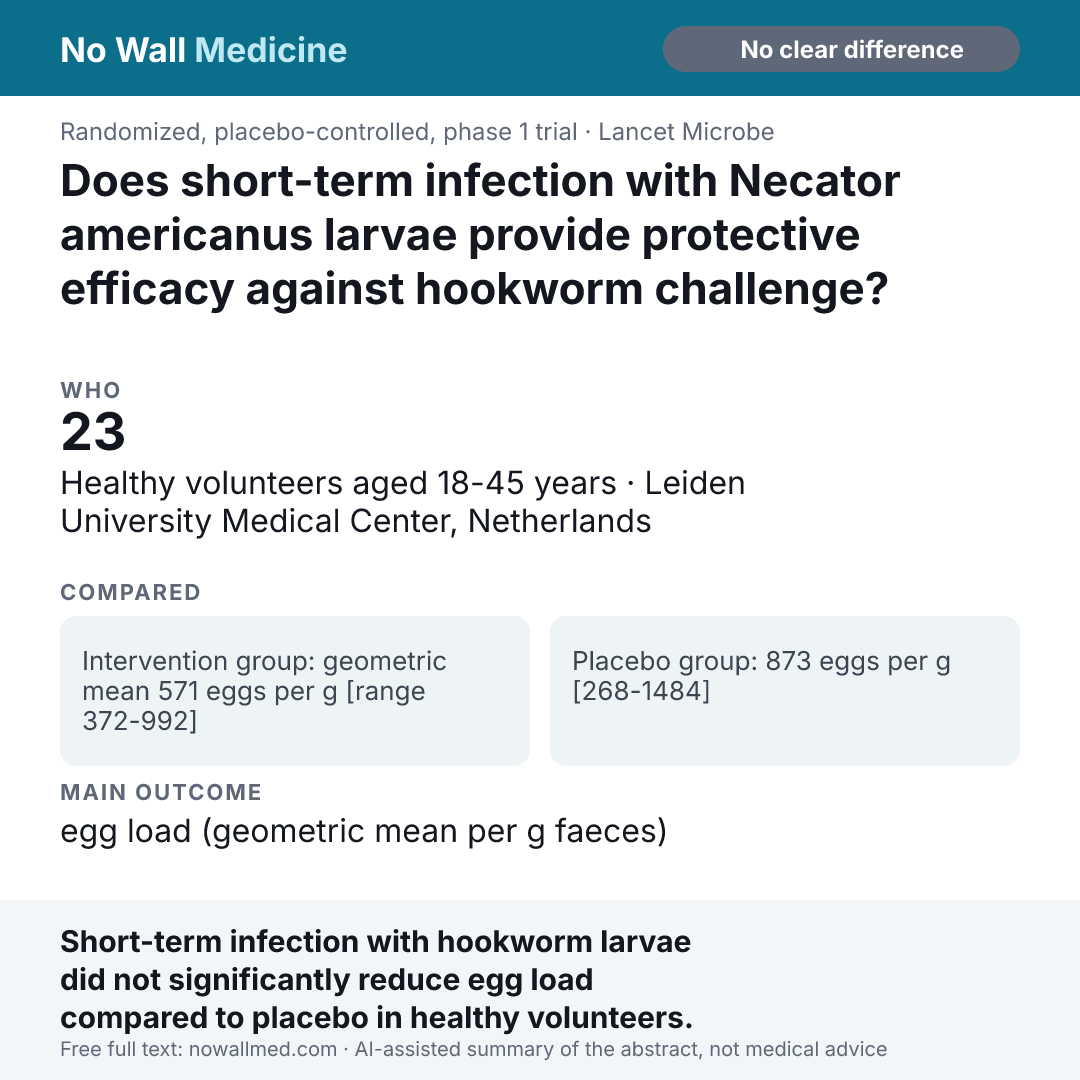
Does short-term infection with Necator americanus larvae provide protective efficacy against hookworm challenge?
Who
23
Healthy volunteers aged 18-45 years · Leiden University Medical Center, Netherlands
Compared
Intervention group: geometric mean 571 eggs per g [range 372-992]
Placebo group: 873 eggs per g [268-1484]
Main outcome
egg load (geometric mean per g faeces)
Bottom line: Short-term infection with hookworm larvae did not significantly reduce egg load compared to placebo in healthy volunteers.
Limitation: The difference in egg load between groups was not statistically significant (p=0·10).
Lancet Microbe · 2023-12-03 · Funded by Dioraphte Foundation · NCT03702530
Why it matters: Vaccine development is hampered by the lack of protective immunity in exposed populations, limiting the identification of new vaccine targets.
Headline and visual abstract written with AI from the paper’s abstract, with every number checked against it. Read the paper before relying on them.
Was this summary helpful?
Abstract
Background
Vaccine development against hookworm is hampered by the absence of the development of protective immunity in populations repeatedly exposed to hookworm, limiting identification of mechanisms of protective immunity and new vaccine targets. Immunisation with attenuated larvae has proven effective in dogs and partial immunity has been achieved using an irradiated larvae model in healthy volunteers. We aimed to investigate the protective efficacy of immunisation with short-term larval infection against hookworm challenge. Methods
We did a single-centre, placebo-controlled, randomised, controlled, phase 1 trial at Leiden University Medical Center (Leiden, Netherlands). Healthy volunteers (aged 18-45 years) were recruited using advertisements on social media and in publicly accessible areas. Volunteers were randomly assigned (2:1) to receive three short-term infections with 50 infectious Necator americanus third-stage filariform larvae (50L3) or placebo. Infection was abrogated with a 3-day course of albendazole 400 mg, 2 weeks after each exposure. Subsequently all volunteers were challenged with two doses of 50L3 at a 2-week interval. The primary endpoint was egg load (geometric mean per g faeces) measured weekly between weeks 12 and 16 after first challenge, assessed in the per-protocol population, which included all randomly assigned volunteers with available data on egg counts at week 12-16 after challenge. This study is registered with ClinicalTrials.gov, NCT03702530. Findings
Between Nov 8 and Dec 14, 2018, 26 volunteers were screened, of whom 23 enrolled in the trial. The first immunisation was conducted on Dec 18, 2018. 23 volunteers were randomly assigned (15 to the intervention group and eight to the placebo group). Egg load after challenge was lower in the intervention group than the placebo group (geometric mean 571 eggs per g [range 372-992] vs 873 eggs per g [268-1484]); however, this difference was not statistically significant (p=0·10). Five volunteers in the intervention group developed a severe skin rash, which was associated with 40% reduction in egg counts after challenge (geometric mean 742 eggs per g [range 268-1484] vs 441 eggs per g [range 380-520] after challenge; p=0·0025) and associated with higher peak IgG1 titres. Interpretation
To our knowledge, this is the first study to describe a protective effect of short-term exposure to hookworm larvae and show an association with skin response, eosinophilic response, and IgG1. These findings could inform future hookworm vaccine development. Funding
Dioraphte Foundation.
Abstract reproduced under the article’s CC BY licence.
Subject terms
Cite this article
Hoogerwerf MA, Janse JJ, Kuiper VP, et al. Protective efficacy of short-term infection with Necator americanus hookworm larvae in healthy volunteers in the Netherlands: a single-centre, placebo-controlled, randomised, controlled, phase 1 trial. Lancet Microbe. 2023;4(12):e1024-e1034. doi:10.1016/S2666-5247(23)00218-5
Spotted a mistake? Suggest a correction