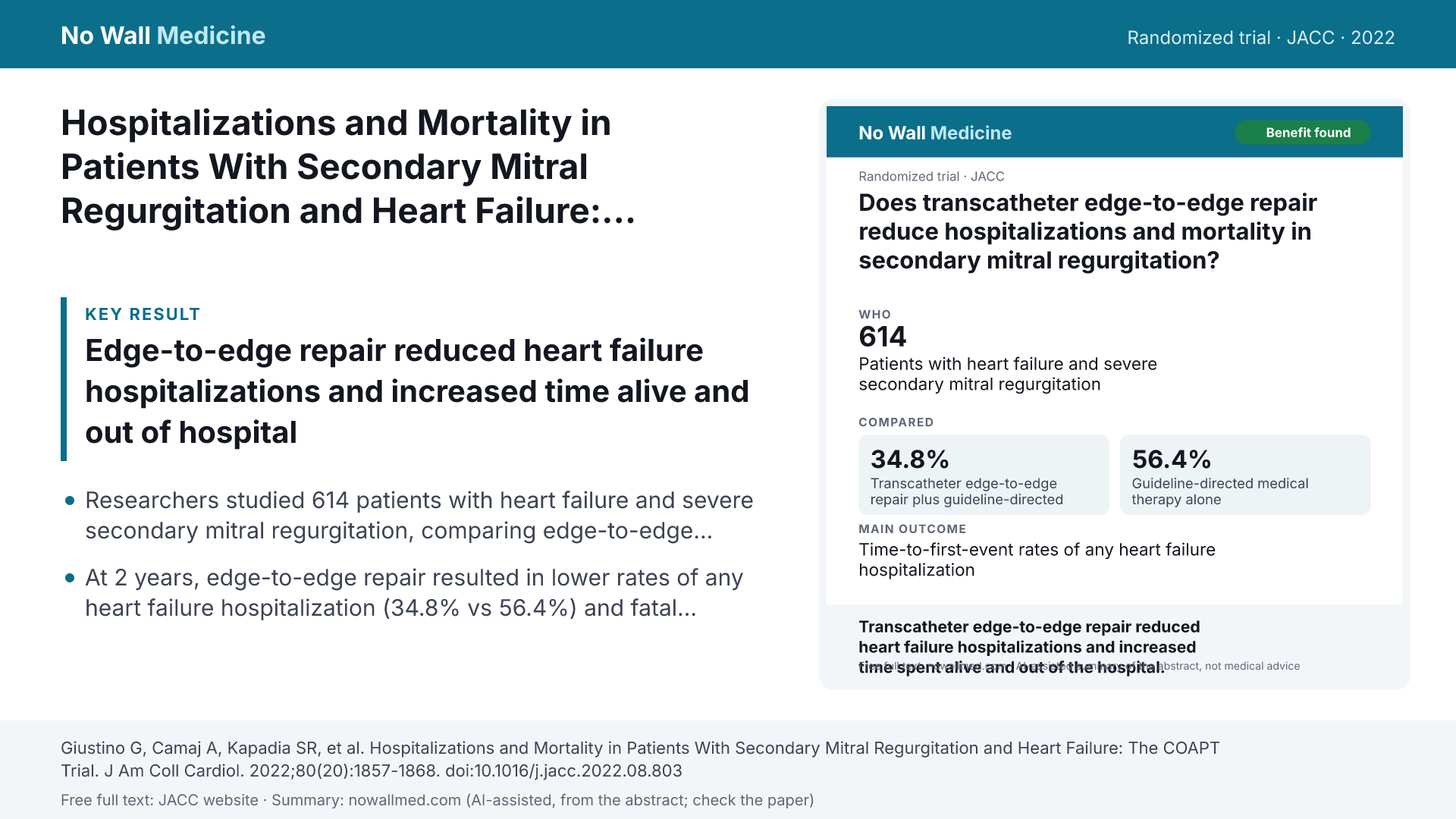
Edge-to-edge repair reduced heart failure hospitalizations and increased time alive and out of hospital
Hospitalizations and Mortality in Patients With Secondary Mitral Regurgitation and Heart Failure: The COAPT Trial
Randomized trialBenefit found
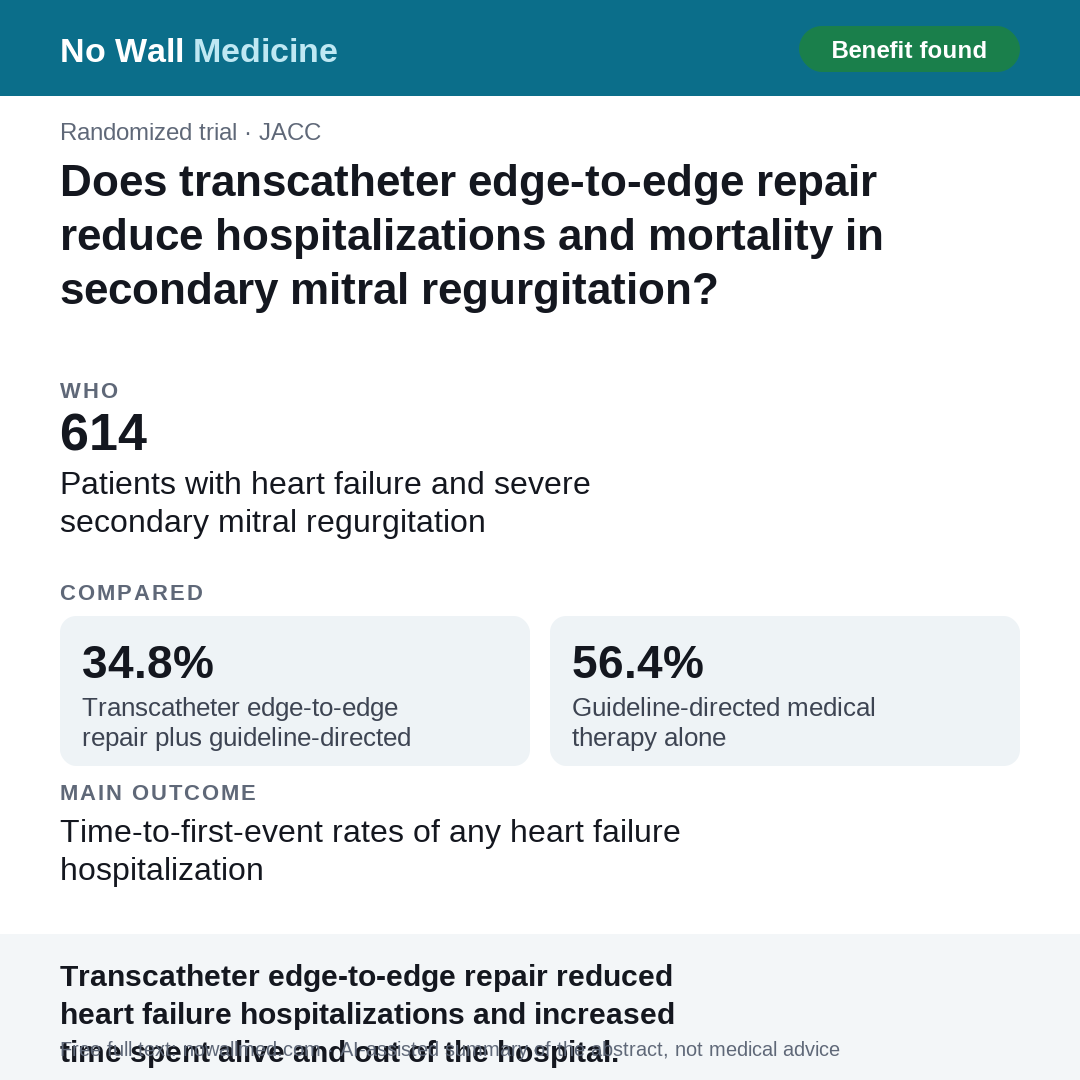
Does transcatheter edge-to-edge repair reduce hospitalizations and mortality in secondary mitral regurgitation?
Who
614
Patients with heart failure and severe secondary mitral regurgitation
Compared
34.8%Transcatheter edge-to-edge repair plus guideline-directed medical therapy
56.4%Guideline-directed medical therapy alone
Main outcome
Time-to-first-event rates of any heart failure hospitalization
Result: hazard ratio 0.51 (95% CI 0.39-0.66)
Bottom line: Transcatheter edge-to-edge repair reduced heart failure hospitalizations and increased time spent alive and out of the hospital.
JACC · 2022-11-10Download image
Clinical question: Does transcatheter edge-to-edge repair reduce hospitalizations and mortality in secondary mitral regurgitation?
Why it matters: The impact of transcatheter edge-to-edge repair on the rate and prognostic impact of hospitalizations in patients with heart failure and severe secondary mitral regurgitation is unknown.
Key points
- Researchers studied 614 patients with heart failure and severe secondary mitral regurgitation, comparing edge-to-edge repair plus medical therapy to medical therapy alone.
- At 2 years, edge-to-edge repair resulted in lower rates of any heart failure hospitalization (34.8% vs 56.4%) and fatal heart failure hospitalization (6.5% vs 12.6%).
- Patients receiving edge-to-edge repair spent an average of 581 ± 27 days alive and out of the hospital compared to 519 ± 26 days for medical therapy alone.
Headline and key points written with AI from the paper’s abstract, with every number checked against it. Read the paper before relying on them.
Was this summary helpful?
Subject terms
Cite this article
Giustino G, Camaj A, Kapadia SR, et al. Hospitalizations and Mortality in Patients With Secondary Mitral Regurgitation and Heart Failure: The COAPT Trial. JACC. 2022. doi:10.1016/j.jacc.2022.08.803
Spotted a mistake? Suggest a correction