Hospitalizations and Mortality in Patients With Secondary Mitral Regurgitation and Heart Failure: The COAPT Trial
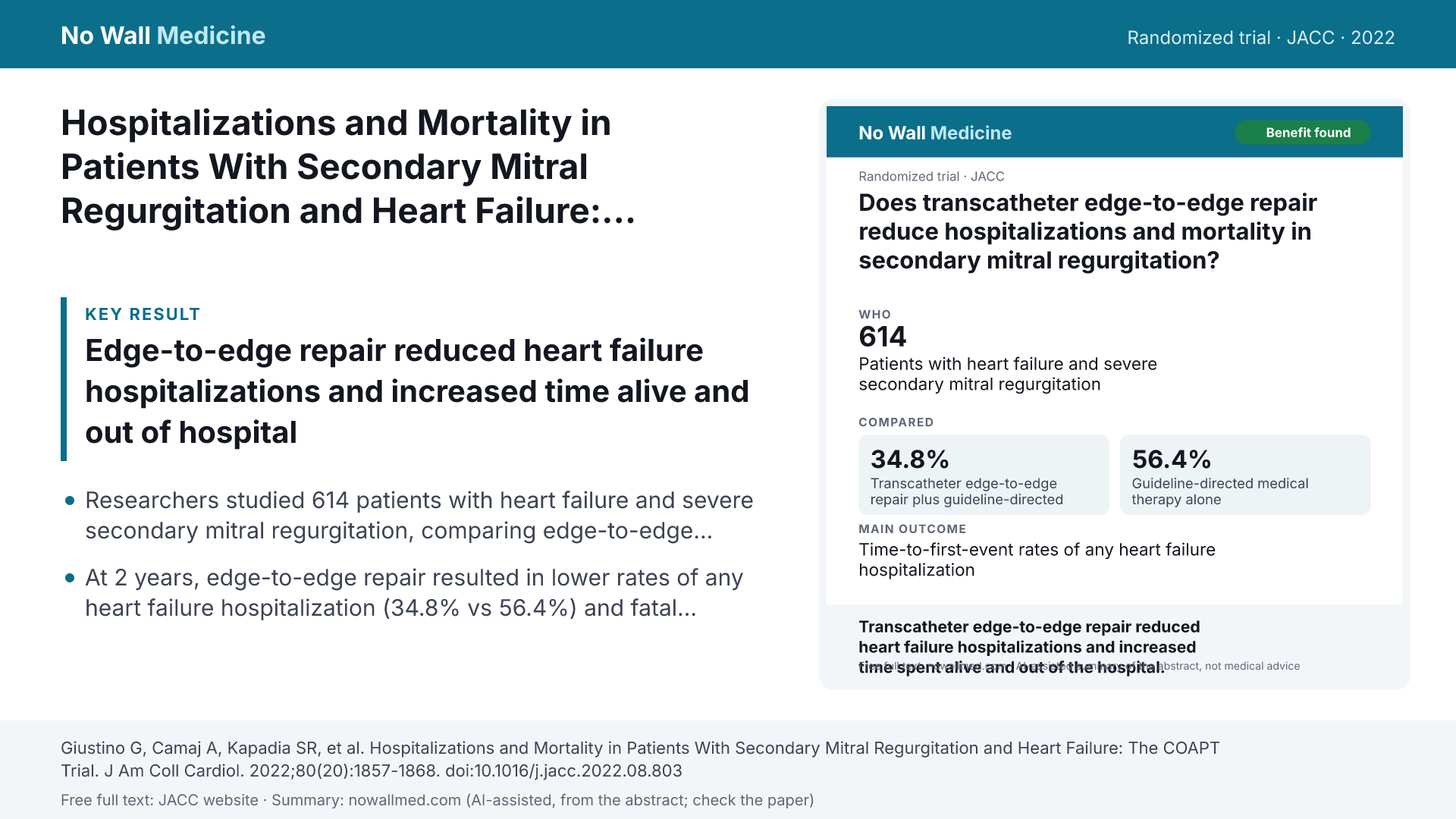
Key result: Edge-to-edge repair reduced heart failure hospitalizations and increased time alive and out of hospital
Randomized trialBenefit found
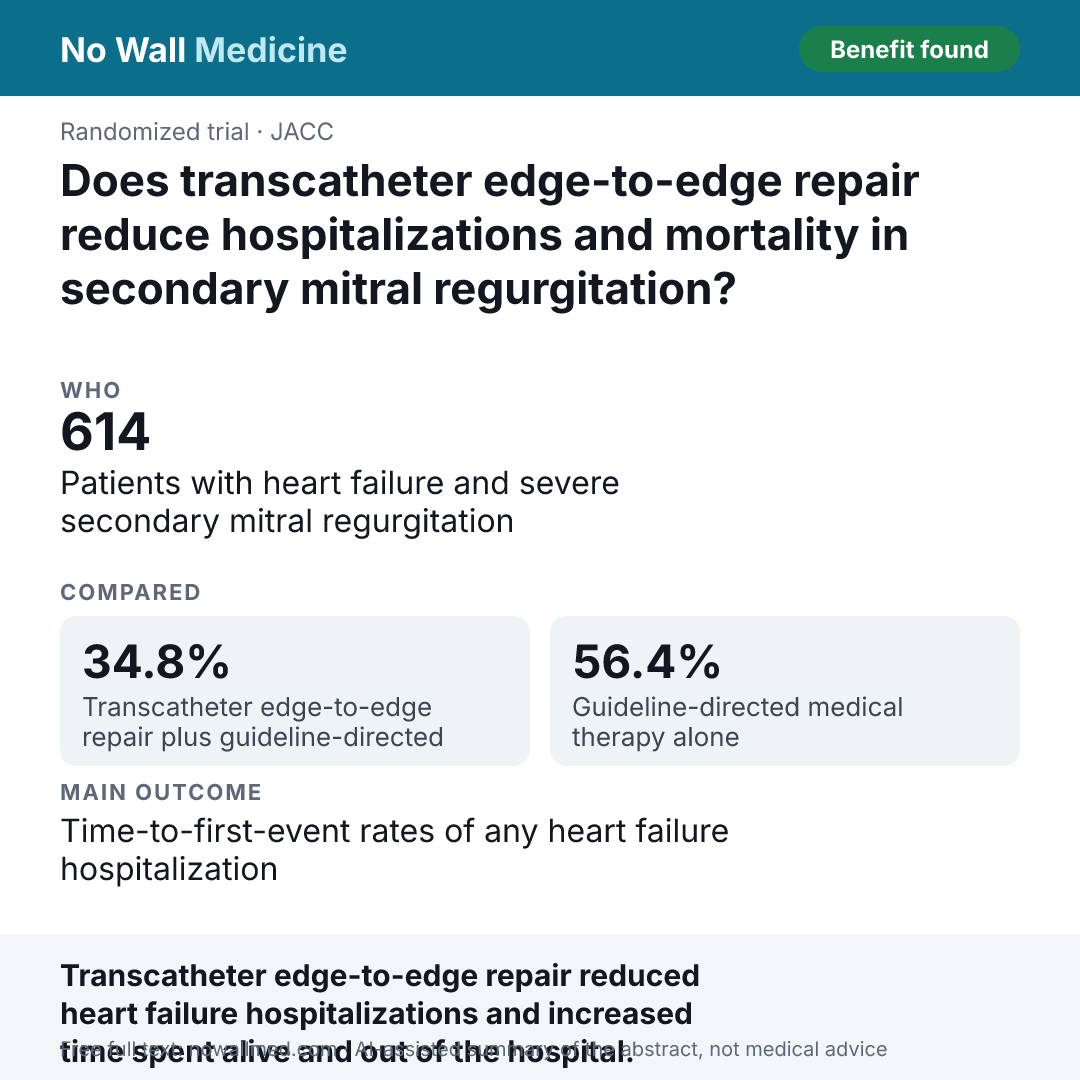
Does transcatheter edge-to-edge repair reduce hospitalizations and mortality in secondary mitral regurgitation?
Who
614
Patients with heart failure and severe secondary mitral regurgitation
Compared
34.8%Transcatheter edge-to-edge repair plus guideline-directed medical therapy
56.4%Guideline-directed medical therapy alone
Main outcome
Time-to-first-event rates of any heart failure hospitalization
Result: hazard ratio 0.51 (95% CI 0.39-0.66)
Bottom line: Transcatheter edge-to-edge repair reduced heart failure hospitalizations and increased time spent alive and out of the hospital.
JACC · 2022-11-10 · Save PNG
Key points
- Researchers studied 614 patients with heart failure and severe secondary mitral regurgitation, comparing edge-to-edge repair plus medical therapy to medical therapy alone.
- At 2 years, edge-to-edge repair resulted in lower rates of any heart failure hospitalization (34.8% vs 56.4%) and fatal heart failure hospitalization (6.5% vs 12.6%).
- Patients receiving edge-to-edge repair spent an average of 581 ± 27 days alive and out of the hospital compared to 519 ± 26 days for medical therapy alone.
Discussion prompts
- Would these patients look like yours? Who was left out?
- Is the main outcome one that matters to patients?
- Is the difference large enough to change what you do?
Cite: Giustino G, Camaj A, Kapadia SR, et al. Hospitalizations and Mortality in Patients With Secondary Mitral Regurgitation and Heart Failure: The COAPT Trial. J Am Coll Cardiol. 2022;80(20):1857-1868. doi:10.1016/j.jacc.2022.08.803
Free full text: JACC website · Summary and visual abstract: nowallmed.com/a/hospitalizations-and-mortality-in-patients-with-secondary-mitral-11espr3/ (AI-assisted from the abstract; check the paper before relying on it).