Do Not Attempt Cardiopulmonary Resuscitation decisions were associated with different clinical care choices in a vignette study
How might a 'Do Not Attempt Cardiopulmonary Resuscitation' (DNACPR) decision affect other aspects of patient care? A vignette-based randomised study
Double-blind randomized vignette-based studyHarm found
Does a Do Not Attempt Cardiopulmonary Resuscitation decision affect other aspects of patient care?
Who
226
Senior geriatricians and specialist trainees
Compared
DNACPR decision in place: 67.3% considered non-invasive ventilation; 10.9% considered intensive care
DNACPR decision absent: 83.6% considered non-invasive ventilation; 25.5% considered intensive care
Main outcome
Consideration of escalation of care interventions
Bottom line: A Do Not Attempt Cardiopulmonary Resuscitation decision may lead to unconscious bias in other clinical escalation decisions.
Age Ageing · 2025-08-13Download image
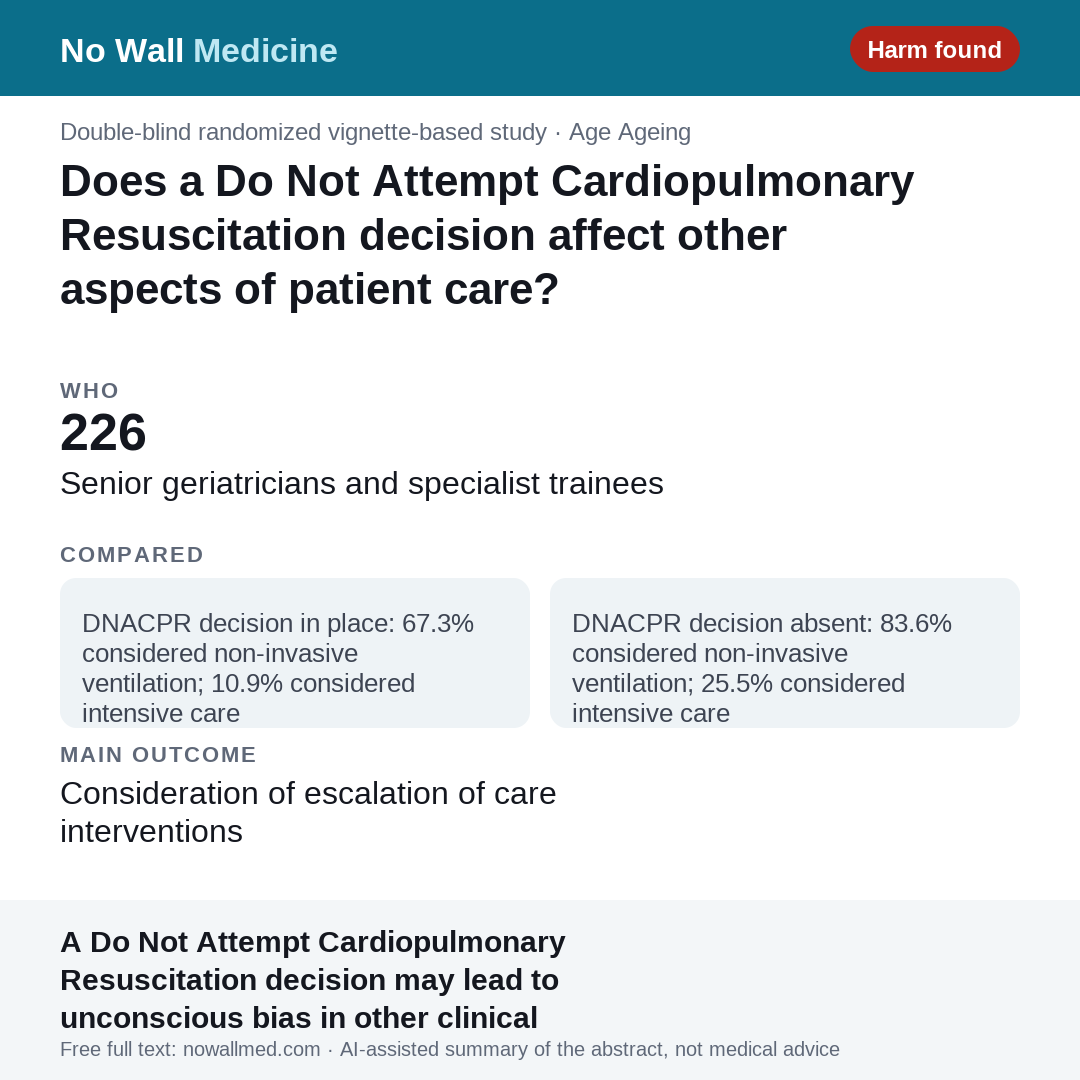
Clinical question: Does a Do Not Attempt Cardiopulmonary Resuscitation decision affect other aspects of patient care?
Why it matters: Clinicians and patients often question whether a decision to withhold cardiopulmonary resuscitation might affect the attention paid to other aspects of patient care.
Key points
- Researchers presented clinical scenarios of a deteriorating patient to 226 senior geriatricians and specialist trainees using a double-blind approach.
- A Do Not Attempt Cardiopulmonary Resuscitation decision was associated with 67.3% of clinicians considering non-invasive ventilation for respiratory failure compared to 83.6% without the decision.
- The presence of a Do Not Attempt Cardiopulmonary Resuscitation decision was associated with 10.9% of clinicians considering intensive care compared to 25.5% when the decision was absent.
Headline and key points written with AI from the paper’s abstract, with every number checked against it. Read the paper before relying on them.
Was this summary helpful?
Subject terms
Cite this article
Tham Y, Brooks D, Venkatesh A, Johansen A. How might a 'Do Not Attempt Cardiopulmonary Resuscitation' (DNACPR) decision affect other aspects of patient care? A vignette-based randomised study. Age Ageing. 2025. doi:10.1093/ageing/afaf223
Spotted a mistake? Suggest a correction
Top studies every Monday
The week’s key trials and guidelines in your specialties, plus any topics you follow. By email, free.
Get the weekly digest