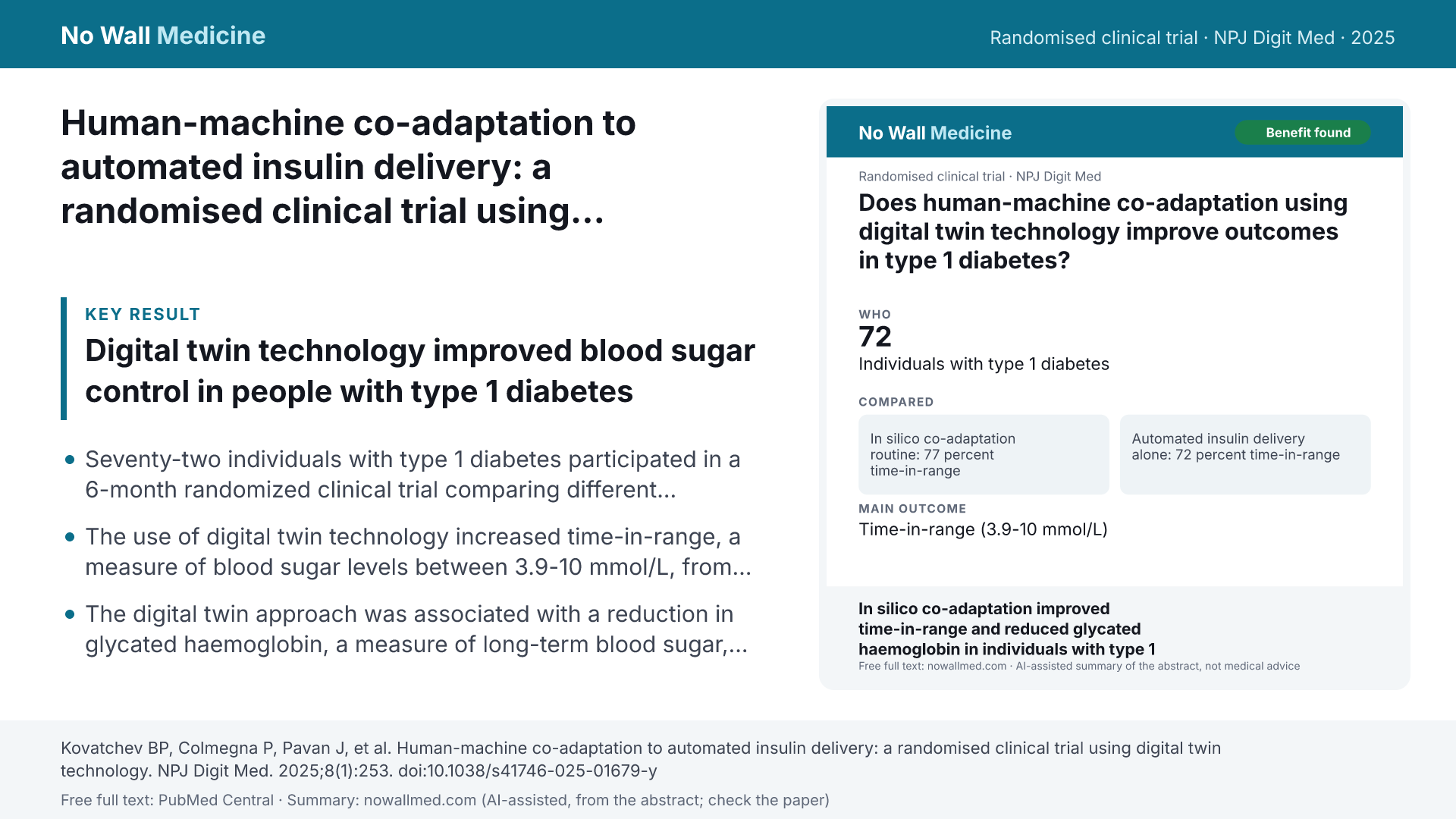
Digital twin technology improved blood sugar control in people with type 1 diabetes
Human-machine co-adaptation to automated insulin delivery: a randomised clinical trial using digital twin technology
Randomised clinical trialBenefit found
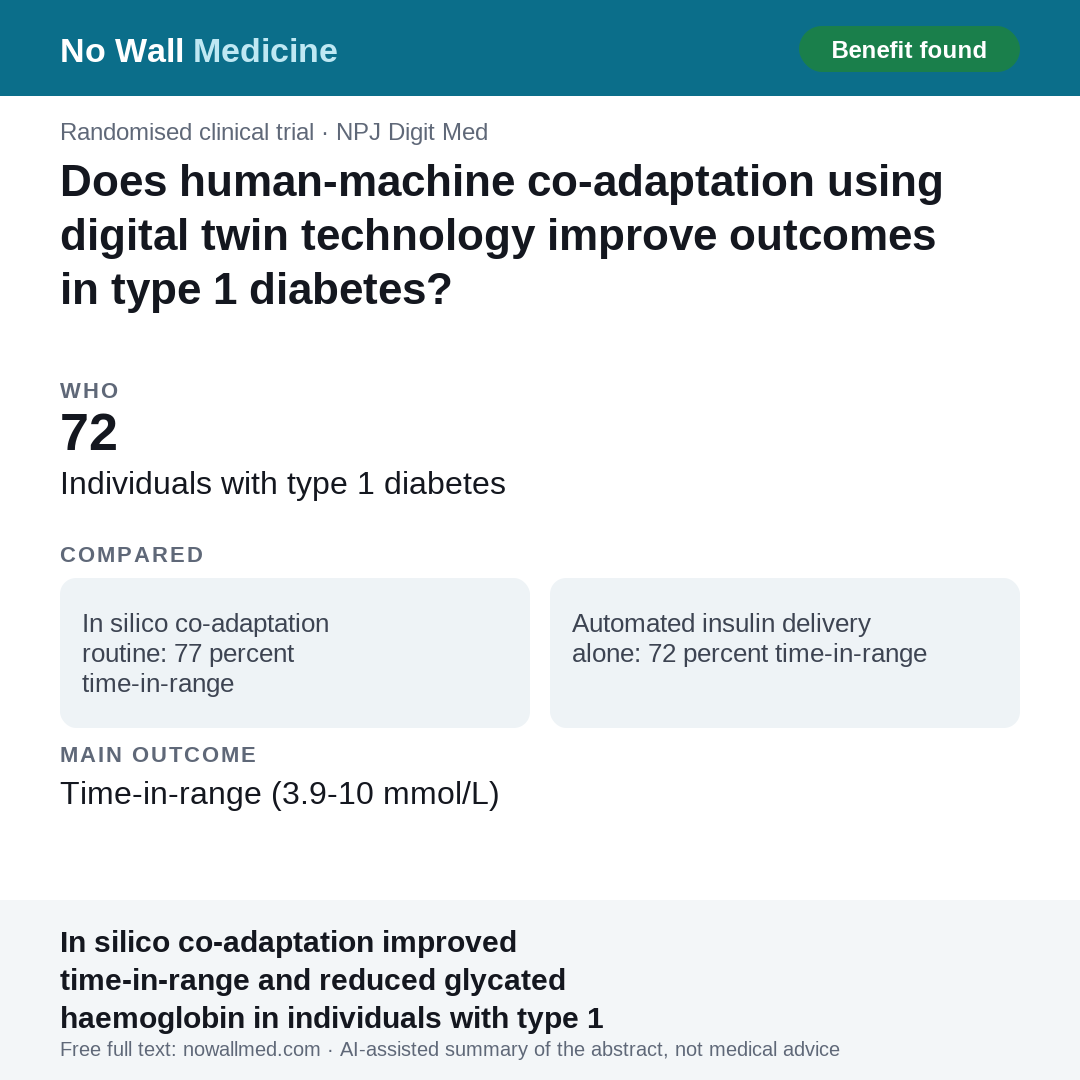
Does human-machine co-adaptation using digital twin technology improve outcomes in type 1 diabetes?
Who
72
Individuals with type 1 diabetes
Compared
In silico co-adaptation routine: 77 percent time-in-range
Automated insulin delivery alone: 72 percent time-in-range
Main outcome
Time-in-range (3.9-10 mmol/L)
Bottom line: In silico co-adaptation improved time-in-range and reduced glycated haemoglobin in individuals with type 1 diabetes.
NPJ Digit Med · 2025-05-06Download image
Clinical question: Does human-machine co-adaptation using digital twin technology improve outcomes in type 1 diabetes?
Why it matters: Most automated insulin delivery algorithms do not adapt to changing user physiology or provide ways for users to adapt to the algorithm's actions.
Key points
- Seventy-two individuals with type 1 diabetes participated in a 6-month randomized clinical trial comparing different methods of information feedback and digital twin simulation.
- The use of digital twin technology increased time-in-range, a measure of blood sugar levels between 3.9-10 mmol/L, from 72% to 77%.
- The digital twin approach was associated with a reduction in glycated haemoglobin, a measure of long-term blood sugar, from 6.8% to 6.6%.
Headline and key points written with AI from the paper’s abstract, with every number checked against it. Read the paper before relying on them.
Was this summary helpful?
Cite this article
Kovatchev BP, Colmegna P, Pavan J, Diaz Castañeda JL, Villa-Tamayo MF, Koravi CLK. Human-machine co-adaptation to automated insulin delivery: a randomised clinical trial using digital twin technology. NPJ Digit Med. 2025. doi:10.1038/s41746-025-01679-y
Spotted a mistake? Suggest a correction