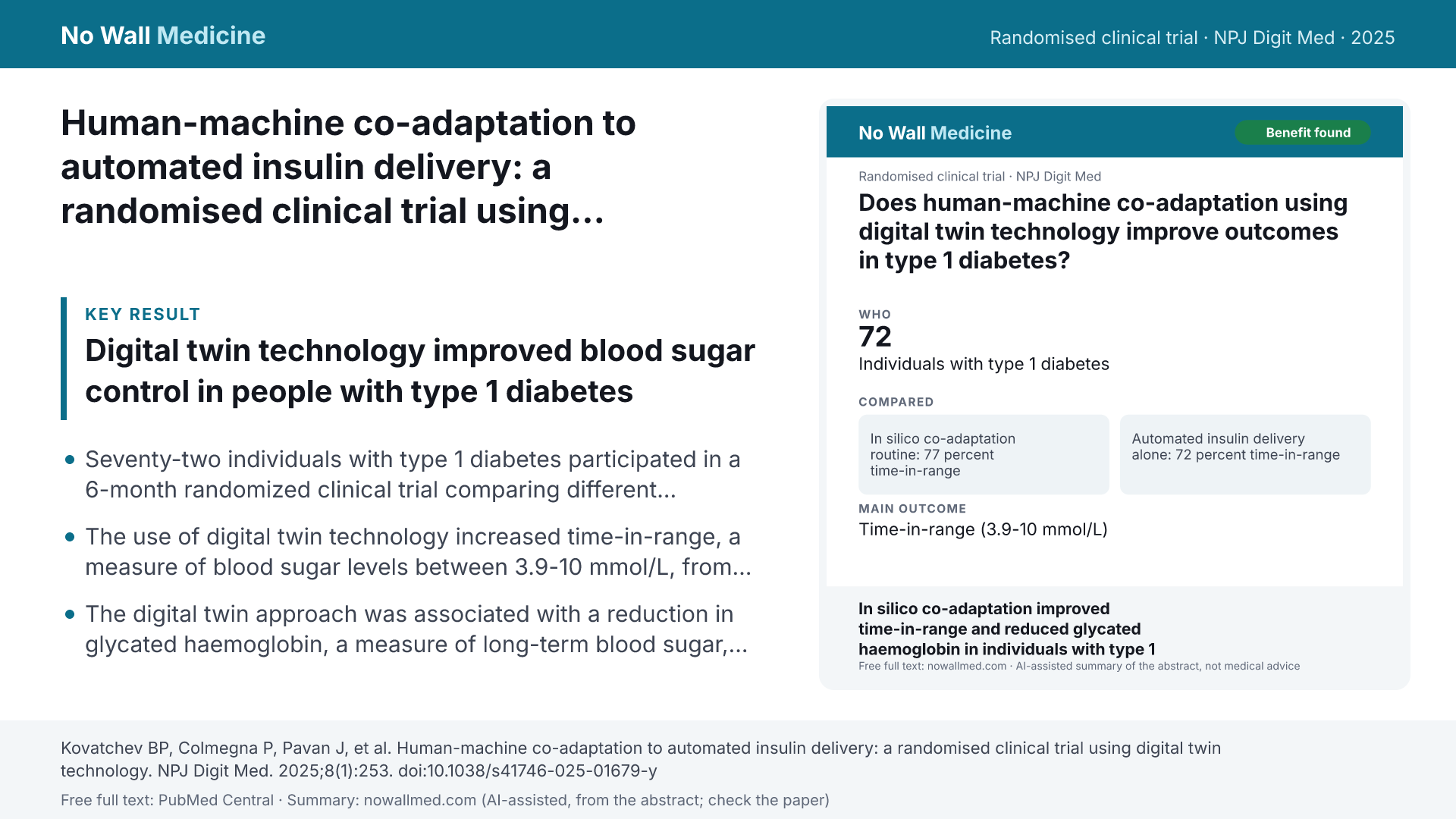
Human-machine co-adaptation to automated insulin delivery: a randomised clinical trial using digital twin technology
Key result: Digital twin technology improved blood sugar control in people with type 1 diabetes
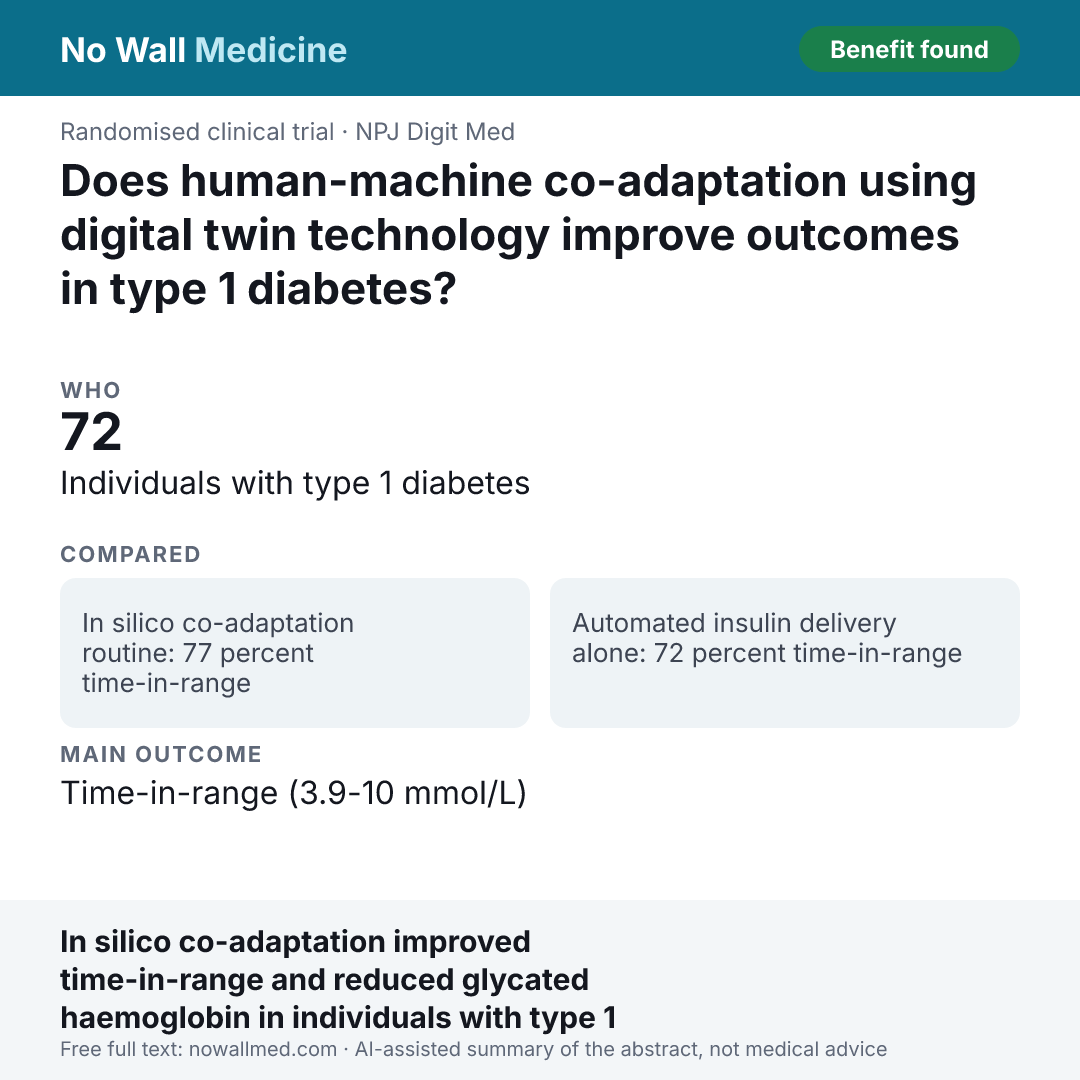
Randomised clinical trialBenefit found
Does human-machine co-adaptation using digital twin technology improve outcomes in type 1 diabetes?
Who
72
Individuals with type 1 diabetes
Compared
In silico co-adaptation routine: 77 percent time-in-range
Automated insulin delivery alone: 72 percent time-in-range
Main outcome
Time-in-range (3.9-10 mmol/L)
Bottom line: In silico co-adaptation improved time-in-range and reduced glycated haemoglobin in individuals with type 1 diabetes.
NPJ Digit Med · 2025-05-06 · Save PNG
Key points
- Seventy-two individuals with type 1 diabetes participated in a 6-month randomized clinical trial comparing different methods of information feedback and digital twin simulation.
- The use of digital twin technology increased time-in-range, a measure of blood sugar levels between 3.9-10 mmol/L, from 72% to 77%.
- The digital twin approach was associated with a reduction in glycated haemoglobin, a measure of long-term blood sugar, from 6.8% to 6.6%.
Why it matters: Most automated insulin delivery algorithms do not adapt to changing user physiology or provide ways for users to adapt to the algorithm's actions.
Discussion prompts
- Would these patients look like yours? Who was left out?
- Is the main outcome one that matters to patients?
- Is the difference large enough to change what you do?
Cite: Kovatchev BP, Colmegna P, Pavan J, et al. Human-machine co-adaptation to automated insulin delivery: a randomised clinical trial using digital twin technology. NPJ Digit Med. 2025;8(1):253. doi:10.1038/s41746-025-01679-y
Free full text: PubMed Central · Summary and visual abstract: nowallmed.com/a/human-machine-co-adaptation-to-automated-insulin-delivery-a-1e5zxr4/ (AI-assisted from the abstract; check the paper before relying on it).