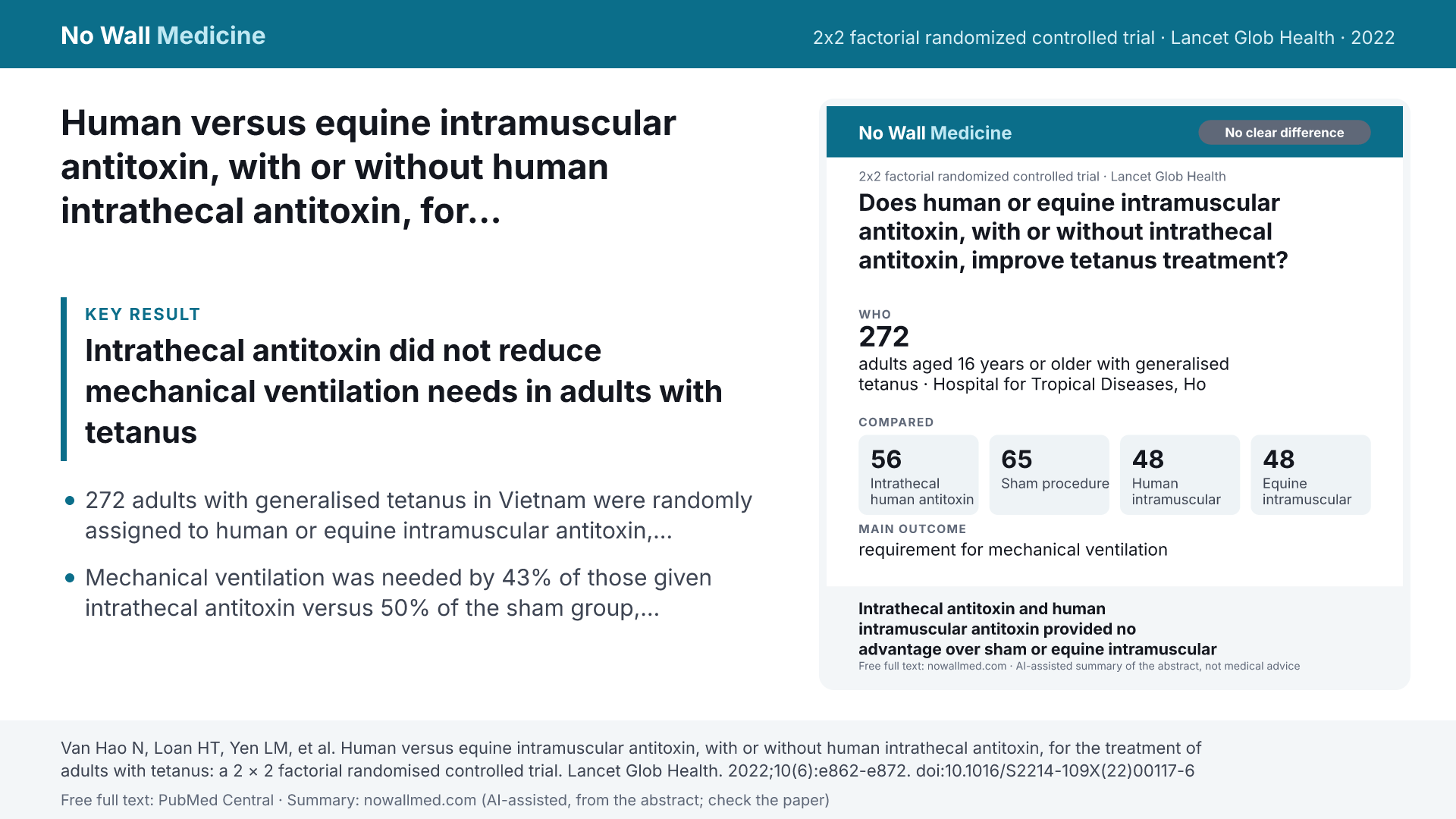
Intrathecal antitoxin did not reduce mechanical ventilation needs in adults with tetanus
Human versus equine intramuscular antitoxin, with or without human intrathecal antitoxin, for the treatment of adults with tetanus: a 2 × 2 factorial randomised controlled trial
2x2 factorial randomized controlled trialNo clear difference
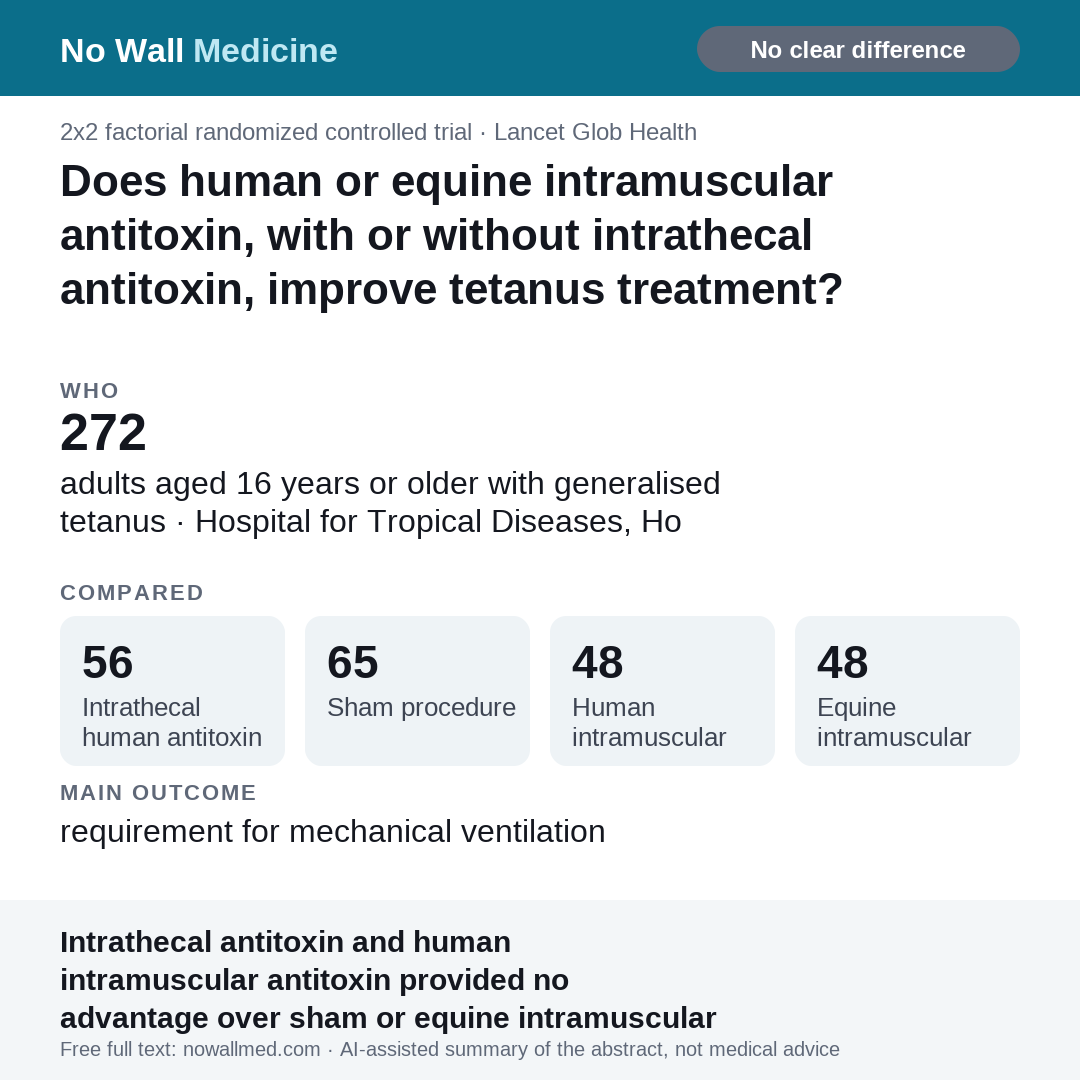
Does human or equine intramuscular antitoxin, with or without intrathecal antitoxin, improve tetanus treatment?
Who
272
adults aged 16 years or older with generalised tetanus · Hospital for Tropical Diseases, Ho Chi Minh City, Vietnam
Compared
56Intrathecal human antitoxin (43%)
65Sham procedure (50%)
48Human intramuscular antitoxin (45%)
48Equine intramuscular antitoxin (44%)
Main outcome
requirement for mechanical ventilation
Result: RR 0.87 (95% CI 0.66-1.13); RR 1.01 (95% CI 0.75-1.36)
Bottom line: Intrathecal antitoxin and human intramuscular antitoxin provided no advantage over sham or equine intramuscular antitoxin for tetanus.
Funded by: The Wellcome Trust
Lancet Glob Health · 2022-05-13Download image
Clinical question: Does human or equine intramuscular antitoxin, with or without intrathecal antitoxin, improve tetanus treatment?
Why it matters: Few data compared human and equine antitoxin, and it was unclear if intrathecal injection improved outcomes given limited central nervous system penetration.
Key points
- 272 adults with generalised tetanus in Vietnam were randomly assigned to human or equine intramuscular antitoxin, plus intrathecal antitoxin or sham.
- Mechanical ventilation was needed by 43% of those given intrathecal antitoxin versus 50% of the sham group, a difference that was not statistically significant.
- No clinically relevant difference in adverse events was reported between the groups, and there were no intervention-related deaths.
Limitation the authors note: 54 patients received antitoxin at a previous hospital, excluding them from the intramuscular antitoxin groups.
Headline and key points written with AI from the paper’s abstract, with every number checked against it. Read the paper before relying on them.
Was this summary helpful?
Abstract
Background
Intramuscular antitoxin is recommended in tetanus treatment, but there are few data comparing human and equine preparations. Tetanus toxin acts within the CNS, where there is limited penetration of peripherally administered antitoxin; thus, intrathecal antitoxin administration might improve clinical outcomes compared with intramuscular injection. Methods
In a 2 × 2 factorial trial, all patients aged 16 years or older with a clinical diagnosis of generalised tetanus admitted to the intensive care unit of the Hospital for Tropical Diseases, Ho Chi Minh City, Vietnam, were eligible for study entry. Participants were randomly assigned first to 3000 IU human or 21 000 U equine intramuscular antitoxin, then to either 500 IU intrathecal human antitoxin or sham procedure. Interventions were delivered by independent clinicians, with attending clinicians and study staff masked to treatment allocations. The primary outcome was requirement for mechanical ventilation. The analysis was done in the intention-to-treat population. The study is registered at ClinicalTrials.gov, NCT02999815; recruitment is completed. Findings
272 adults were randomly assigned to interventions between Jan 8, 2017, and Sept 29, 2019, and followed up until May, 2020. In the intrathecal allocation, 136 individuals were randomly assigned to sham procedure and 136 to antitoxin; in the intramuscular allocation, 109 individuals were randomly assigned to equine antitoxin and 109 to human antitoxin. 54 patients received antitoxin at a previous hospital, excluding them from the intramuscular antitoxin groups. Mechanical ventilation was given to 56 (43%) of 130 patients allocated to intrathecal antitoxin and 65 (50%) of 131 allocated to sham procedure (relative risk [RR] 0·87, 95% CI 0·66-1·13; p=0·29). For the intramuscular allocation, 48 (45%) of 107 patients allocated to human antitoxin received mechanical ventilation compared with 48 (44%) of 108 patients allocated to equine antitoxin (RR 1·01, 95% CI 0·75-1·36, p=0·95). No clinically relevant difference in adverse events was reported. 22 (16%) of 136 individuals allocated to the intrathecal group and 22 (11%) of 136 allocated to the sham procedure experienced adverse events related or possibly related to the intervention. 16 (15%) of 108 individuals allocated to equine intramuscular antitoxin and 17 (16%) of 109 allocated to human antitoxin experienced adverse events related or possibly related to the intervention. There were no intervention-related deaths. Interpretation
We found no advantage of intramuscular human antitoxin over intramuscular equine antitoxin in tetanus treatment. Intrathecal antitoxin administration was safe, but did not provide overall benefit in addition to intramuscular antitoxin administration. Funding
The Wellcome Trust.
Abstract reproduced under the article’s CC BY licence.
Subject terms
Headline, design, result, key points, caveat and citation as plain text.
Cite this article
Van Hao N, Loan HT, Yen LM, et al. Human versus equine intramuscular antitoxin, with or without human intrathecal antitoxin, for the treatment of adults with tetanus: a 2 × 2 factorial randomised controlled trial. Lancet Glob Health. 2022. doi:10.1016/S2214-109X(22)00117-6
Spotted a mistake? Suggest a correction