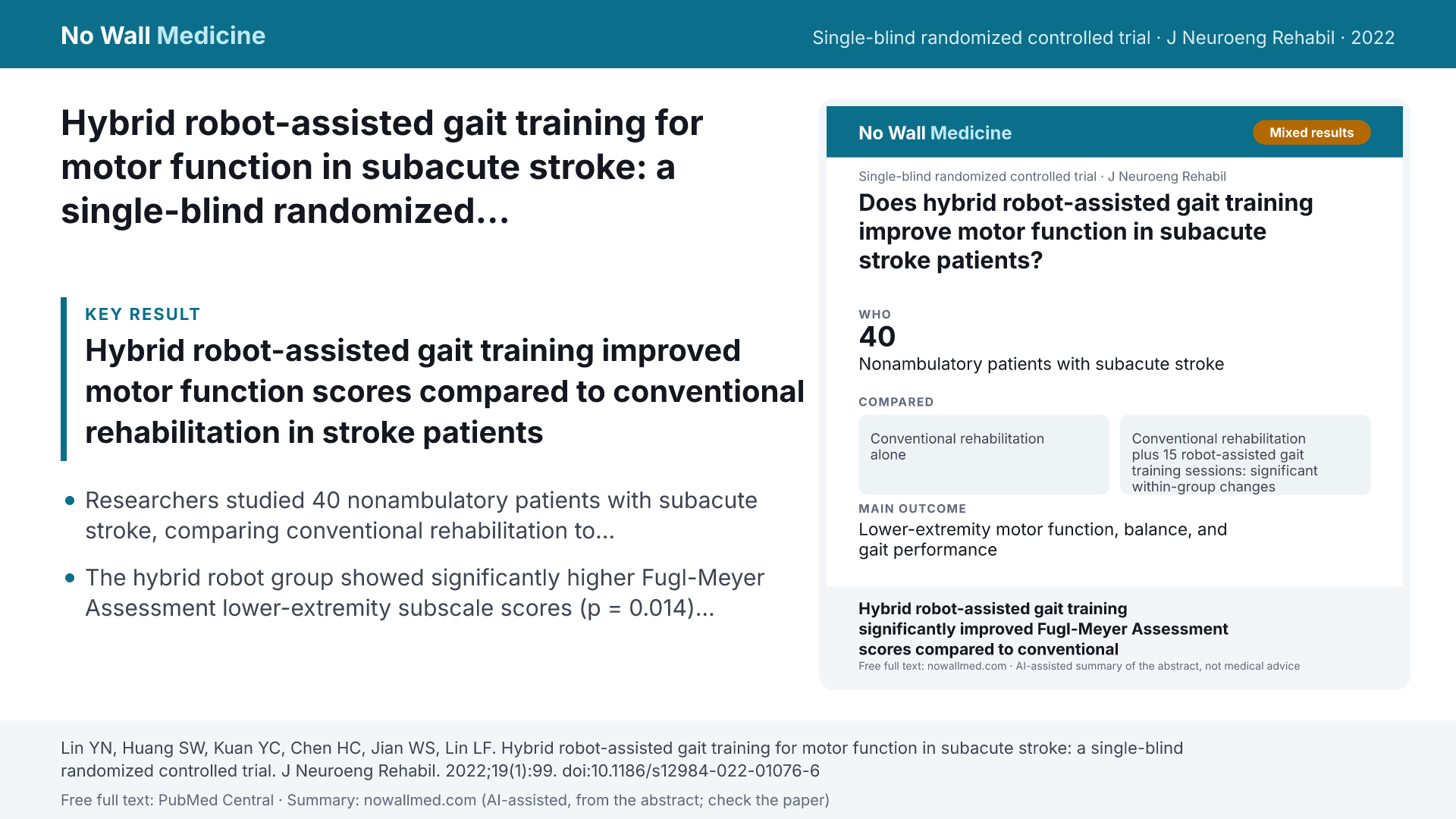
Hybrid robot-assisted gait training improved motor function scores compared to conventional rehabilitation in stroke patients
Hybrid robot-assisted gait training for motor function in subacute stroke: a single-blind randomized controlled trial
Single-blind randomized controlled trialMixed results
Does hybrid robot-assisted gait training improve motor function in subacute stroke patients?
Who
40
Nonambulatory patients with subacute stroke
Compared
Conventional rehabilitation alone
Conventional rehabilitation plus 15 robot-assisted gait training sessions: significant within-group changes
Main outcome
Lower-extremity motor function, balance, and gait performance
Bottom line: Hybrid robot-assisted gait training significantly improved Fugl-Meyer Assessment scores compared to conventional rehabilitation alone.
J Neuroeng Rehabil · 2022-09-14Download image
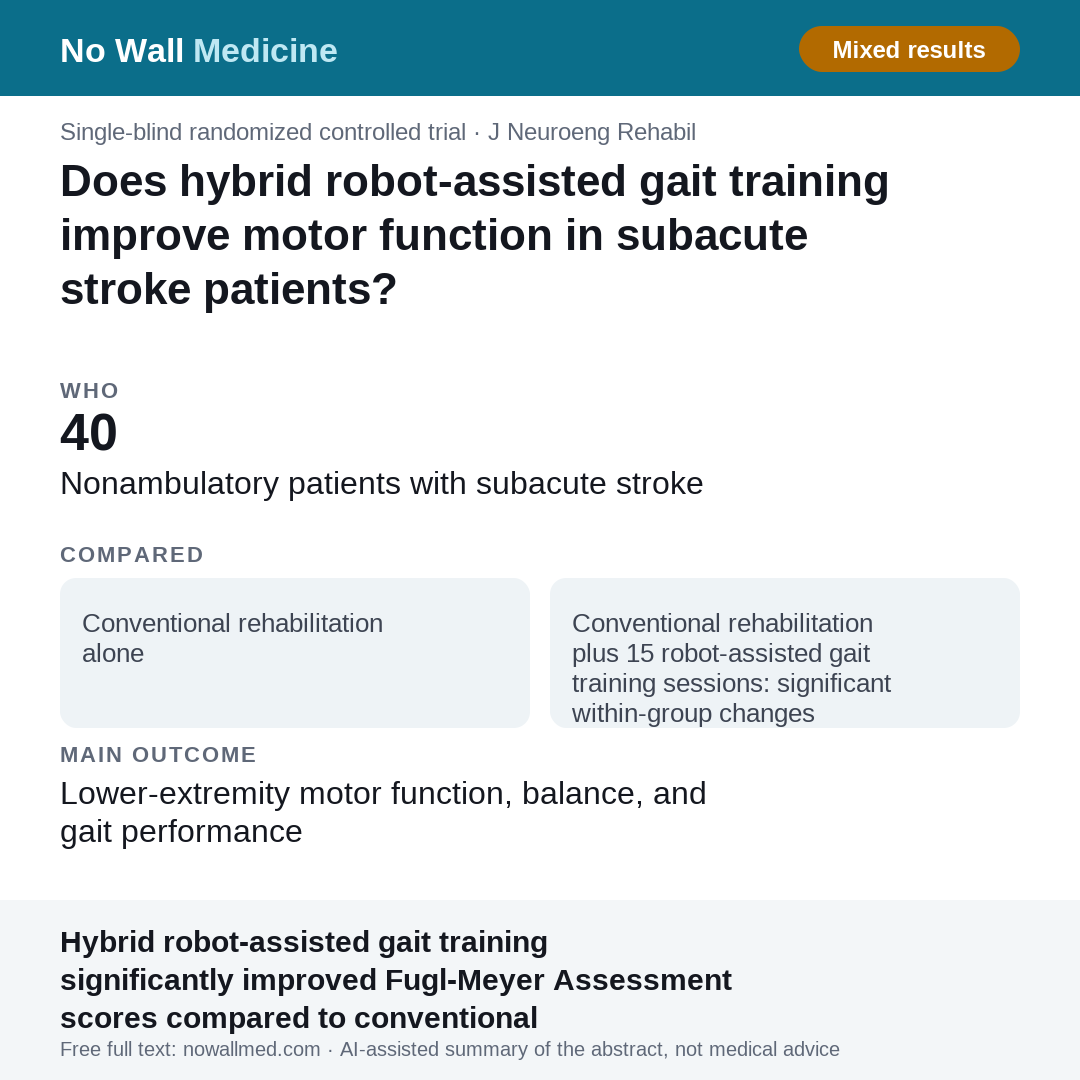
Clinical question: Does hybrid robot-assisted gait training improve motor function in subacute stroke patients?
Why it matters: It was unknown if a novel hybrid robot-assisted gait training system provides better clinical outcomes for motor function than conventional rehabilitation alone in subacute stroke patients.
Key points
- Researchers studied 40 nonambulatory patients with subacute stroke, comparing conventional rehabilitation to rehabilitation plus 15 sessions of a novel hybrid robot-assisted gait training system.
- The hybrid robot group showed significantly higher Fugl-Meyer Assessment lower-extremity subscale scores (p = 0.014) and total scores (p = 0.002) than the control group.
- Both groups showed significant within-group improvements in active range of motion, muscle strength, balance, and walking speed both immediately after and 3 months after the intervention.
Headline and key points written with AI from the paper’s abstract, with every number checked against it. Read the paper before relying on them.
Was this summary helpful?
Subject terms
Cite this article
Lin YN, Huang SW, Kuan YC, Chen HC, Jian WS, Lin LF. Hybrid robot-assisted gait training for motor function in subacute stroke: a single-blind randomized controlled trial. J Neuroeng Rehabil. 2022. doi:10.1186/s12984-022-01076-6
Spotted a mistake? Suggest a correction