Hybrid robot-assisted gait training for motor function in subacute stroke: a single-blind randomized controlled trial
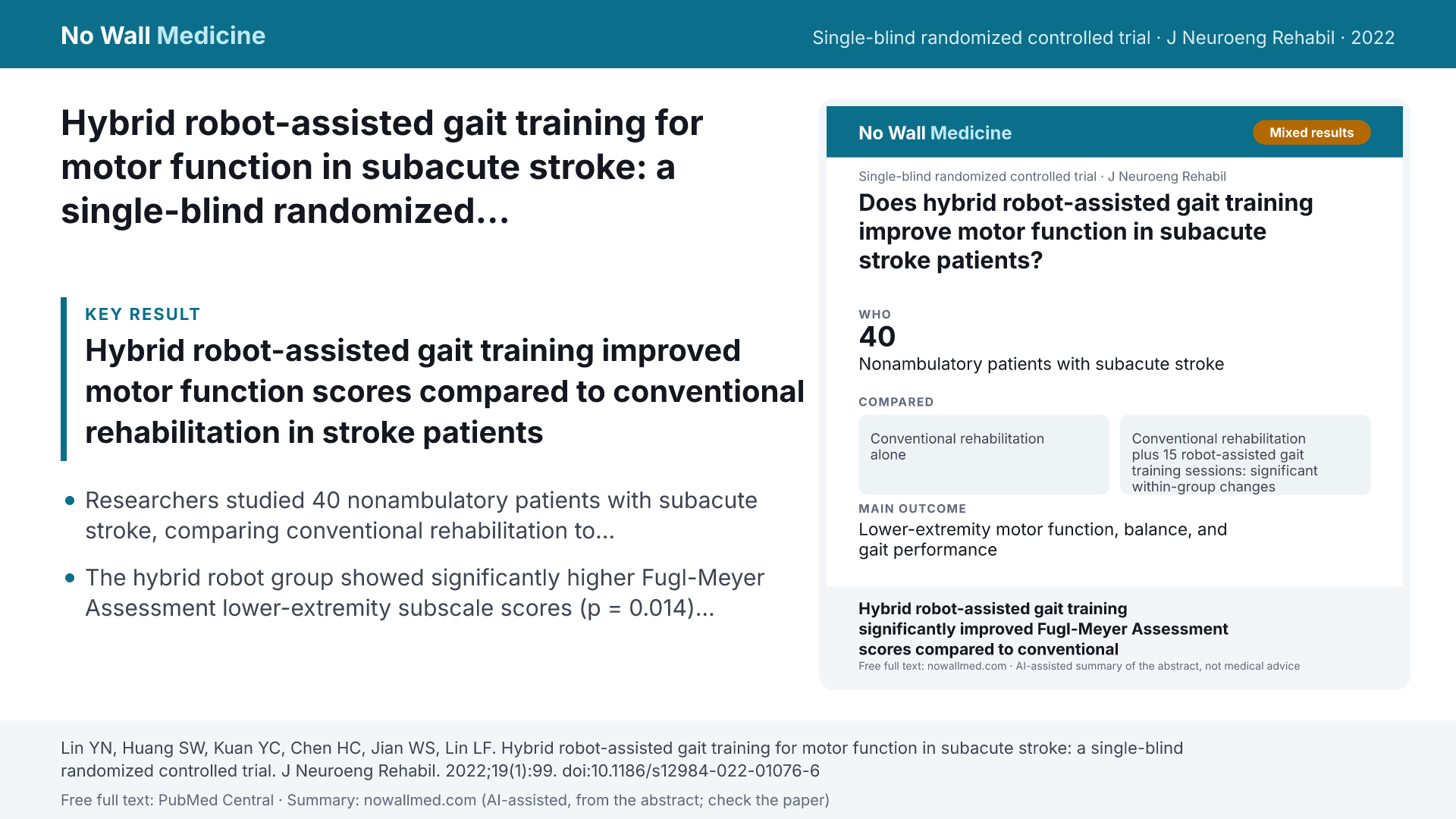
Key result: Hybrid robot-assisted gait training improved motor function scores compared to conventional rehabilitation in stroke patients
Single-blind randomized controlled trialMixed results
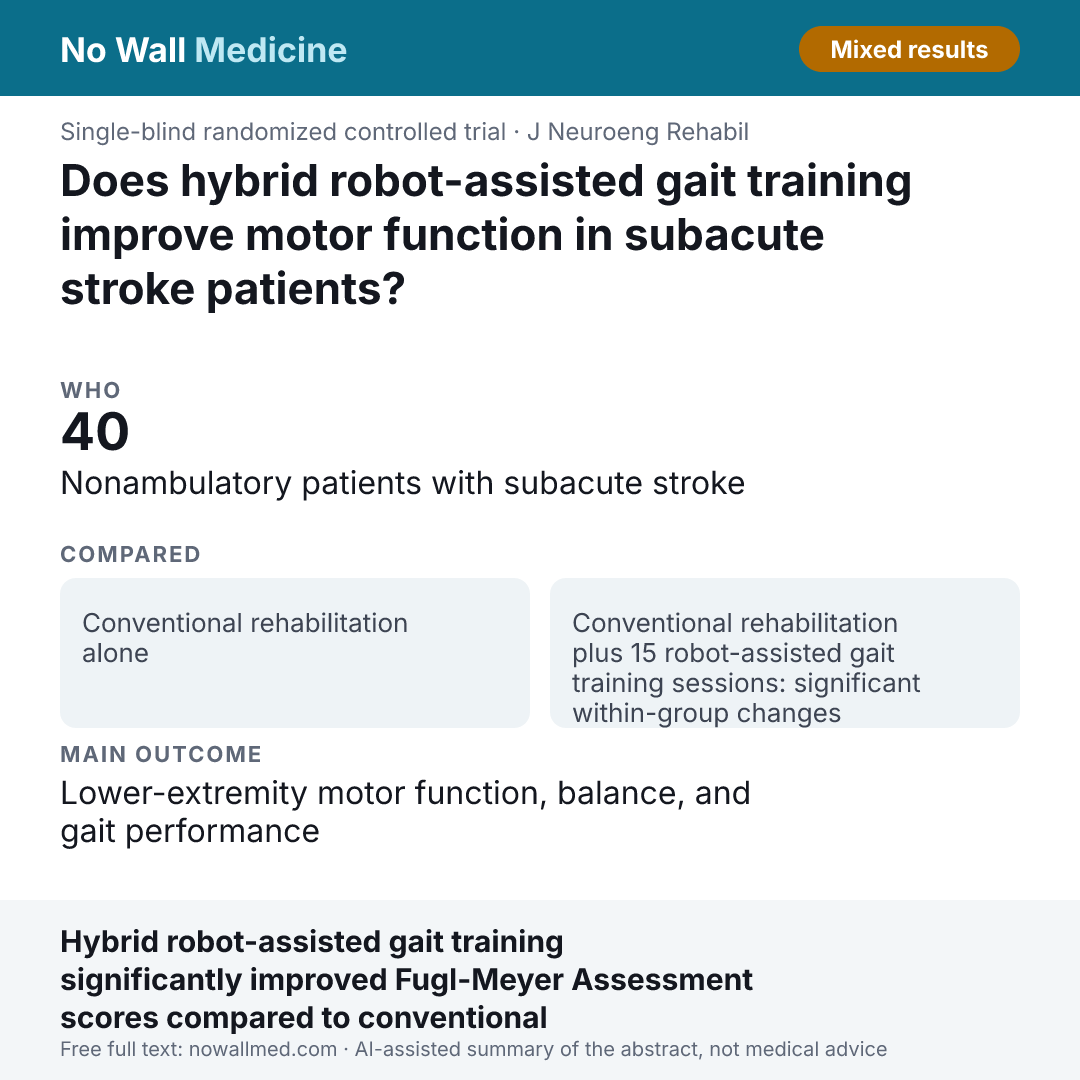
Does hybrid robot-assisted gait training improve motor function in subacute stroke patients?
Who
40
Nonambulatory patients with subacute stroke
Compared
Conventional rehabilitation alone
Conventional rehabilitation plus 15 robot-assisted gait training sessions: significant within-group changes
Main outcome
Lower-extremity motor function, balance, and gait performance
Bottom line: Hybrid robot-assisted gait training significantly improved Fugl-Meyer Assessment scores compared to conventional rehabilitation alone.
J Neuroeng Rehabil · 2022-09-14 · Save PNG
Key points
- Researchers studied 40 nonambulatory patients with subacute stroke, comparing conventional rehabilitation to rehabilitation plus 15 sessions of a novel hybrid robot-assisted gait training system.
- The hybrid robot group showed significantly higher Fugl-Meyer Assessment lower-extremity subscale scores (p = 0.014) and total scores (p = 0.002) than the control group.
- Both groups showed significant within-group improvements in active range of motion, muscle strength, balance, and walking speed both immediately after and 3 months after the intervention.
Discussion prompts
- Would these patients look like yours? Who was left out?
- Is the main outcome one that matters to patients?
- Is the difference large enough to change what you do?
Cite: Lin YN, Huang SW, Kuan YC, Chen HC, Jian WS, Lin LF. Hybrid robot-assisted gait training for motor function in subacute stroke: a single-blind randomized controlled trial. J Neuroeng Rehabil. 2022. doi:10.1186/s12984-022-01076-6
Free full text: PubMed Central · Summary and visual abstract: nowallmed.com/a/hybrid-robot-assisted-gait-training-for-motor-function-in-subacute-1x51g5h/ (AI-assisted from the abstract; check the paper before relying on it).