Hydrosalpinx treatments show no significant difference in live birth rates after embryo transfer
Hydrosalpinx treatment before in-vitro fertilization: systematic review and network meta-analysis
Systematic review and network meta-analysisMixed results
What are the most effective and safe methods to treat hydrosalpinx before in-vitro fertilization?
Who
Infertile patients with hydrosalpinx
Compared
Salpingectomy: OR, 4.35 (95% CI, 1.70-11.14) for ongoing pregnancy
Ultrasound-guided aspiration: OR, 2.80 (95% CI, 1.03-7.58) for ongoing pregnancy
No treatment
Main outcome
Live birth, ongoing pregnancy, and clinical pregnancy
Bottom line: Treatments may improve ongoing and clinical pregnancy rates, but no method significantly improves live birth rates in randomized trials.
Ultrasound Obstet Gynecol · 2025-01-26Download image
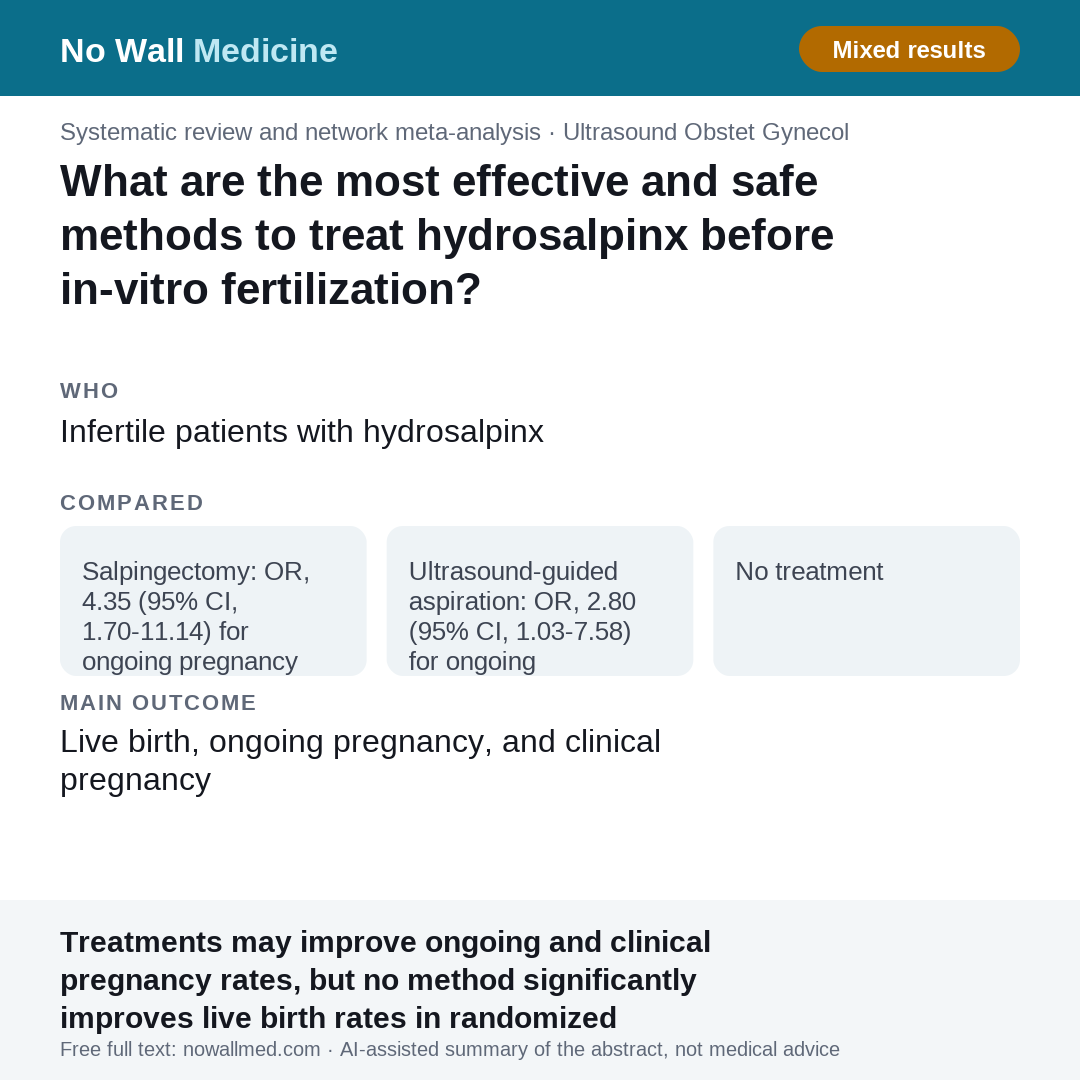
Clinical question: What are the most effective and safe methods to treat hydrosalpinx before in-vitro fertilization?
Why it matters: It is unknown which surgical or non-surgical methods for treating hydrosalpinx are most effective for improving pregnancy outcomes before in-vitro fertilization.
Key points
- Researchers analyzed nine randomized controlled trials and 17 observational studies comparing treatments for hydrosalpinx, which is fluid-filled fallopian tube swelling, before embryo transfer.
- Salpingectomy, or surgical removal of the fallopian tube, was associated with higher ongoing pregnancy rates (OR, 4.35 (95% CI, 1.70-11.14)) and clinical pregnancy rates (OR, 2.24 (95% CI, 1.30-3.86)) compared to no treatment.
- Laparoscopic proximal tubal occlusion, or blocking the tube, was associated with higher clinical pregnancy rates (OR, 2.55 (95% CI, 1.20-5.51)) compared to no treatment.
Headline and key points written with AI from the paper’s abstract, with every number checked against it. Read the paper before relying on them.
Topics
Cite this article
Pérez-Milán F, Caballero-Campo M, Carrera-Roig M, Moratalla-Bartolomé E, Domínguez-Arroyo JA, Alcázar-Zambrano JL. Hydrosalpinx treatment before in-vitro fertilization: systematic review and network meta-analysis. Ultrasound Obstet Gynecol. 2025. doi:10.1002/uog.27697
Spotted a mistake? Suggest a correction
Top studies every Monday
The week’s key trials and guidelines in your specialties, plus any topics you follow. By email, free.
Get the weekly digest