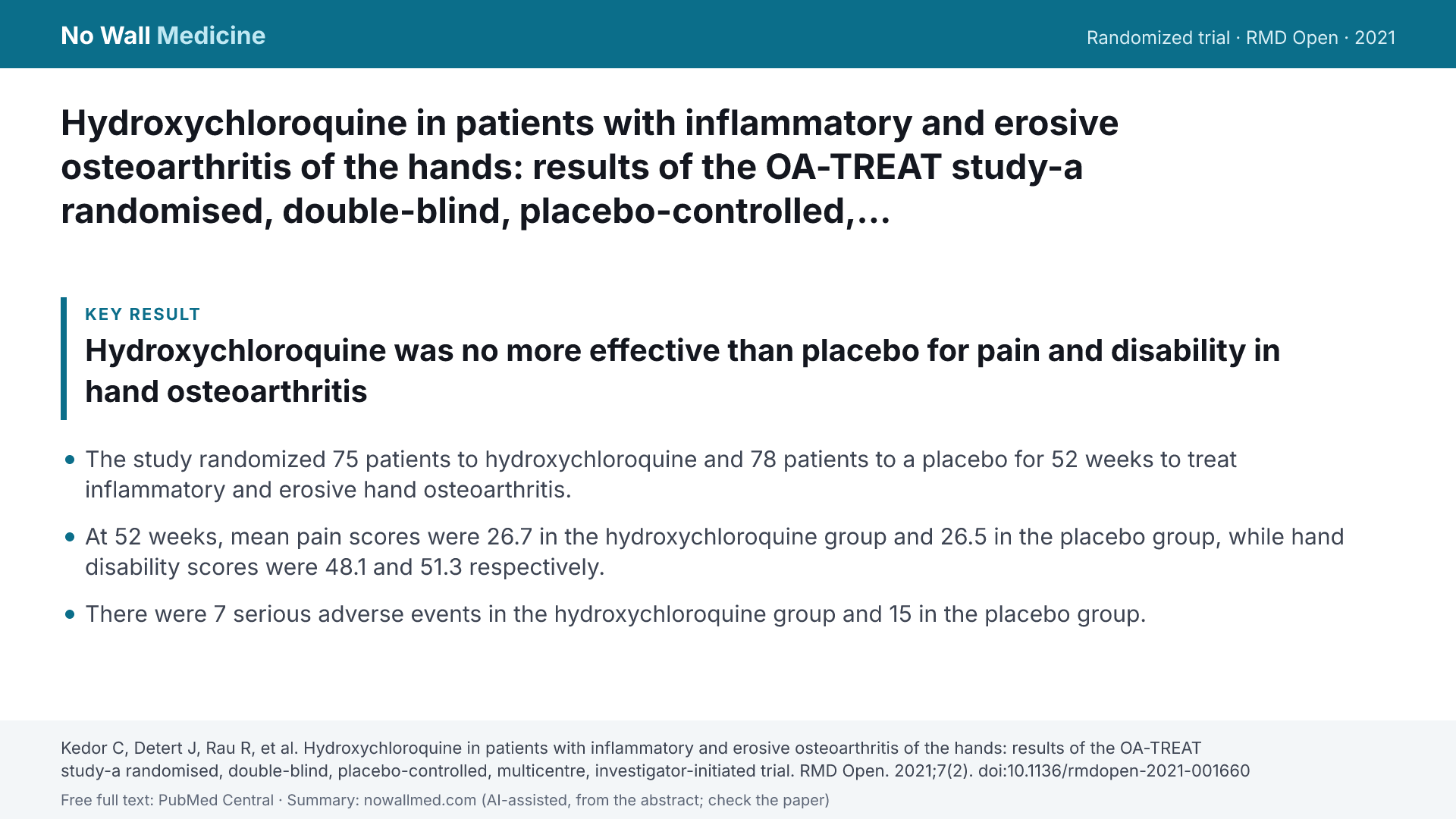
Hydroxychloroquine was no more effective than placebo for pain and disability in hand osteoarthritis
Hydroxychloroquine in patients with inflammatory and erosive osteoarthritis of the hands: results of the OA-TREAT study-a randomised, double-blind, placebo-controlled, multicentre, investigator-initiated trial
Key points
- The study randomized 75 patients to hydroxychloroquine and 78 patients to a placebo for 52 weeks to treat inflammatory and erosive hand osteoarthritis.
- At 52 weeks, mean pain scores were 26.7 in the hydroxychloroquine group and 26.5 in the placebo group, while hand disability scores were 48.1 and 51.3 respectively.
- There were 7 serious adverse events in the hydroxychloroquine group and 15 in the placebo group.
Headline and key points written with AI from the paper’s abstract, with every number checked against it. Read the paper before relying on them.
Was this summary helpful?
Abstract
Objectives
Hand osteoarthritis (OA) is a condition characterised by cartilage degradation and frequently erosive changes. Analgesics and non-steroidal anti-inflammatory drugs are used for symptomatic relief but are often poorly tolerated or contraindicated. Previous publications suggest hydroxychloroquine (HCQ) as a possible treatment for hand OA. The OA-TREAT study aimed to investigate the efficacy and safety of HCQ in patients with inflammatory and erosive hand OA (EOA). Methods
OA-TREAT was an investigator-initiated, multicentre, randomised, double-blind, placebo (PBO)-controlled trial. Patients with inflammatory and EOA, according to the ACR criteria, with radiographically erosive disease were randomised 1:1 to HCQ 200-400 mg/day or PBO for 52 weeks (W52). Both groups received stable standard therapy. The primary endpoint was Australian Canadian Hand Osteoarthritis Index (AUSCAN) for pain and hand disability at W52. Results
75 patients were randomised to HCQ and 78 to PBO. At W52, mean AUSCAN pain was 26.7 in HCQ and 26.5 in PBO patients (p=0.92). Hand disability measured by AUSCAN function (mean) was 48.1 in HCQ and 51.3 in PBO patients (p=0.36). Changes in radiographic scores did not differ significantly (p>0.05) between treatment groups. There were 7 serious adverse events in the HCQ and 15 in the PBO group. Conclusions
OA-TREAT is the first large randomised PBO controlled trial focusing on EOA. HCQ was no more effective than PBO for changes in pain, function and radiographic scores in the 52-week period. Overall safety findings were consistent with the known profile of HCQ.
Abstract reproduced under the article’s CC BY licence.
Subject terms
Headline, design, result, key points, caveat and citation as plain text.
Cite this article
Kedor C, Detert J, Rau R, et al. Hydroxychloroquine in patients with inflammatory and erosive osteoarthritis of the hands: results of the OA-TREAT study-a randomised, double-blind, placebo-controlled, multicentre, investigator-initiated trial. RMD Open. 2021. doi:10.1136/rmdopen-2021-001660
Spotted a mistake? Suggest a correction