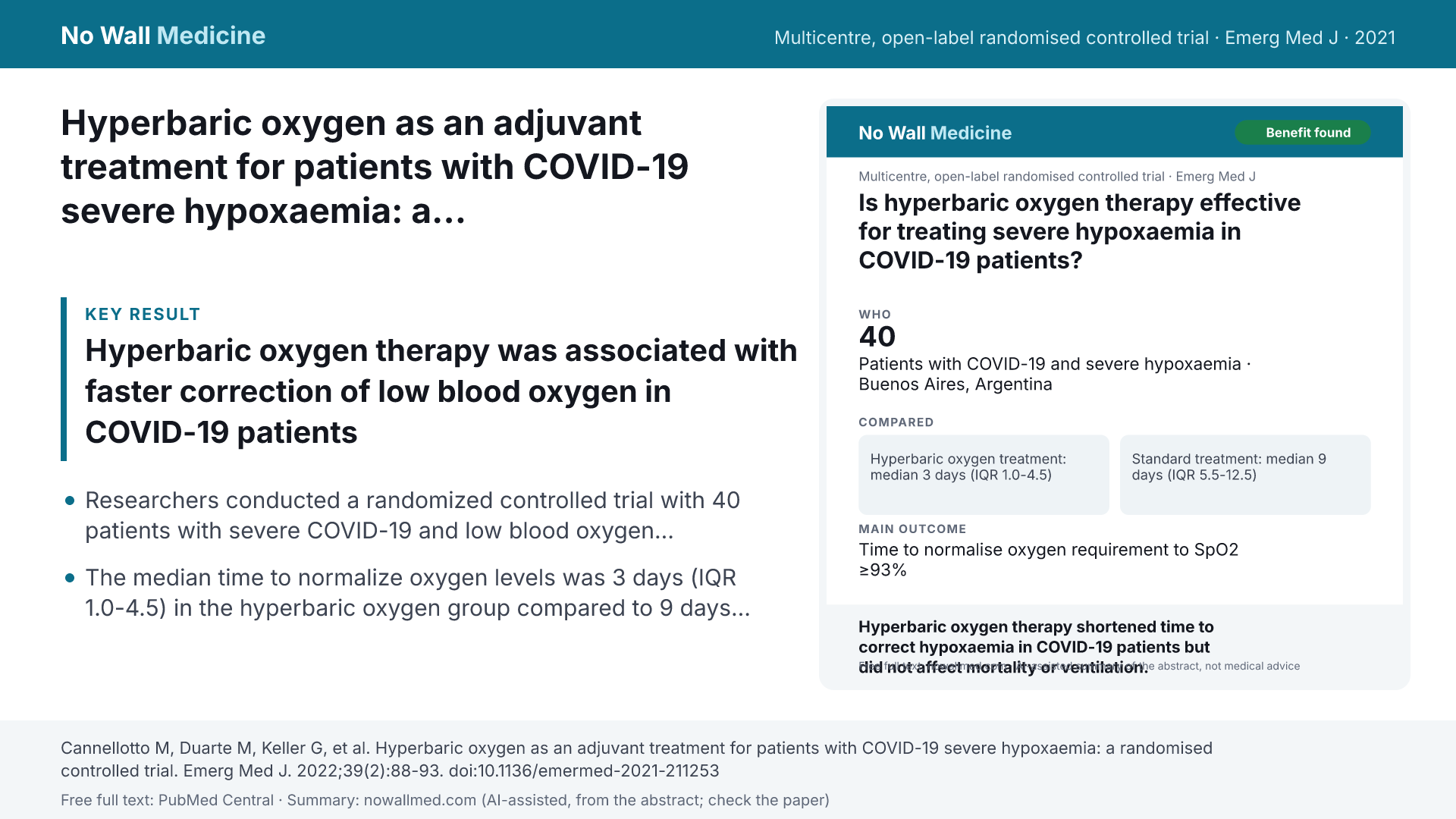
Hyperbaric oxygen therapy was associated with faster correction of low blood oxygen in COVID-19 patients
Hyperbaric oxygen as an adjuvant treatment for patients with COVID-19 severe hypoxaemia: a randomised controlled trial
Multicentre, open-label randomised controlled trialBenefit found
Is hyperbaric oxygen therapy effective for treating severe hypoxaemia in COVID-19 patients?
Who
40
Patients with COVID-19 and severe hypoxaemia · Buenos Aires, Argentina
Compared
Hyperbaric oxygen treatment: median 3 days (IQR 1.0-4.5)
Standard treatment: median 9 days (IQR 5.5-12.5)
Main outcome
Time to normalise oxygen requirement to SpO2 ≥93%
Result: OR 23.2 (95% CI 1.6 to 329.6)
Bottom line: Hyperbaric oxygen therapy shortened time to correct hypoxaemia in COVID-19 patients but did not affect mortality or ventilation.
Emerg Med J · 2021-12-14 · Save PNG
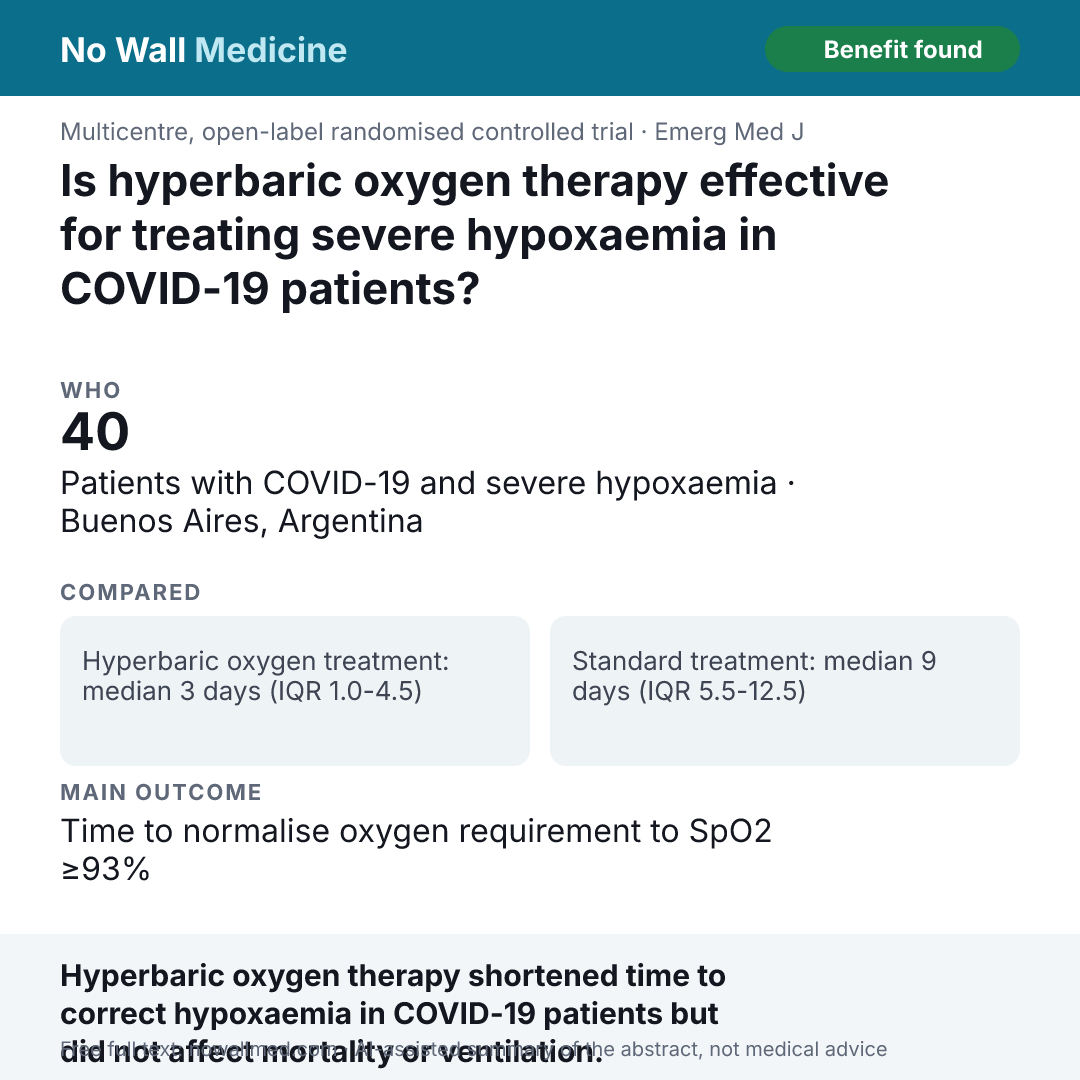
Clinical question: Is hyperbaric oxygen therapy effective for treating severe hypoxaemia in COVID-19 patients?
Key points
- Researchers conducted a randomized controlled trial with 40 patients with severe COVID-19 and low blood oxygen levels, comparing hyperbaric oxygen therapy to standard treatment.
- The median time to normalize oxygen levels was 3 days (IQR 1.0-4.5) in the hyperbaric oxygen group compared to 9 days (IQR 5.5-12.5) in the control group.
- Hyperbaric oxygen therapy had no statistically significant effect on death within 30 days, the need for mechanical ventilation, or the development of acute respiratory distress syndrome.
Headline and key points written with AI from the paper’s abstract, with every number checked against it. Read the paper before relying on them.
Was this summary helpful?
Abstract
Background
Hyperbaric oxygen (HBO2) therapy has been proposed to treat hypoxaemia and reduce inflammation in COVID-19. Our objective was to analyse safety and efficacy of HBO2 in treatment of hypoxaemia in patients with COVID-19 and evaluate time to hypoxaemia correction. Methods
This was a multicentre, open-label randomised controlled trial conducted in Buenos Aires, Argentina, between July and November 2020. Patients with COVID-19 and severe hypoxaemia (SpO2 ≤90% despite oxygen supplementation) were assigned to receive either HBO2 treatment or the standard treatment for respiratory symptoms for 7 days. HBO2 treatment was planned for ≥5 sessions (1 /day) for 90 min at 1.45 atmosphere absolute (ATA). Outcomes were time to normalise oxygen requirement to SpO2 ≥93%, need for mechanical respiratory assistance, development of acute respiratory distress syndrome and mortality within 30 days. A sample size of 80 patients was estimated, with a planned interim analysis after determining outcomes on 50% of patients. Results
The trial was stopped after the interim analysis. 40 patients were randomised, 20 in each group, age was 55.2±9.2 years. At admission, frequent symptoms were dyspnoea, fever and odynophagia; SpO2 was 85.1%±4.3% for the whole group. Patients in the treatment group received an average of 6.2±1.2 HBO2 sessions. Time to correct hypoxaemia was shorter in treatment group versus control group; median 3 days (IQR 1.0-4.5) versus median 9 days (IQR 5.5-12.5), respectively (p<0.010). OR for recovery from hypoxaemia in the HBO2 group at day 3 compared with the control group was 23.2 (95% CI 1.6 to 329.6; p=0.001) Treatment had no statistically significant effect on acute respiratory distress syndrome, mechanical ventilation or death within 30 days after admission. Conclusion
Our findings support the safety and efficacy of HBO2 in the treatment of COVID-19 and severe hypoxaemia. Trial registration number
NCT04477954.
Abstract reproduced under the article’s CC BY NC licence.
Subject terms
Headline, design, result, key points, caveat and citation as plain text.
Cite this article
Cannellotto M, Duarte M, Keller G, et al. Hyperbaric oxygen as an adjuvant treatment for patients with COVID-19 severe hypoxaemia: a randomised controlled trial. Emerg Med J. 2022;39(2):88-93. doi:10.1136/emermed-2021-211253
Spotted a mistake? Suggest a correction