Targeting lower oxygen levels resulted in more days alive without life support for COVID-19 patients
Lower vs Higher Oxygenation Target and Days Alive Without Life Support in COVID-19: The HOT-COVID Randomized Clinical Trial
Multicenter randomized clinical trialBenefit found
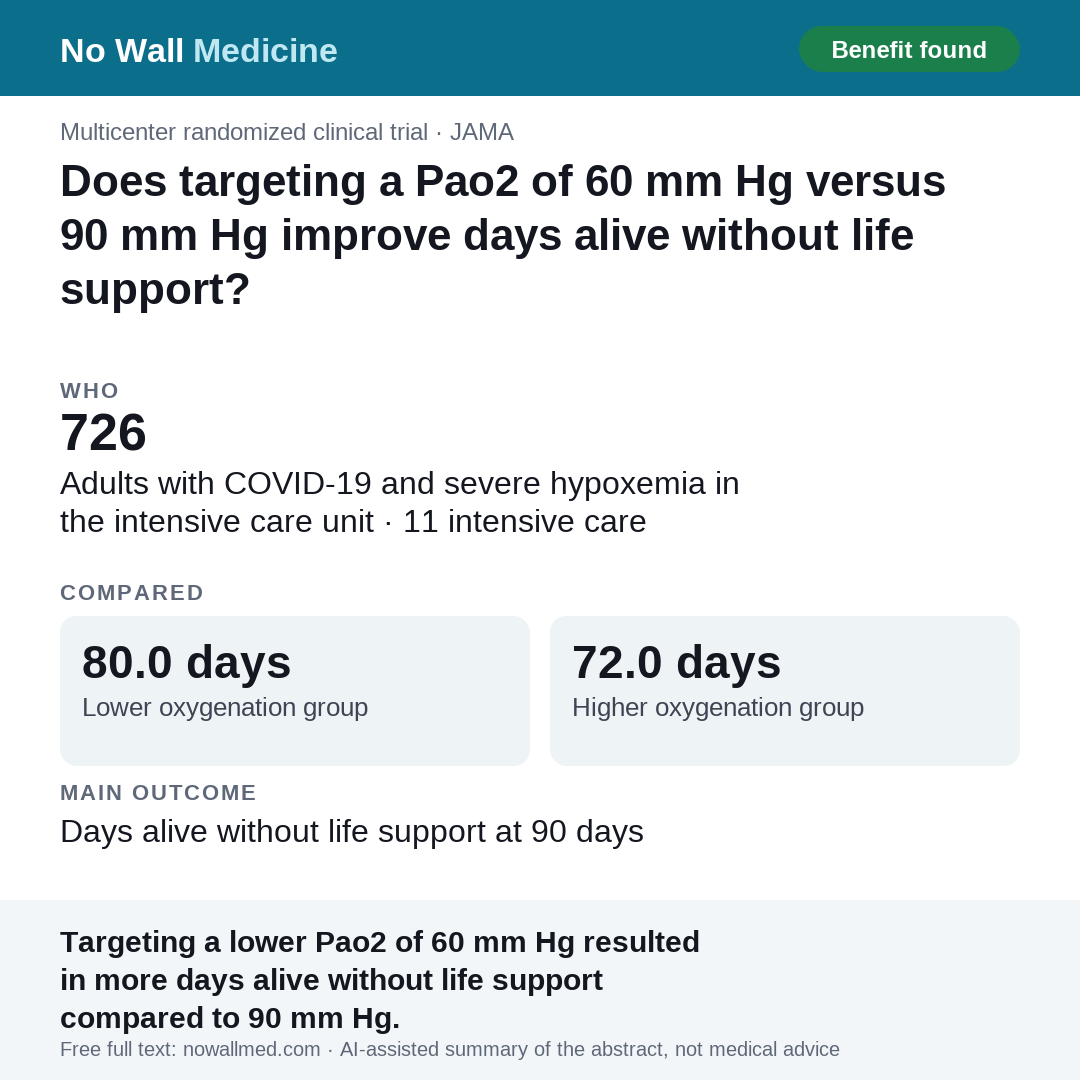
Does targeting a Pao2 of 60 mm Hg versus 90 mm Hg improve days alive without life support?
Who
726
Adults with COVID-19 and severe hypoxemia in the intensive care unit · 11 intensive care units in Europe
Compared
80.0 daysLower oxygenation group (IQR, 9.0-89.0 days)
72.0 daysHigher oxygenation group (IQR, 2.0-88.0 days)
Main outcome
Days alive without life support at 90 days
Result: adjusted mean difference, 5.8 days (95% CI, 0.2-11.5 days)
Bottom line: Targeting a lower Pao2 of 60 mm Hg resulted in more days alive without life support compared to 90 mm Hg.
JAMA · 2024-03-19Download image
Clinical question: Does targeting a Pao2 of 60 mm Hg versus 90 mm Hg improve days alive without life support?
Why it matters: It is unclear if a lower dose of supplemental oxygen is beneficial for patients with COVID-19 and severe hypoxemia in the intensive care unit.
Key points
- Researchers studied 726 adults with COVID-19 in 11 intensive care units, comparing a target partial pressure of arterial oxygen (PaO2) of 60 mm Hg to 90 mm Hg.
- At 90 days, the median number of days alive without life support was 80.0 days in the lower oxygenation group compared to 72.0 days in the higher group.
- Mortality at 90 days was 30.2% in the lower oxygenation group and 34.7% in the higher oxygenation group, which was not a statistically significant difference.
Headline and key points written with AI from the paper’s abstract, with every number checked against it. Read the paper before relying on them.
Topics
Cite this article
Nielsen FM, Klitgaard TL, Siegemund M, Laake JH, Thormar KM, Cole JM. Lower vs Higher Oxygenation Target and Days Alive Without Life Support in COVID-19: The HOT-COVID Randomized Clinical Trial. JAMA. 2024. doi:10.1001/jama.2024.2934
Spotted a mistake? Suggest a correction