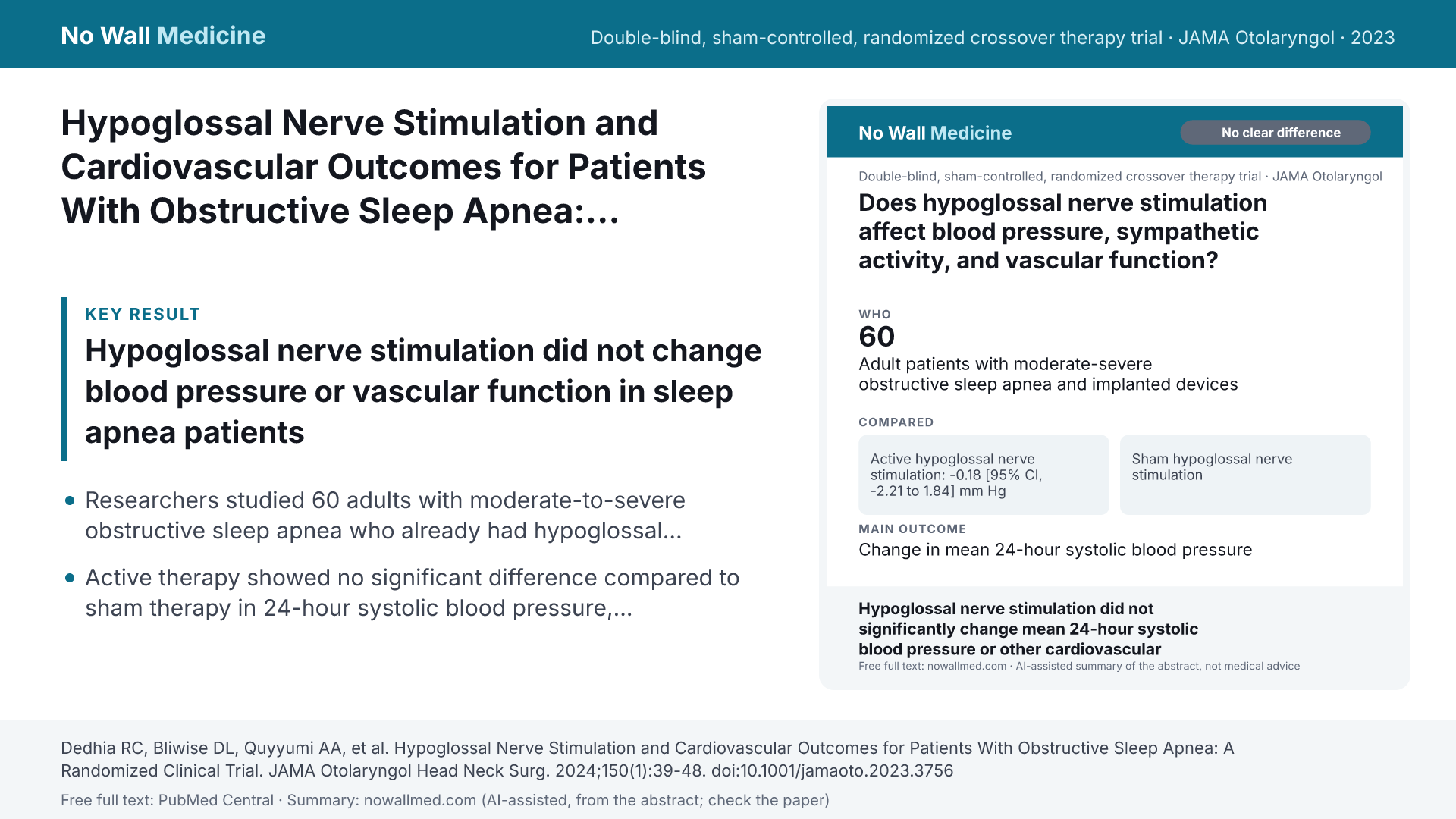
Hypoglossal nerve stimulation did not change blood pressure or vascular function in sleep apnea patients
Hypoglossal Nerve Stimulation and Cardiovascular Outcomes for Patients With Obstructive Sleep Apnea: A Randomized Clinical Trial
Double-blind, sham-controlled, randomized crossover therapy trialNo clear difference
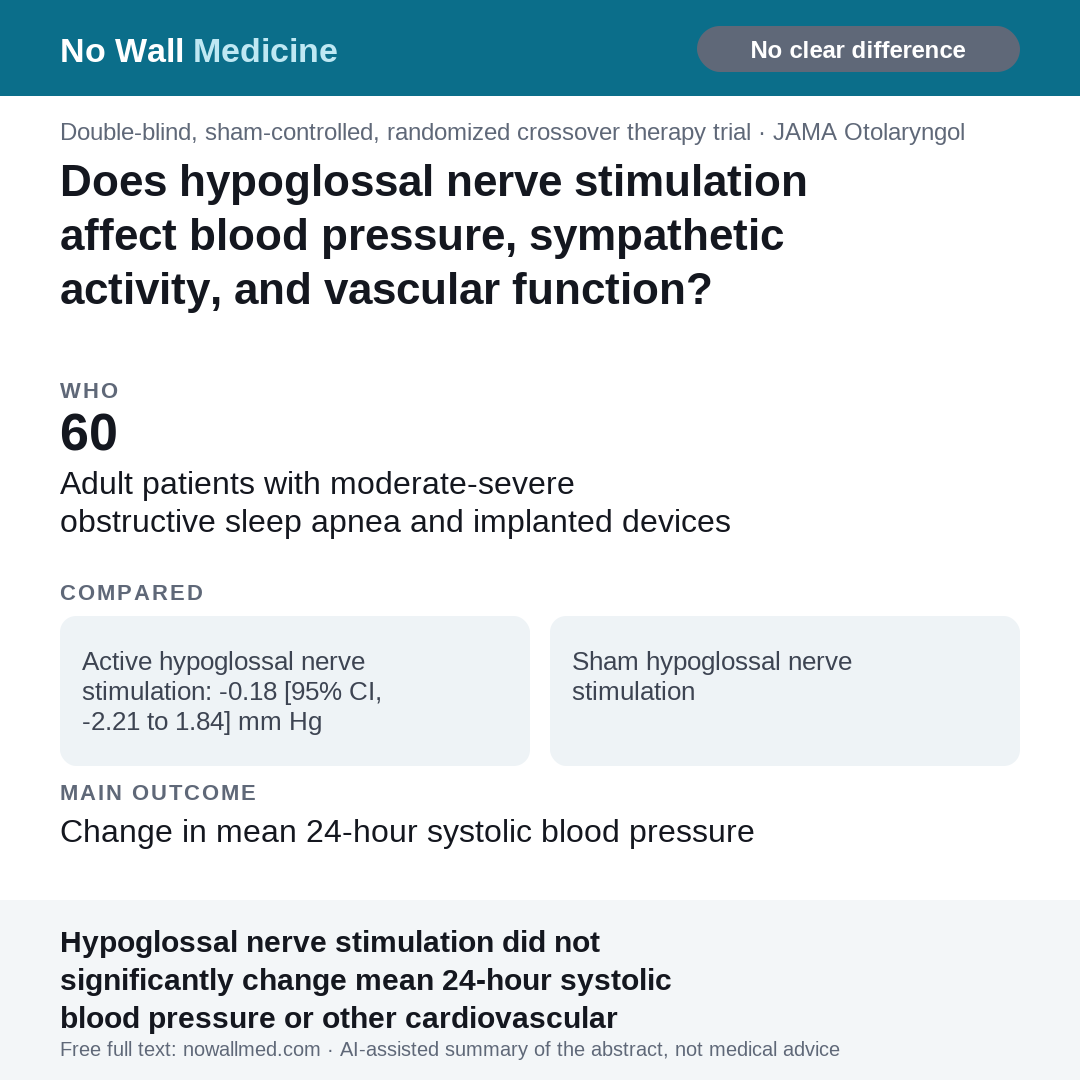
Does hypoglossal nerve stimulation affect blood pressure, sympathetic activity, and vascular function?
Who
60
Adult patients with moderate-severe obstructive sleep apnea and implanted devices · 3 separate academic medical centers
Compared
Active hypoglossal nerve stimulation: -0.18 [95% CI, -2.21 to 1.84] mm Hg
Sham hypoglossal nerve stimulation
Main outcome
Change in mean 24-hour systolic blood pressure
Bottom line: Hypoglossal nerve stimulation did not significantly change mean 24-hour systolic blood pressure or other cardiovascular measures compared to sham.
JAMA Otolaryngol · 2023-11-30Download image
Clinical question: Does hypoglossal nerve stimulation affect blood pressure, sympathetic activity, and vascular function?
Key points
- Researchers studied 60 adults with moderate-to-severe obstructive sleep apnea who already had hypoglossal nerve stimulation devices implanted.
- Active therapy showed no significant difference compared to sham therapy in 24-hour systolic blood pressure, pre-ejection period, or flow-mediated dilation.
- The mean change in 24-hour systolic blood pressure during active therapy was -0.18 mm Hg (95% CI, -2.21 to 1.84).
Headline and key points written with AI from the paper’s abstract, with every number checked against it. Read the paper before relying on them.
Was this summary helpful?
Subject terms
Headline, design, result, key points, caveat and citation as plain text.
Cite this article
Dedhia RC, Bliwise DL, Quyyumi AA, et al. Hypoglossal Nerve Stimulation and Cardiovascular Outcomes for Patients With Obstructive Sleep Apnea: A Randomized Clinical Trial. JAMA Otolaryngol. 2023. doi:10.1001/jamaoto.2023.3756
Spotted a mistake? Suggest a correction